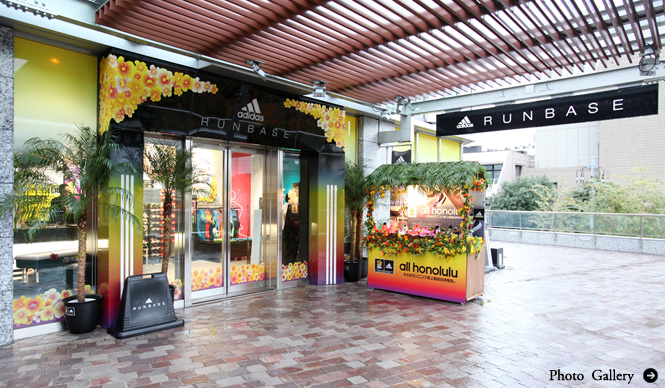
Feature: DJ Toshio Matsuura Experiences the "Adidas Running Dock" Personal Physical Check Service
The Road to Completing 42.195km Starts at adidas "Runbase"
A Must-See for Runners! Toshio Matsuura Experiences the "adidas Running Dock" (Part 1)
DJ Toshio Matsuura will participate in the "Tokyo Marathon 2012" next February. While he usually runs, it's purely a hobby. To complete the 42.195km race, he needs to get his body in peak condition. So, he visited "adidas Running Dock," a personal physical check-up service launched in December at "Runbase," an adidas running facility located right next to the Imperial Palace, a popular spot for runners. Before starting his training, he decided to check his current physical condition and get advice from a professional trainer on his future training menu!
Text by FUJITA Mayu (OPENERS)
Photos by SUZUKI Kenta
What is the New "adidas Running Dock" Service?
Most runners probably train entirely on their own, referring to magazines or specialized books. However, many might also feel some kind of physical discomfort. Unless they perform stretches and training methods suited to their body, these issues won't resolve and could even lead to injury! This service helps you identify your body's weaknesses and the countermeasures needed to enjoy running.──That's what "adidas Running Dock" is all about.
It comprehensively analyzes scientific diagnostics using specialized equipment and muscle responses during physical activity, allowing professional trainers to advise on stretches and training methods tailored to each individual's weaknesses.
One might feel intimidated, thinking it's only for serious runners aiming for higher goals like participating in competitions. However, this is a service highly recommended for runners who enjoy running casually as a hobby.
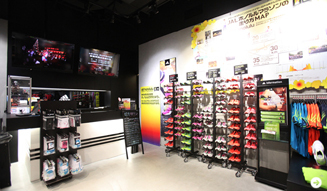
Here, we'll introduce the "adidas Running Dock" menu that Matsuura actually experienced. The check is conducted one-on-one with a trainer, but there's no need to be nervous. The measurements are taken in a very casual atmosphere. The key is to ask questions freely. Since it's a valuable opportunity to receive professional advice, don't hesitate to ask anything, from diet to running speed, frequency, and stretching tips. Now, let's start the measurements!
Stay Hydrated After Drinking Alcohol!
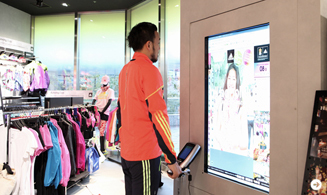
Body Composition Analysis with InBody
Using specialized measurement equipment, it scans the body. It checks internal body conditions essential for running, such as body fat, muscle mass, and hydration levels. After registering age and gender, simply stand on the platform. In less than two minutes, the results are printed out and explained in detail during the subsequent training guidance, along with other check results.
Advice from Master Staff Mako Fukano
Generally, if you're within the standard range, there are no issues. Good numbers are hydration levels, and bad is body fat. However, too little body fat can make it difficult to maintain body temperature, so it's ideal to reduce body fat while increasing muscle mass. Muscles generate heat. Using your current body fat percentage as a baseline, it's best to measure at the same time each day to adjust. If daily measurement is difficult, measure at the same time, even if the intervals are longer. Body fat percentage can vary significantly depending on the time of day. Also, alcohol reduces hydration levels, so drink plenty of water if you had alcohol the night before. Water is essential for muscle function!
The Road to Completing 42.195km Starts at adidas "Runbase"
A Must-See for Runners! Toshio Matsuura Experiences the "adidas Running Dock" (Part 2)
Ignoring Skeletal Asymmetry Can Lead to Injury!
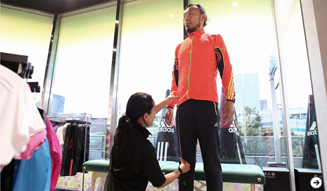
Alignment Check
This checks the skeletal structure of the legs, which is crucial for running. It measures knee angle, leg length, and heel angle, and finally observes leg characteristics like bowlegs or knock-knees. An unbalanced state with asymmetry not only hinders performance improvement but can also cause injuries such as lower back pain or joint pain! The check is very simple.
1. Knee AngleA string is used to connect the top of the kneecap to the hip bone, and the angle is measured with a protractor.
2. Leg LengthThe length is measured from the apex of the thigh bone to the inner ankle.
3. Heel AngleIt checks if the heel is pointing inward or outward by drawing a line from the center of the calf through the Achilles tendon to the heel bone and measuring the angle with a protractor.
4. Leg CharacteristicsStand straight with heels together, and observe characteristics like bowlegs or knock-knees based on the gap between the legs.
Advice from Master Staff Mako Fukano
For example, if the knee angle is too large, it can put stress on the knees. This is particularly common in women. Also, if there's a difference in leg length, there might be issues with the flexibility around the pelvis or muscle balance. We provide advice on necessary support, such as thorough stretching or strengthening exercises. However, Matsuura's angles and leg lengths are fine! That's excellent. He might be slightly bowlegged, possibly due to tightness in the outer thigh muscles, but this degree can be sufficiently improved with stretching.
Next, Let's Focus on Muscles and Check Flexibility
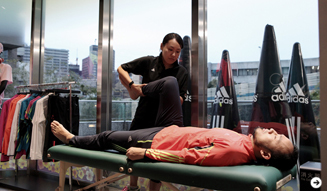
Tightness Check
Lying on a bed, this checks the flexibility of the muscles, mainly in the lower body, including the front and back of the thighs and the hip joints. There are four basic check items. Based on flexibility and alignment checks, additional checks are performed according to each person's physical condition, such as the balance between flexibility and strength, center of gravity, and balance ability.
1. Hamstring FlexibilityLying on your back, a staff member lifts your leg as high as possible with your knee extended to check hamstring flexibility. Then, try lifting your leg as high as you can on your own to assess the balance between flexibility and strength. If you can't lift your leg as high as the staff member could, it means your strength is insufficient relative to your flexibility.
2. Hip Flexor FlexibilityWhile keeping your knee bent and close to your abdomen, a staff member pushes your leg up to check hip flexor flexibility. Tightness here can make it difficult to move your legs forward, so it's important to loosen it up.
3. Hip Joint FlexibilityWhile in the same position, the knee is dropped outward and inward to check hip joint flexibility and the tightness of the gluteal muscles. Tight glutes can make it easier for the legs to spread apart and can also lead to fatigue.
4. Quadriceps FlexibilityLying on your stomach, bend your knee to bring your heel towards your buttocks and check the tightness of the quadriceps.
Advice from Master Staff Mako Fukano
In Matsuura's case, we also checked his ankle stiffness and center of gravity. The muscles used for dorsiflexion when kicking off the ground are stiff, and he doesn't seem to be using them effectively. Conversely, the muscles for plantarflexion are too flexible. Be careful, as excessive flexibility can make it difficult to stabilize during landing, increasing the risk of sprains. Also, his center of gravity seems to be shifted backward. A backward center of gravity makes it difficult to move the legs forward. Additionally, his hamstrings, hip flexors, and glutes are tight. Tight hamstrings pull the legs backward, which likely contributes to the backward shift in his center of gravity, so we'll work on stretching them thoroughly.
The Road to Completing 42.195km Starts at adidas "Runbase"
A Must-See for Runners! Toshio Matsuura Experiences the "adidas Running Dock" (Part 3)
Announcing the Check Results! What Training Methods Are Needed Now?
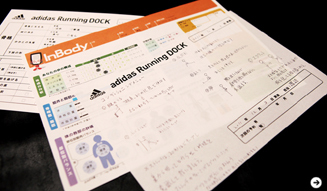
Feedback & Care
Based on the results of the InBody, alignment, and tightness checks, advice is given on the stretches and training methods needed for each individual. In Matsuura's case, the tightness in his hamstrings is a concern, causing his center of gravity to shift backward. He was taught stretching methods to lengthen the muscles and shift his center of gravity forward. You'll also receive a sheet summarizing the advice, along with your InBody and tightness check results, so you don't need to memorize everything on the spot. Don't hesitate to ask questions, even about minor details, to get as much advice as possible!
Basic Rules for Stretching
1. Don't Hold Your BreathMany people hold their breath during stretching. Inhale through your nose and exhale through your mouth. Be conscious of not holding your breath.
2. Stretch One Side at a TimeSince there are asymmetries in the body, always stretch one limb at a time.
3. Promote Blood FlowBlood flow is restricted during stretching, so after completing one pose, always move your muscles by marching in place or similar actions.
4. Maintain Proper PostureInstead of arching your lower back, engage your core and keep your chest lifted.
5. Take Your TimeThe guideline is to hold each pose for 30 seconds. Holding for too long can restrict blood flow, so longer isn't always better.
Stretches to Shift Your Center of Gravity Forward!
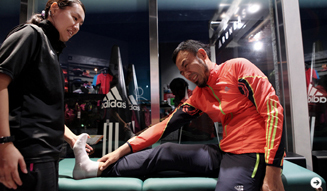
1. Hamstring Stretch
Place your leg on a bench or similar surface with your knee extended, and grasp your toes with both hands. If this is difficult, one hand is fine. Ideally, use the opposite hand to the leg you're stretching (e.g., left hand for the right leg), but if that's too hard, use the same side hand, or grasp your ankle instead of your toes. Keep your chest up and imagine extending your knee. While doing this, try moving your toes forward, backward, left, and right, and hold the position with your ankle turned towards the direction that feels painful. The painful area indicates muscles that are not being used!
2. Calf StretchHold onto a wall or railing, step back with the leg that was on the bench, and press your heel into the ground as if stretching your calf. The key is to focus on "pressing your heel into the ground" rather than just shifting your weight.
* March in place once to promote blood flow, then switch legs.
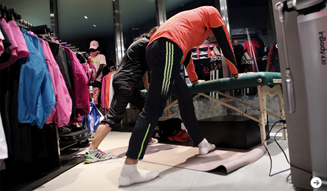
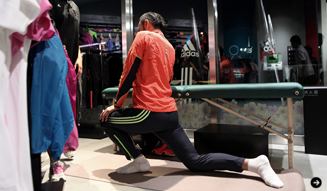
3. Quadriceps and Hip Flexor StretchStep forward with one leg, place the knee of the other leg on the ground, and lean forward while engaging your glutes and core. This stretches the front of the thigh of the back leg, but focus on stretching the hip flexors.
* March in place once to promote blood flow, then switch legs.
After completing these stretches, try standing naturally. You should feel your center of gravity shift forward. Also, try touching your toes; you might find your hands reaching the floor now. This is proof that your hamstrings have been stretched. Finally, let's stretch your glutes and chest!
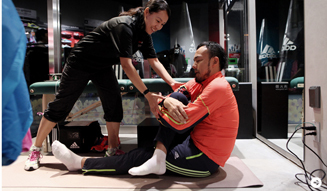
Glute StretchSit on the floor with your legs extended. Bend one knee and cross it over the extended leg. Hug the bent knee and pull it towards the opposite shoulder (e.g., left shoulder for the right leg).
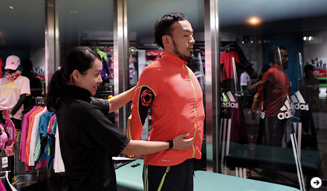
Chest StretchStand straight and pull your arms back, imagining squeezing your shoulder blades together. Engage your core and be mindful not to arch your lower back. This stretch alone should allow you to move your arms smoothly backward.
The Road to Completing 42.195km Starts at adidas "Runbase"
A Must-See for Runners! Toshio Matsuura Experiences the "adidas Running Dock" (Part 4)
Squats: The Effective Warm-up
Squats
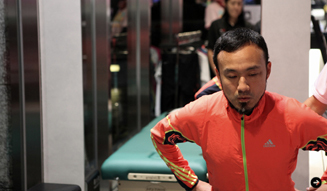
Stand with feet shoulder-width apart, hands on hips. Lower your hips as if sitting back, bending your knees. Engage your core and keep your weight on the balls of your feet, performing the movement slowly. Aim for 10 repetitions. This not only allows you to run with your core engaged but also improves your push-off. It also keeps your muscles active, warming up your body. Incorporating jump rope after this is ideal. Since running involves stepping forward from the motion of jump rope, it's the perfect warm-up.
Stretch Thoroughly After Running!
Advice from Master Staff Mako Fukano
Ideally, we'd include more stretches, but if we add too many, each one might be done superficially. So, we've introduced the "minimum necessary" stretches based on Matsuura's physical condition. First, consistently practice these stretches and warm-ups. You should start seeing changes in about a month. Stretch thoroughly after running, taking as much time as possible. This not only prevents next-day fatigue but also transforms your body into one capable of fluid movement. When doing so, adjust the volume of stretching by increasing the number of sets rather than extending the hold time for each pose.
Personalized Running Form Check Service Also Recommended!
That concludes the "Running Dock" menu. The session takes about an hour. Originally, this menu includes foot scanning and advice on shoe selection. However, Matsuura decided to create custom "mi adidas" custom shoes for his full marathon goal, so these measurements were omitted this time. We'll introduce the "mi adidas Order Edition" next. Additionally, a "Personal Training Program" (1 hour) is available separately, where you can run along the Imperial Palace with a professional trainer and receive advice on your running form.
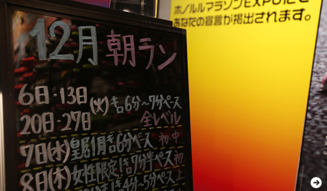
Since you have this opportunity, it's a great idea to thoroughly check your running performance in addition to the "adidas Running Dock." Let's start running towards your next goal from adidas "Runbase"!
adidas Running DOCK
Price: First visit ¥6,000 / Subsequent visits ¥4,000 (Includes RUNBASE facility usage fee)
Personal Training Program: ¥5,000 (Advance reservation required, 1 hour per session)
* For same-day cancellations, half of the service fee will be charged as a cancellation fee.
Service Details
Foot Scan
Body composition and skeletal muscle measurement using InBody
Alignment measurement (leg shape, joint stiffness, range of motion, etc.)
Consultation and proposal for optimal training menu (including diet and care methods)
Shoe selection advice
* The Personal Training Program is not included in these services. Separate reservation is required.
adidas RUNBASE
Hirakawacho Mori Tower 1F, 2-16-1 Hirakawacho, Chiyoda-ku, Tokyo
Business Hours: Weekdays 7:00 AM - 10:30 PM / Weekends & Holidays 7:00 AM - 7:00 PM
Price: Visitor ¥700
Passes: ¥5,000 (10 sessions / valid for 6 months)
Shoe Rental: ¥100
Wear Rental: Full set ¥500 / Individual item ¥300
Towel Rental: Small ¥100 / Large ¥200
adidas RUNBASE
Tel. 03-3261-9980
http://adidas.jp/running/runbase/