BOOK | A narrative of objects surrounding Hemingway: 'Hemingway’s Favorites'.
BOOK | A "Material" Tale of Literary Giant Hemingway
By TATSUO IMAMURA and JUN YAMAGUCHI | Hemingway’s Favorites
Through research encompassing over ten thousand photographs, hundreds of receipts, personal belongings, and letters, this book unveils the wardrobe and cherished possessions of the literary giant Hemingway. Jun Yamaguchi, co-author of the unconventional Hemingway study "Hemingway's Favorites," shares the book's allure.
Text by JUN YAMAGUCHIPhoto by BB Company
A Young Hemingway in a Mackinaw
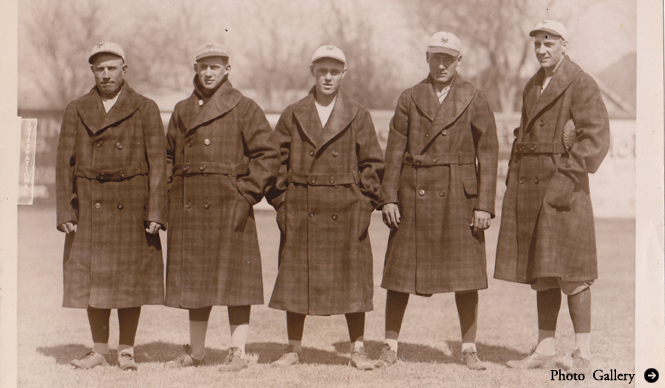
What comes to mind when you hear the word “Mackinaw”? Some might picture a Filson Mackinaw Cruiser, others a World War II U.S. military Mackinaw where the original thick plaid wool fabric was replaced with cotton duck. Perhaps you’re thinking of the single-breasted jacket called a Mackinaw that has become popular in vintage clothing stores recently. None of these are entirely wrong, but they aren’t entirely right either.
This is because a Mackinaw was originally a shawl-collared, double-breasted, fingertip-length belted coat for forest workers like lumberjacks, hunters, and prospectors. Tracing history further back, the Mackinaw appears to have evolved from a Native American poncho made from blankets, and the name itself seems to originate from the practice of the government distributing blankets to Native Americans and others on Mackinac Island in Michigan.
From the late 19th to the early 20th century, the Mackinaw, originally a forest worker's garment, gradually became known as an iconic outerwear piece within the nascent movement of what we now call American casual wear, as traditional workwear began to spread into everyday urban fashion. By the 1920s, it had sparked a nationwide craze.
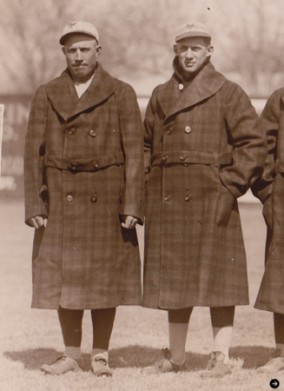
In other words, what we currently envision as a Mackinaw has been shaped by the original Mackinaw undergoing various transformations in name and style over time.
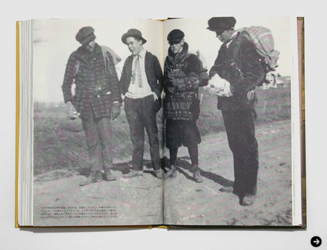
Several photographs remain of Hemingway, in his mid-teens during the mid-1910s, wearing a Mackinaw. Having been introduced to outdoor life from a young age by his father, who taught him stream fishing and hunting, the Mackinaw seems to have been a prized item in his wardrobe.
While in Italy during World War I as an ambulance driver for the Red Cross, Hemingway even wrote to his parents from the front lines, "My Mackinaw is becoming quite a curiosity here on the battlefield."
This letter, boastfully mentioning, "I'm thinking of changing the buttons to something flashier next time," reveals a carefree young man who loved clothes, a stark contrast to his later macho and rugged image.
The Mackinaw also appears in Hemingway's Nick Adams short story, "The Last Good Country." It features a memorable scene where Nick, waking up cold in the middle of the night while camping, wraps his sister, who had followed him out of concern, in his favorite coat. That coat, a crucial prop, was a Mackinaw.
Abercrombie, Vuitton, Rolex – Also Cherished
Hemingway once told his younger friend A.E. Hotchner, "A novel is a structure, and what I create is rooted in experience. A true novel must be written from everything one knows, has seen, and has worn" (from "Papa Hemingway"). For this man of action, whose life experiences—bullfighting, fishing, war, safari trips, love affairs—formed the very blood and flesh of his work, his wardrobe and cherished possessions were also vital props, as the Mackinaw anecdote and Hemingway's words to Hotchner suggest.
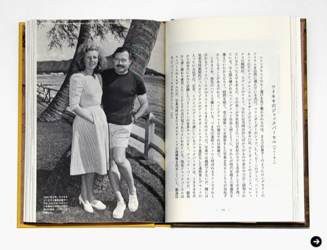
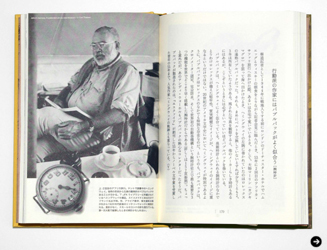
Viewed from this perspective, re-examining his works, biographies, and photographs reveals a different Hemingway from the one scholars have long believed: one who, while not sparing expense on art purchases, travel, or his hobbies of fishing and hunting, was indifferent to clothes and unattached to possessions. Instead, a meticulous Hemingway emerges, one with distinct preferences.
By shedding light on Hemingway through his "things," "Hemingway's Favorites" aims to illuminate this lesser-known reality of the author and reveal how these preferences underpinned his literary style, often lauded as hard-boiled realism.
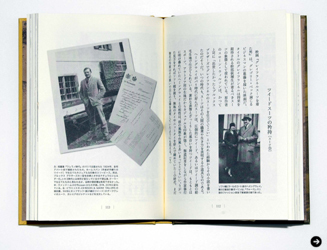
Last year, I spent a week at the JFK Library & Museum in Boston, which houses Hemingway's personal effects. By examining over ten thousand photographs, hundreds of receipts, and the collection of his belongings, I was able to uncover numerous cherished items beyond the relatively well-known Abercrombie & Fitch safari jacket and Moleskine notebook. These included Louis Vuitton trunks, Brooks Brothers suits, Rolex watches, Parker fountain pens, Loveless knives, Hardy fishing tackle, L.L. Bean boots, and a Thompson submachine gun. This book features a curated selection of photographs, personal effects, and letters to substantiate these findings.
Hemingway was born in 1899 and died in 1961. This period remarkably coincides with the dawn and golden age of American casual wear, American traditional style, and 20th-century product history. In a sense, examining Hemingway's wardrobe and cherished possessions is akin to revisiting those eras through his personal history. We believe this book will be enjoyed not only by Hemingway enthusiasts but also by fans of American casual, American traditional, and product design.
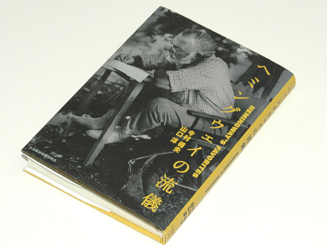
Hemingway's Favorites
Authors | TATSUO IMAMURA, JUN YAMAGUCHI
Price | ¥1,890
Format | 46-size
Cover Design | TSUNETSUGU TSUKANO, YOSHIMI OTA (both BB)
Publisher | NIKKEI PUBLISHING INC.
Available at bookstores nationwide, as well as five Beams stores, primarily Beams Plus.