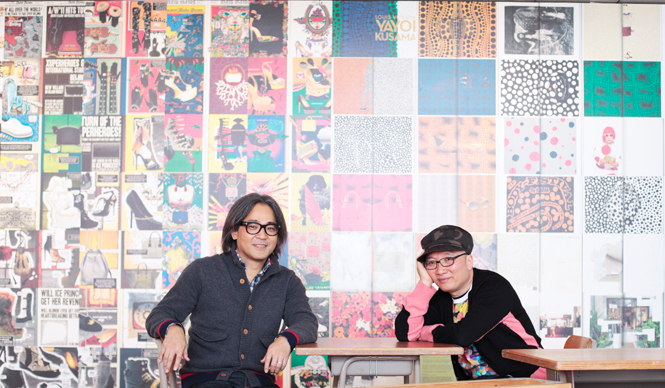
Space Composer Junji Tanigawa x Art Director Theseus Chan | Special Talk
Space Composer Junji Tanigawa × Art Director Theseus Chan
JTQ 10th Anniversary Book Special Talk (1)
All Handmade! The Making of a Tactile Book Limited to 2,000 Copies
Space composer Junji Tanigawa. A professional in "space creation," he conveys clients' messages through space. On January 25th (Friday), "Junji Tanigawa, The Space Composer" (Page One Publishing/Singapore), a collection of his work over 10 years of space creation, will be released. Of course, it's no ordinary "collection of works." It's filled with ingenious touches that surprise the reader, just as his spaces appeal to the five senses.
Photographs (portrait) by JAMANDFIXInterview & Text by TANAKA Junko (OPENERS)Special Thanks to ggg (ginza graphic gallery)
A "Tactile" Book That Surprises the Reader
Junji Tanigawa, familiar from OPENERS' series "Space Composer Junji Tanigawa's Spatial Records". JTQ (Japan Time Quality), which he founded in 2002, celebrated its 10th anniversary last year. His work involves professional "space creation," conveying clients' messages through space. As a unique Space Composer, not merely a designer, creator, or art director, he has successfully completed various projects both domestically and internationally.
For example,recreating the Taklamakan Desert's starry sky at Yakushiji Temple in Nara,expressing Japanese aesthetics at the Musée des Arts Décoratifs in the Louvre, Paris,splendidly unfolding Lexus's worldview on Odaiba, or designing the bottle cooler for Krug, a world-renowned Champagne house.Looking at each project individually, the breadth of expression is astonishing for a single individual.
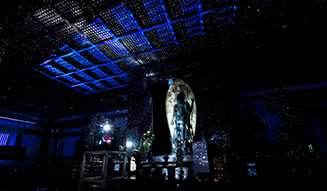
Yakushiji Temple Light Painting for the 1300th Anniversary of Heijo-kyo Capital
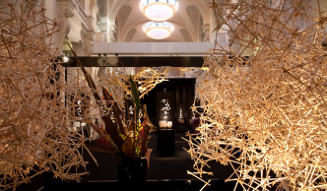
Kansei – Japan Design Exhibition
With the rise of the internet, we can now see and hear almost anything from home, far more than 10 years ago. Yet, Tanigawa says, "There are things that can only be felt by actually visiting the place. These are 'live' experiences that stir the five senses, such as atmosphere, impressions, and memories. My job is to create spaces that generate such experiences."
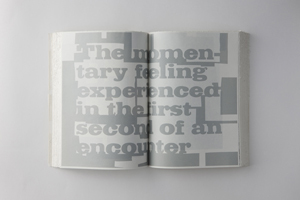
On January 25th (Friday), Tanigawa's first collection of works, "Junji Tanigawa, The Space Composer" (Page One Publishing/Singapore), tracing his 10 years of space creation, will be released. It's a "tactile" book filled with ingenious touches that surprise the reader, so much so that calling it merely a "collection of works" feels inadequate. The entire design was handled by Singapore's leading art director, Theseus Chan. He founded the independent magazine "WERK," which has passionate fans worldwide, in 2000, and in 2012, he garnered significant attention for "LOUIS VUITTON - YAYOI KUSAMA" (Louis Vuitton Japan), commemorating the collaboration between Louis Vuitton and Yayoi Kusama.
The two, who have only met a few times, sat down to discuss how they brought together 10 years of activity into a single book. We interviewed them in December 2012, when Chan visited Japan for the exhibition "Theseus Chan: WERK No. 20 Ginza THE EXTREMITIES OF THE PRINTED MATTER" held at the ginza graphic gallery (ggg).
Space Composer Junji Tanigawa × Art Director Theseus Chan
JTQ 10th Anniversary Book Special Talk (2)
All Handmade! The Making of a Tactile Book Limited to 2,000 Copies
I didn't want it to feel like a typical "collection of works."
—Do you remember the first time you met?
Junji Tanigawa (hereinafter Tanigawa):We were introduced when I visited Singapore for another project in 2011. I still vividly remember the impression I had of his office (Note: now relocated) – it was in a renovated old school building, and I thought, "This is such a 'gentle' office, just like Theseus."
Theseus Chan (hereinafter Chan):I was a bit surprised when I first heard he wanted to meet me, as I didn't expect Tanigawa to visit. I thought it would be a brief courtesy call, but I was delighted to learn how interested he was in our work.
—How did you go from that first meeting to deciding to "create a book together"?
Chan:When he visited my office, I showed him various things we had created. He particularly liked issue No. 16, "JOE MAGEE SPECIAL," of "WERK," which featured illustrator Joe Magee. That's when we decided, "Let's create a book for JTQ together."
That book would cover all of JTQ's work over the past 10 years. Tanigawa's request was that it shouldn't feel like a typical hardcover "collection of works." He wanted something more special. When I saw the photos of the spaces he had created, I was amazed that he had produced so many elaborate spaces in just 10 years. With all the material ready, all that was left was to cook it. Tanigawa gave us the ingredients and said, "Do whatever you like with them," leaving everything to our discretion.
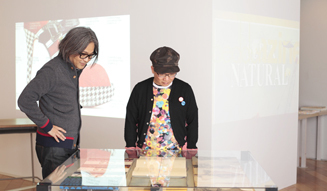
—That's an incredible level of trust!
Tanigawa:That's because I truly believed Theseus was an amazing designer. I was curious, and perhaps a little apprehensive, to see what he would create if I entrusted everything to him. I left the selection of photos (recording the spaces he had created) entirely to him. It must have been a lot of work. I gave him photos from 10 years and asked him to "choose from these."
Chan:Ah, yes, it was a terrifyingly large number of photos! (Laughter from everyone) But it was a great help that he didn't ask for them to be arranged chronologically. There's nothing more boring than seeing photos arranged chronologically when you open a 200-page book. If they're arranged out of order, you can get a sense of the 10-year journey just by casually flipping through it.
Tanigawa:The only thing Theseus consulted me on was the colophon, the part with the title, publisher, etc. He presented two versions for that: one neatly arranged and another with the text scattered, asking, "Which do you prefer?"
Chan:I wasn't sure if Tanigawa preferred very avant-garde designs or something more structured. So, I made both and showed them to him. He said the structured one was "a bit too ordinary," which made me think, "Great, I have his approval!" (laughs) This book isn't just mine; it's also Tanigawa's, so it wouldn't be meaningful if he didn't like it. But since he liked the one I preferred, I felt confident in pushing the design further.
Tanigawa:Of course, if it hadn't matched my vision, I would have said so. But what he presented exceeded my expectations, so I thought it was best to proceed as is.
Space Composer Junji Tanigawa × Art Director Theseus Chan
JTQ 10th Anniversary Book Special Talk (3)
All Handmade! The Making of a Tactile Book Limited to 2,000 Copies
The Protagonist is a Pop-Up Book of Summer Vacation Memories!?
Opening the finished book, "Junji Tanigawa, The Space Composer," amidst the various spaces created by Tanigawa, handmade pop-ups of cars, houses, and boys occasionally appear. These are actually copies from a pop-up picture book that young Tanigawa created during his summer vacation in the third grade, chronicling his memories. This picture diary, which he himself calls the "origin of my current work," seems to have been the "protagonist" of this project.
—At what stage was the decision made to incorporate elements from this picture diary?
Chan:I believe it was a request from Tanigawa?
Tanigawa:Yes. It was quite early on. When I found it, I thought, "This is it!" so I immediately took photos and sent them to Theseus.
—What were your impressions upon actually seeing the picture diary?
Chan:I was deeply moved. Needless to say, this picture diary is very personal. It's filled with Tanigawa's childhood dreams and purity. Seeing it, I realized that even then, he possessed an incredible imagination.
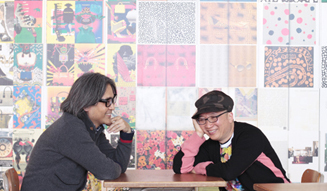
It was Tanigawa's strong request, and I wanted to incorporate this picture diary into the book somehow. But simply including it wouldn't have been enough. It reflects his childhood, so it needed to be updated to match the current Tanigawa. Therefore, we decided to extract the "purity" from the picture diary and incorporate it into the book. After copying the pages, we cut them into various shapes and presented them as pop-ups, or overlaid them on photos of spaces, making it look like parts were cut out. It's a bit like a child's mischief, isn't it? In this book, the purity found in the picture diary appears in a form that entertains the reader.
The book itself has a very simple design that evokes purity. The act of creation requires a certain purity, doesn't it? I wanted to make a book that would remind people of that feeling.
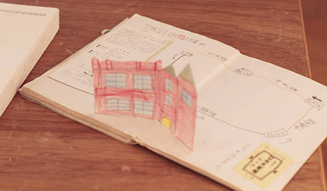
Tanigawa's picture diary from his third-grade summer vacation
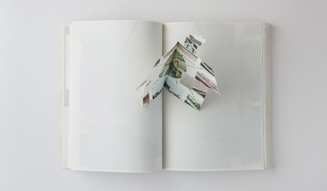
That picture diary appears in the book as pop-ups
—You mentioned purity as a key element. Do you consciously consider that in your daily work?
Tanigawa:All adults were once children, and they naturally possessed purity. When I made this picture diary, I wasn't trying to do anything special; I just wanted to convey my feelings to the reader, so I made it a pop-up book. Now, nearly 40 years later, my work is to give form to the messages I want to convey. In that sense, I'm still creating pop-ups. Listening to Theseus, I realized anew that not much has changed between then and now. Perhaps that's what he calls "purity."
Chan:That's exactly what I mean by "purity"! The desire to convey something to others. That's what drives Tanigawa. He's a bit wild, but equally innocent... I found that aspect of him so fascinating that I wanted to reflect it in the book.
Space Composer Junji Tanigawa × Art Director Theseus Chan
JTQ 10th Anniversary Book Special Talk (4)
All Handmade! The Making of a Tactile Book Limited to 2,000 Copies
Memories That Mature Like Wine
The spaces created by Tanigawa are ephemeral, like cherry blossoms that bloom brilliantly and then scatter. The photographs that document these spaces are the only clues to recalling memories, but it's inherently difficult to retrace the three-dimensional world of a space from the two-dimensional world of a photograph. It's impossible to evoke the "thrill" of visiting the space. However, Chan has managed to bring Tanigawa's spaces back to life using these documentary photographs, employing his forte: the medium of books.
—What was your "vision for the finished product" as you worked on it?
Chan:I approached it with the same three principles I use for my own magazine. First, a design that conveys depth. Second, materials that make you want to touch and open it, making the book itself a complete work of art. And third, something that resonates with the reader. But above these principles, my most important mission was to surprise Tanigawa! (laughs) Knowing his childlike spirit, I imagined he'd be very excited to see what kind of pop-ups would emerge from the book.
—What were Tanigawa's thoughts when he saw the finished book?
Tanigawa:It was as if opening a box, my 10 years of memories flooded back. What I found very characteristic of Theseus was that the photos were designed as "memories," not just arranged as "records." They weren't in chronological order, they varied in size, and the presentation was all over the place. It felt like a symbol of how some memories are vivid and others are hazy. I was simply moved that he had perfectly captured the idea of "returning experience to memory."
When I first turned the pages, I felt like I was looking at a new work by Theseus rather than my own book, so I viewed it quite objectively. But after finishing it once, I thought, "Ah, this is my book," and when I looked at it again as my own, I was incredibly delighted, thinking, "Wow, we've created something amazing." I've looked at it so many times since then that the first copy I received is already falling apart! (laughs)
Chan:Actually, this book is made with materials and paper that change over time. When exposed to sunlight or touched by hands, the color gradually shifts. It's like wine aging. It becomes more interesting as time passes. I'm also looking forward to seeing how the memories of the first 10 years captured in this book will have changed by the time we celebrate the 20th anniversary.
—A book that matures like wine. That's very unique.
Tanigawa:Memories do mature, don't they? So, a book that matures is the perfect way to evoke memories from the past 10 years. Experiences become memories, and then we return them to experience through a book... Theseus expressed that in a way that exceeded my imagination.
Chan:I wanted to create something special for Tanigawa. I designed it as if it were my own magazine, not just for a client. When you're told, "You can make whatever you like," something special tends to emerge. He understood that well and entrusted everything to me from beginning to end, so this book has become very special to me as well.
Junji Tanigawa
Born in 1965. Space Composer / Representative of JTQ. With the theme of "message transmission using space as media," he constructs communication contexts tailored to objectives, including events, exhibitions, installations, and commercial space development. He provides creative direction from both design and functional perspectives. Major works include KRUG bottle cooler (2011), Yakushiji Temple Light Painting for the 1300th Anniversary of Heijo-kyo Capital (2010), Kansei exhibition at the Musée des Arts Décoratifs in the Louvre, Paris (2009), Good Design Expo (2007-2011), JAPAN BRAND EXHIBITION (2007), and the Agency for Cultural Affairs Media Arts Festival (2005-2008). www.jtq.jp
Theseus Chan
Born in Singapore in 1961. Art Director / Representative of WORK. After working at McCann Erickson and other agencies, he established WORK, a design office that transcends advertising, design, fashion, and publishing, in 1997. His magazine "WERK," launched in 2000, is an independent magazine that pushes the boundaries of printing technology and has passionate fans worldwide. From 2004 to 2009, he operated Southeast Asia's only Comme des Garçons guerrilla store, simultaneously producing the visual magazine "Guerrillazine." In 2006, he received the Singapore President's Design Award. In 2009, "WERK" issue No. 16 won a D&AD Yellow Pencil award. In Japan, he gained attention for "LOUIS VUITTON - YAYOI KUSAMA" (2012/Published by Louis Vuitton Japan), created to commemorate the collaboration between Louis Vuitton and Yayoi Kusama. He held a solo exhibition at the ginza graphic gallery (ggg) in December 2012. www.workwerk.com
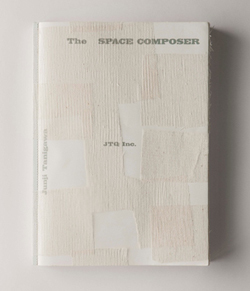
"Junji Tanigawa, The Space Composer"
Author: Junji Tanigawa (JTQ)
Book Design: Theseus Chan (WORK)
Pages: 400 pages
Publisher: Page One Publishing (Singapore)
Print Run: 2,000 copies (300 copies in Japan)
Release Date: January 25, 2013 (Friday)
Bookstores: Daikanyama Tsutaya Books, and others
Price: 8,800 yen
Inquiries
JTQ
Tel. 03-3711-9499
"Junji Tanigawa, The Space Composer" Publication Commemorative Fair
Dates: January 25 (Fri) - February 11 (Mon)
Time: 7:00 - 26:00
Venue: Tsutaya Books Building 2, 1F Book Floor
17-5 Sarugaku-cho, Shibuya-ku, Tokyo Daikanyama Tsutaya Books
Talk Show: Junji Tanigawa (JTQ) × Kosuke Obo (WOW) × Mutsumi Ota (Editor)
"The Profession of Space Composer - How to Create Memorable Spaces -"
Date: February 8 (Fri)
Time: 19:00 - 20:30
Venue: Tsutaya Books Building 1, 1F General Information
How to Apply: Event participation tickets will be distributed to those who pre-order or purchase "Junji Tanigawa, The Space Composer" at Daikanyama Tsutaya Books.
Inquiries
Daikanyama Tsutaya Books
Tel. 03-3770-2525
http://tsite.jp/daikanyama/