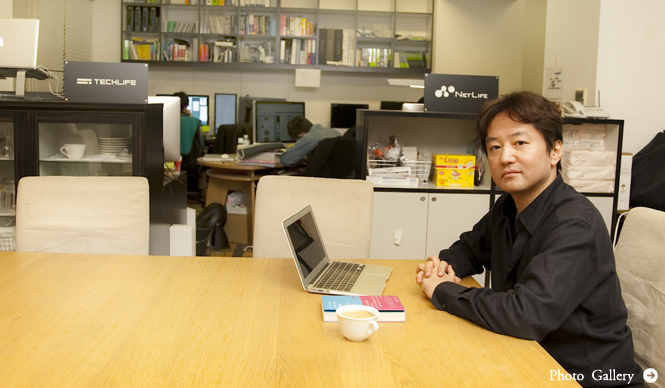
An Interview with Tomoyasu Hirano, Author of "The Dawn of Social Media"
Interview with Tomoyasu Hirano, Author of "The Dawn of Social Media" (Part 1)
Ranked #1 on Amazon in Business & IT
"Even in IT, it's all about the 'Love Factor'"
Media creator Tomoyasu Hirano has been engaged in media design using social media such as Twitter, Facebook, and Ustream since 2010. And at the end of last year, he published a book titled "The Dawn of Social Media." What exactly is social media? The answer can be found by reading this book, which is written in an accessible style that anyone can understand. But what I really wanted to ask was why Hirano-san became so passionate about social media.
Text by KASE Tomoshige (OPENERS)Photographs by NISHIMURA Saiko (SELF:PSY'S)
There Should Be Individual Happiness
This book, "The Dawn of Social Media," is indeed about IT. It also has aspects of a business book by an author who has practiced social media. However, my immediate impression after reading it was that it's "actually closer to an essay." The author, deeply moved by social media, becomes engrossed in it—because he narrates the scenes of each moment with a quiet sincerity.
—It's an IT book, but it doesn't contain any difficult technical terms.
How should I put it... I dislike difficult books. Rather than trying to write difficult things simply, I wrote it because I found difficult books unappealing. There's no way I can compete with people who have studied so much (laughs). That's why I wanted to make it a book that felt like a story, entirely from my subjective perspective.
—So, I should just say 'I see' then? (laughs)
I haven't covered any academic research findings or topics based on data. Instead, I tried to write as honestly and clearly as possible about what I've experienced and realized myself. I wanted to share many "insights" rather than "analyses." When I was writing, I was constantly thinking about how my experiences could help the readers.
—The writing itself is very easy to read.
There are many books on the market that are analyzed based on statistics and theories, and there are many people who can present them clearly. But I wanted to convey the gaps that such books don't cover, the reasons why social media feels so exciting, and so on. Also, I felt that people think social media is somehow cool, but no one really understands why. When I tried to explain this "coolness," the writing style, or rather the atmosphere, ended up like this.
—Several keywords are scattered throughout the text that catch the eye. The term "love factor" was particularly memorable.
I'm glad it registered as a keyword. The "love factor," meaning nothing is more important than affection and trust. At first, I thought it was just a keyword for social media... but then the earthquake happened during the writing process, and many people started to seriously consider their way of life. Perhaps because of that, my conviction grew stronger that "love factor" applies to everything.
—It feels like there's a world that's a bit different from "profit above all else," doesn't it?
Pursuing only numbers and profits is so lacking in class, and I believe such a world will eventually collapse. Instead, wouldn't it be better to search for a "way of life that feels right" even a little, or to place yourself in an environment you cherish? Perhaps in the past, we were too poisoned by the life images and ideals presented by mass media. The point is that realizing such things might lead to happiness.
—Could you be a little more specific?
If I were the CEO of a large corporation, I would think about the high unemployment rate and changes in employment systems. But if not, then Tokyo has its own happiness, overseas has its own, and freelancers have their own. In other words, rather than being exhausted by seeking overall happiness, I increasingly felt that we could live a slightly happier life with just one idea. When I thought about it that way, social media became a field where we could be active in the future. I believe it will expand into a field sufficient for us to make a living within the next two to three years.
Interview with Tomoyasu Hirano, Author of "The Dawn of Social Media" (Part 2)
Ranked #1 on Amazon in Business & IT
"I Used to Think Technology Was Pretty Useless"
Something That Changes Your Way of Life
—I feel like many people still don't know about social media or SNS.
Nowadays, when people say "social," they might think of "social games" first. They're even advertised on TV. But I just can't bring myself to like social games. That's because, to me, what's social is something you cultivate diligently for your own happiness. To put it crudely, it's not something you get from money or games. That's why I hope that through this book and articles like this, more people will start to think, even vaguely, 'Social media might be good.'
—What is the opposite of something social?
I'd say it's the "mass media sickness," or the tendency to think in terms of large entities. To be specific, if someone says, "Japan is still no good," I'd ask them, "Are you a politician?" (laughs). Social is something you nurture on a small scale. With a social mindset, rather than criticizing, you first think about what you want to do with society going forward, together with yourself and the people you're connected to. Then you move to concrete actions based on those genuine feelings. It's difficult, but I believe it's a happier way to live.
—Thinking about individuals rather than the whole makes more visceral sense.
You shouldn't think of social media as existing media. On Twitter or Facebook, I think the most impactful moments are when you see acquaintances making a resolution or when a certain phrase resonates with you. Like when you're in despair, wanting to give up everything, and someone says, "What's wrong? Are you okay?" I think things like that are incredibly important. Fundamentally, there is no such thing as "the whole." For example, "online opinions" don't exist. Opinions online, opinions on TV, public opinion... they are all things without substance. This might be a leap, but it ultimately comes down to the basics: "Let's make good friends."
—I also found the expression "human-centered technology" interesting.
Originally, I wanted to do theater or film, so I wasn't interested in technology. However, I always thought that if I were to be born into this world, I'd like to do something to make it better.
—You wanted to contribute to society through IT, right?
While doing this work, I actually thought that technology-related fields were pretty useless (laughs). People easily get addicted to something, and it's convenient yet inconvenient. Everyone is just clicking away in front of their PCs. Moreover, online shopping is too convenient, leading to consumption addiction, without even walking on two legs... I thought, this isn't good.
—It sounds rather apocalyptic (laughs).
It felt like, "Sorry for being born into this world" (laughs). Buildings are densely packed, there's no soil, and humanity is in trouble. And I realized I was working in a field that was accelerating this situation. In the back of my mind, I'd think, "Internet live streaming? So what? Software development? So what?" Deep down.
—It was in that situation that you encountered social media.
It Changes Your Way of Life—Media that generates countless things like that doesn't come along often. I was truly moved. It meant that I could potentially create something in "information technology" that surpasses movies, novels, or theater. I had always felt that I needed to return to analog at some point, even while working in this field. I became convinced that IT could still evolve and that it was okay to continue. That made me truly happy.
Interview with Tomoyasu Hirano, Author of "The Dawn of Social Media" (Part 3)
Ranked #1 on Amazon in Business & IT
"It Comes with E-books, Isn't That Great?"
Uploading the Book Manuscript to Facebook
—It's mentioned that you traveled around the country for sales events for Digital Stage, the company you manage. However, you also wrote that broadcasting events on Ustream allowed you to connect with more people than actually traveling nationwide. This is truly a testament to the power of social media.
From a business perspective, that's everything, isn't it? There are two important aspects to social media: one is one's way of life, and the other is business. For example, if I stream this interview on Ustream... after properly announcing it around 9 PM, about 300 to 500 people will listen.
—That's quite a large hall in reality, isn't it? (laughs)
Imagine renting out a community hall that can hold 500 people for one night – how much would that cost? You'd have to consider venue fees, hosts, receptionists, and so on. But this can be done instantly. I believe that recognizing this and applying it to one's own business activities presents a business opportunity. Whether it's a lecture or a workshop, it's an incredible opportunity. By streaming this interview on Ustream, we can create a situation where most of the viewers learn about the book "The Dawn of Social Media." Anywhere in the world.
—The appeal of the content is extremely high.
Precisely because it's a medium anyone can start, we can nurture it from a small seed together with viewers and potential fans. My book started from the perspective of "Who are you, Mr. CEO? Why are you writing a book?" and then evolved to people congratulating me when the release date was decided. The fact that people even knew I was writing a book is amazing, isn't it? Because normally, you'd only find out a book was written after it was published, right? But this time, thousands of people knew about it before the release. That's truly incredible.
—Now, I heard there were several unconventional and rule-breaking moments during the production process.
Actually, I was uploading the manuscript as I was writing it to Facebook. And then, I made it so that anyone could comment, like "Wouldn't it be better to change this part?" or "This section is hard to understand." I even asked for opinions on the cover design. That also increases the "love factor," doesn't it?—If I say that, it sounds a bit crass, but (laughs).
—We're talking about the business aspect.
When people vote in surveys or comment on my posts, they probably feel like they've "been involved in the book," right? In that case, they'll want to buy it. Some people said, "Isn't it wrong to just put your manuscript out there?" I received polite emails expressing concern, like, "Mr. Hirano might not know the publishing industry's norms, but the publisher might get angry."
—While familiar to Twitter users, the hashtag symbol (#) is printed on the cover.
Yes. When you tweet, please use the hashtag "#YOAKE." And then there's this: two e-books are included (laughs).
—So, as a bonus for the physical book, you get two licenses for e-books. The publisher must be crying (laughs).
We founded the publishing company with friends precisely so we could do such unreasonable things. Otherwise, we probably couldn't have come up with this plan. The whole thing started about a month before the release when someone on Twitter or Facebook asked, "Why aren't you releasing an e-book?" and I thought, "That's right... then let's just include them!" It's a huge loss (laughs). Not only are there extra costs for binding, but the e-book sales become zero (laughs). Well, it was quite challenging, but thanks to this, people who buy the book receive two e-book licenses for free. And then there's the fun part: you can give one to someone else. It would be difficult for a regular publisher to do something like attaching e-books to a physical book due to various circumstances. But I really wanted to make a statement in the publishing industry, which seems so rigid right now. Since I put my heart into writing this book, I wanted to go all out with how it was presented. It's just a book, but it's also significant. After all, it's a part of myself.
Tomoyasu HIRANO
Born in Kiryu City, Gunma Prefecture, in 1974. In 1995, he produced "The Third Theater Company" led by Koushun Takami and established the digital division of Third Stage Inc. For two years from April 1997, he hosted "Tomoyasu Hirano's All Night Nippon" on Nippon Broadcasting System. In 1998, he founded Digital Stage Inc. and became its representative director. In the same year, he developed "motion dive," Japan's first VJ software. Since then, he has continued to release software such as "LiFE* with PhotoCinema," which turns photos into cinematic video, "ID for WebLiFE*," which allows anyone to create Flash websites, and the comprehensive website creation solution "BiND for WebLiFE*," winning numerous awards. Since 2010, he has been involved in media design utilizing social media. In January 2011, the "skmts project," which streamed Ryuichi Sakamoto's piano solo tour worldwide, was watched by 200,000 people globally, establishing a new style for live music broadcasting. In December of the same year, he published the groundbreaking book "The Dawn of Social Media" (Media Life), which included two e-books as supplements.
Digital Stage Official Website
http://www.digitalstage.jp/
Official Twitter
https://twitter.com/#!/dshirano/

"The Dawn of Social Media"
Author: Tomoyasu Hirano
Publisher: Media Life
Price: ¥1,980
http://www.digitalstage.jp/book/yoake/