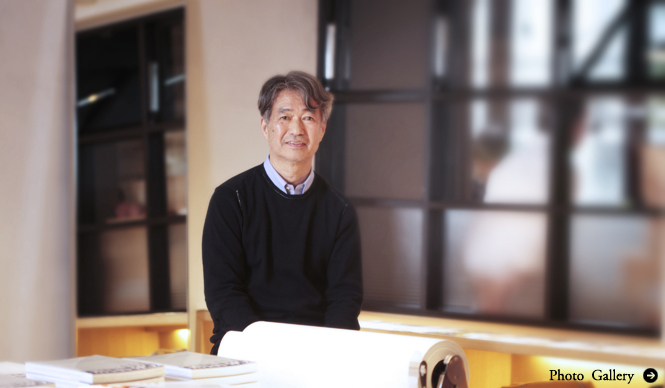
INTERVIEW | Art Director Tamotsu Yagi: The Trajectory of Yagi Design, Admired Worldwide
INTERVIEW | Art Director Tamotsu Yagi
The Trajectory of Yagi Design, Admired Worldwide (1)
Art Director Tamotsu Yagi has released a book, his first in Japan in 20 years. Yagi moved to the U.S. in 1984 to become the art director for the international casual fashion brand "Esprit," and is now based at "Tamotsu Yagi Design," which he established in L.A. This newly released book is a valuable volume that traces Yagi's career to date.
By Yuka Kobayashi
Photos by JAMANDFIX
The Global Art Director's Thoughts on His First Publication in Japan in Two Decades
Yagi's past works have received high acclaim from global companies, including Apple. The U.S. government has awarded him the Asian American Contribution Award for his achievements in the arts, and the San Francisco Museum of Modern Art houses 100 of his design works as part of its permanent collection. "The curator was already very familiar with my work, so they exhibited all the pieces that became part of the permanent collection at the museum's opening event. Recently, museums that traditionally only displayed fine art have been adding sections for design and architecture. But I don't think there will be another opportunity to see these 100 pieces together again (laughs)."
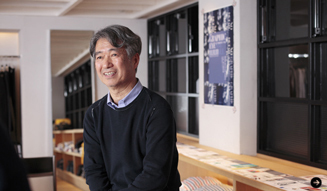
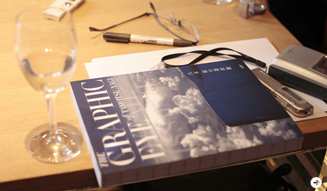
The book, "THE GRAPHIC EYE of Tamotsu Yagi - Tamotsu Yagi's Selection," also conveys his feelings for the next generation. "I wasn't particularly conscious of the younger generation, but unlike myself who decided to move to America in '84, today's young people are increasingly mobile and going abroad. Living overseas, working for Japanese clients, or working for foreign clients – these are wonderful opportunities for the younger generation. When I moved to the U.S. 20 years ago, job requests came by phone or fax, but now they start with a single email. The sense of distance is completely different now compared to then, so I believe there are more possibilities and various ways to achieve things than before."
Looking Back at the Archives, Encounters with People Stand Out
Yagi, known for his unique, boundary-pushing design work, asked a young opinion leader to contribute to the book's obi (bellyband). "In Japan, the obi is a unique format for books, typically featuring comments from well-known figures. I asked Hiroshi Fujiwara to write for it. He is an all-around opinion leader for the younger generation in areas like music and fashion. He visited my L.A. studio a couple of times, and his impression then was different from the young people I had imagined. I felt a connection with him in many ways and wanted him to write the obi."
"Furthermore, when I mentioned this to Tadao Ando, the architect who happened to be in L.A., he became interested and also contributed. And around the same time, I coincidentally ran into Douglas R. Tompkins (founder of The North Face), who had invited me to Esprit 20 years ago. When I told him about this project, he also agreed to contribute (laughs). This book features many people, but looking back at my archives spanning over 20 years, what I feel most strongly is the encounters with people." Yagi also mentioned that the dialogues woven throughout the book were very fruitful.
INTERVIEW | Art Director Tamotsu Yagi
The Trajectory of Yagi Design, Admired Worldwide (2)
Includes Conversations with NIGO and Toshiro Ogata
"I wanted to talk with people outside the world of graphic design as much as possible. In my conversation with Creative Director NIGO, he said, 'Looking at the future in the past, and the past in the future,' a statement that was highly praised by Americans who read the translation. On the other hand, in my conversation with chef Toshiro Ogata, the topic of 'food cannot be eaten in reverse' came up. He explained that food is meant to be eaten in a certain order, starting with appetizers, then soup, then grilled dishes, and so on; it cannot be eaten backward. He argued that a story also wouldn't make sense if read backward. While I do anticipate what people might say before our conversations, I find it fascinating when unexpected words emerge (laughs)."
Linked to each conversation are short "epigrams." "The phrase 'I want pieces that feel born rather than made' is by the potter Shoji Hamada. In the world of ceramics, where painting can take weeks or months, he would complete his paintings in just three seconds. His style was apparently ridiculed by his peers as 'too simple.' But the 80-year-old Hamada would reply, 'I painted it at 80 years old and in three seconds'… That's so cool. He was also very passionate about the Mingei movement."

A Masterpiece Arises from the Convergence of Time, Place, and Element
"Then there's the British artist Richard Long, whom I greatly admire. Artists from the 70s, like him, didn't have money to buy canvases, so they created works purely from ideas. Long used driftwood and stones for his art, and he said, 'A masterpiece arises only when the right element is in the right place at the right time. In other words, it's a place where multiple factors converge.' Essentially, if a driftwood sculpture were placed in a vacant lot, it would just be children's plaything. It's crucial for it to be recognized by a museum and placed within that space. At the end of this book, I also touch upon a project I started with Hiroyuki Sasaki of Tomorrowland. Sasaki was one of the first to realize the concept of branding a company name, something Japanese apparel companies weren't doing 10 years ago. This couldn't have been achieved without a complete brand identity, requiring a keen sense of selection. This point resonates with Long's philosophy."
If I had only heard about it without seeing the actual book, I might not have guessed it was an introduction to a graphic designer's work. "Normally, books by graphic designers tend to showcase works page by page, saying, 'This is what I did.' But in my book, alongside the works, I've included comments from people who were part of the staff at the time and images that connect the developments. The binding is also thread-sewn, allowing the book to lie completely flat. This has greatly expanded the scope of design."
This single volume is packed with Yagi's design work, offering a glimpse into the essence of visual communication, along with introductions to his works from 1984 to 2010 and dialogues with the people involved. It is a concentrated collection of what Yagi has selected and what has cultivated his discerning eye.
"THE GRAPHIC EYE of Tamotsu Yagi - Tamotsu Yagi's Selection"
Price | ¥3,990
Publisher | ADP (Art Design Publishing)