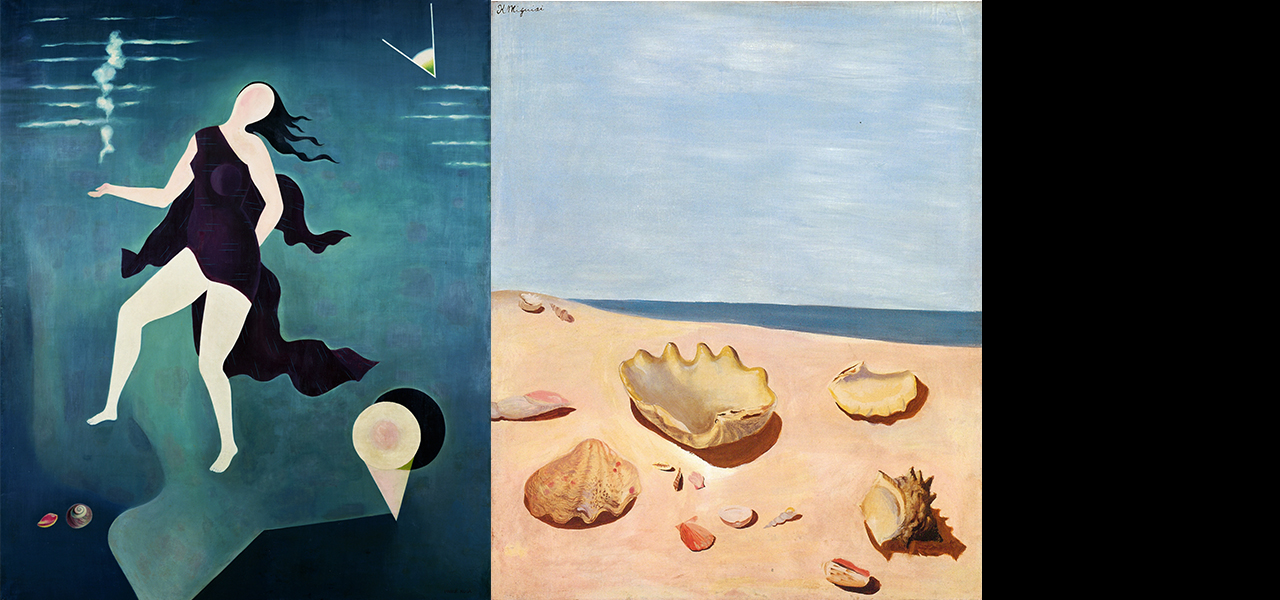
Left: Harue Koga, "White Shell," 1932, oil on canvas, Pola Museum of Art. Right: Kotaro Migishi, "Se
Exhibition 'Surrealism and Painting – Dali, Ernst, and Japanese 'Surreal'' Gathers Approximately 100 Works | ART
ART | From Experimental Techniques in Painting to Video Works by Contemporary Artists
Hakone's Pola Museum of Art Explores Surrealism from its Birth to its Evolution in Japan
2019 marks the centenary of Surrealism's birth. The exhibition 'Surrealism and Painting – Dali, Ernst, and Japanese 'Surreal'' gathers approximately 100 works, including paintings, prints, and video art, tracing the evolution of Surrealism over the past century and its spread from France to Japan, America, and Asia. It will be held at the Pola Museum of Art in Hakone from Sunday, December 15, 2019, to Sunday, April 5, 2020.
Text by OZAKI Sayaka
An Exhibition Tracing Surrealism's Birth and Evolution from France to America, Japan, and Asia
Spearheaded by the French poet André Breton, 'Surrealism' was one of the most influential artistic movements of the 20th century. Critiquing modern thought centered on reason and influenced by psychoanalysis, they pursued a new reality called 'super-reality' in the unconscious world, publishing the 'Surrealist Manifesto' in 1924 and beginning their activities as a group.
Surrealism soon expanded beyond poetry and thought into the realm of painting, giving rise to experimental works by the German-born painter Max Ernst (1891–1971). Concurrently, Salvador Dalí (1904–1989) from Spain joined the movement, creating paintings based on his unique theory of the 'paranoiac-critical method,' sparking a major trend that captivated not only the art world but also the fashion industry.
These developments also reached Japan in the same era. Breton's 'Surrealism and Painting,' published in 1924, was translated and published in Japanese by Shūzō Takiguchi (1903–1979) as early as 1930. Under the translated term 'Chō-genjitsu shugi' (Super-realism), it created a major sensation as the latest avant-garde art style throughout the 1930s. However, in Japan, deviating from its original aim of 'exploring the unconscious,' it resonated with the sense of stagnation in an era heading towards World War II, and was accepted as a fantastical art detached from reality. Gradually, it merged with Eastern thought, leading to the emergence of unique pictorial expressions and a distinct Japanese sensibility of 'surreal.'
This exhibition, 'Surrealism and Painting – Dali, Ernst, and Japanese 'Surreal',' is the first of its kind in the world to focus on how Surrealist painting emerged from the Surrealist movement in the West, its development into super-realism within Japan's avant-garde art circles, and its subsequent influence on the worlds of film and manga.
Surrealism and Painting – Dali, Ernst, and Japanese 'Surreal'
Dates | Sunday, December 15, 2019 – Sunday, April 5, 2020
Venue | Pola Museum of Art
Address | 1285 Kotsukayama, Sengokuhara, Hakone-machi, Ashigarashimo-gun, Kanagawa
Hours | 9:00 AM – 5:00 PM (Last admission 4:30 PM)
Closed | Open daily (Temporary closures for exhibition changes may occur)
Dates | Sunday, December 15, 2019 – Sunday, April 5, 2020
Venue | Pola Museum of Art
Address | 1285 Kotsukayama, Sengokuhara, Hakone-machi, Ashigarashimo-gun, Kanagawa
Hours | 9:00 AM – 5:00 PM (Last admission 4:30 PM)
Closed | Open daily (Temporary closures for exhibition changes may occur)
Inquiries
Pola Museum of Art
Tel. 0460-84-2111
https://www.polamuseum.or.jp/