
ART | Asami Kiyokawa Interview: A Journey to "Night on the Galactic Railroad" - Part 1
ART | A Picture Book for Adults, Adorning Miyazawa Kenji's Eternal Masterpiece with 50 New Works
Asami Kiyokawa: Beyond "Night on the Galactic Railroad" (Part 1)
Artist Asami Kiyokawa has previously released picture books based on timeless masterpieces such as "The Happy Prince" and "The Little Mermaid," each imbued with her unique worldview and techniques. For her latest project, she has chosen Miyazawa Kenji's renowned "Night on the Galactic Railroad." What kind of world did "Night on the Galactic Railroad" reveal to her, both as an artist and as an individual? Beneath a sky shimmering with golden light, she shared her thoughts with us.
Text by OPENERSPhotos by Kenta Suzuki
Fantasy Yet Real: That Ambiguity is the Charm of His Work
—This is the third installment in your series. Why did you choose "Night on the Galactic Railroad"?
I always select my works from the perspective of what kind of story is needed in the current era. It began with the compassion in "The Happy Prince," followed by romance in "The Little Mermaid." So, what next? When I considered that, the world of "Night on the Galactic Railroad," where the end and the beginning are indistinguishable and there are no clear boundaries, felt very "now."
I felt that "Night on the Galactic Railroad," a story set in the afterlife, is filled with themes that everyone inevitably pauses to contemplate at some point in their lives.
I decided on "Night on the Galactic Railroad" because I thought it was incredibly relevant to the present day. However, I believe it's a truly difficult work to depict visually. Yet, I seem to like Miyazawa Kenji.
Perhaps I and Miyazawa Kenji understood each other a little? (laughs) That's because I was able to create this work very quickly.
At first, I was like, "No way, 'Night on the Galactic Railroad' is impossible, I can't depict the universe." Even though I thought it would be impossible, it just flowed, and I moved forward without hesitation, and before I knew it, it was done (laughs).
—Did you thoroughly read the original work for its creation?
I always read it casually because I don't want to have too many preconceived notions. So, I read it about twice this time, and then I created the images in my mind. If I know too much or get too deeply involved, I start to feel like I understand it, which I want to avoid.
I always want to be a blank slate, because I want the images to resonate with what I feel in my daily life. That's why I think my works often feature landscapes that seem familiar, even though they are fantastical.
I'm reminded again of how amazing Miyazawa Kenji is. I'm surprised he wrote about space at a time when humans hadn't yet traveled there. Apparently, some people were inspired to want to travel to space after reading it.
"Night on the Galactic Railroad" has that much influence. It's very fantastical, yet I also find it realistic; I think that ambiguity is the charm of his work.
—Which scene do you like, Kiyokawa-san?
The scene with the silver pampas grass. I drew this scene first. I chose it because it's the first landscape I would want to see if I were on that train of death.
—What aspects of "Night on the Galactic Railroad" did you try to express?
Miyazawa Kenji's worldview. I created it while thinking, "If his world were to be expressed in modern times, it would look something like this..." I imagined how to express the sheer volume of information, the unique worldview, and its novelty, and just kept creating, creating, and before I knew it, I had 50 pieces (laughs).

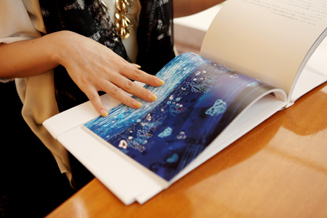
No matter how much I created, I couldn't quite catch up to Miyazawa Kenji's world. However, my technique of sewing on photographs really suited this work this time.
By adding the warmth of thread to the smooth, sleek photographs, I believe it creates a sense of warmth that cannot be expressed through ordinary visuals. I feel that this subtle warmth is akin to the world of Miyazawa Kenji that I want to express.
I think Miyazawa Kenji is very skilled at blurring the lines between reality and fantasy, or between intense calmness and passionate emotion.
It's good that he somewhat confuses the reader, grabs their heart, and then leaves it up to them to interpret what he was ultimately trying to say (laughs). The ending isn't pushy; it feels like it's saying, "Think about life by looking at this!"
And then he passed away without even finishing this work, which is just too cool (laughs).

—Towards the latter half of the interview
Asami Kiyokawa
http://www.asamikiyokawa.com
Born in Awaji Island in 1979. Since 2001, she has continuously presented a wide range of works across genres, including art pieces using various threads and fabrics, costumes, spaces, and illustrations. In recent years, she has also worked as an art director on numerous projects, such as Kimura Kaela's CD jackets and the PARCO "PARCO SWIM DRESS" summer swimwear campaign artwork. Starting this year, she is responsible for the cover artwork of the magazine "Subaru," and has also presented works in collaboration with Naoko Yamazaki, Yo Hitoto, and Miminashi Hachigashi. Her "complex" series, which expresses women's complexes through elaborate embroidery, uses an innovative technique of directly embroidering onto printed photographs. She has achieved further remarkable leaps as an artist, with exhibitions of this series held this summer at the Mito Art Museum and the Tokyo Garden Art Museum. Her major publications include the art collections "futo" (Madra Publishing), "Bijyo Saishu" (INFAS), and "caico" (Kyuryudo), as well as the picture books "The Happy Prince" and "The Little Mermaid" (both published by our company).
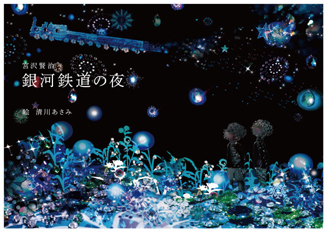
3rd installment in the picture book series
"Night on the Galactic Railroad"
Original Work | Kenji Miyazawa
Illustrations | Asami Kiyokawa
Price | ¥1,800
Publisher | Little More