ART | Sabine Pigalle Photography Exhibition "TIMEQUAKES"
ART | The Accumulation of Time, Evoked Through Court Portraits, Contemporary Photography, and Tokyo Landscapes
Sabine Pigalle's "TIMEQUAKES" Exhibition
The exhibition "TIMEQUAKES" by Paris-based photographer Sabine Pigalle will be held from Friday, January 17th to Sunday, February 9th, at Chanel Nexus Hall in Ginza, Chuo-ku. Works that seem to compress centuries of time, created by combining court portraits, contemporary portrait photography, and abstract photographs of Tokyo, will be publicly exhibited in Japan for the first time.
Text by YANAKA Tomomi
Works Born from the Great East Japan Earthquake Exhibited Publicly in Japan for the First Time
Sabine Pigalle was born in Paris in 1963. After graduating from university, she entered the world of fashion photography but later shifted to conceptual photography. She has garnered attention for her works that intersect various elements, including "DUTCH LAST SUPPER" (2012), which reimagined Leonardo da Vinci's "The Last Supper" with women and created an eccentric encounter with Flemish art.
The exhibition title "TIMEQUAKES" means "tremors of time" in Japanese. She states, "My work was born from my experiences related to the Great East Japan Earthquake. As an outlet for that experience, I transformed the chaos of material destruction into temporal shock."
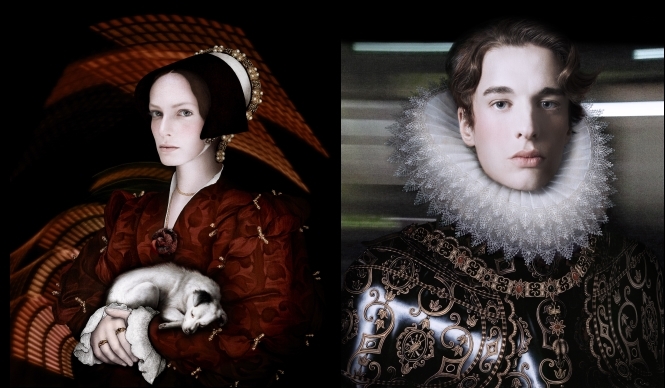
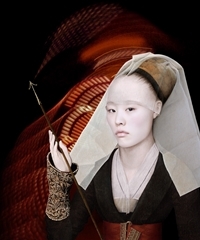
Thus, shocked and disoriented by the earthquake, Pigalle combined 15th to 17th-century court portraits with contemporary portrait photography. Furthermore, she expresses the accumulation of eras through a unique approach, integrating abstract photographs of Tokyo taken during several visits to Japan. By layering photographs from different periods onto the works of masters like Raphael and Leonardo da Vinci, she achieved a compression of time.

This series, which Pigalle herself describes as "votive paintings created by mixing contemporary portrait photography with portraits of 15th-16th century humanists and courtiers," bridges portraiture and abstract art, as well as past and present artistic traditions. By presenting disparate layers like a collage, the works achieve a sense of timelessness and resonate with us with a peculiar sense of familiarity.
Sabine Pigalle's "TIMEQUAKES" Exhibition
Dates: Friday, January 17th – Sunday, February 9th
Hours: 12:00 PM – 8:00 PM
Venue: Chanel Nexus Hall
4F Chanel Ginza Building, 3-5-3 Ginza, Chuo-ku, Tokyo
Tel. 03-3779-4001
Admission: Free