INTERVIEW│Artist Tatsuo Nishino Interview
INTERVIEW|Tatsu Nishi
The World is Captivated! Inside Tatsu Nishi's Bold Imagination (Part 1)
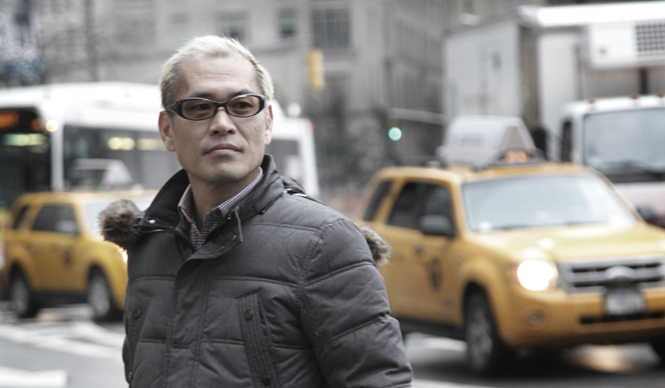
Last autumn, a large-scale installation appeared around Columbus Circle in New York. Titled “Discovering Columbus,” the work completely enveloped the towering statue of Columbus, transforming the space into a “living room.” The total number of visitors during its approximately two-and-a-half-month exhibition period, starting in late September 2012, was an astonishing 100,000. The artist behind this much-talked-about piece is Tatsu Nishi. What lies at the source of his inspiration?—.
Text by KUROBE EriPhotographs by MOCHIZUKI Michika
I Wanted to Break Out of the Narrow Art Scene
“I wanted to break the coolness of the audience. When you go to a museum, don’t the visitors all seem so cool? It’s boring. I wanted to move the audience,”
says Nishi, who is currently based in Germany and undertakes various art projects worldwide. His works, such as “The Merlion Hotel” in Singapore or “Chéri in the sky” created on the rooftop of Maison Hermès in Ginza, consistently offer fresh surprises to viewers.
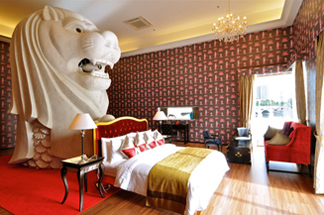
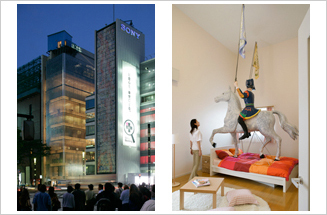
(Right) “Chéri in the sky” 2006 Chéri in the sky (The Pyrotechnician, Atelier Gilod-Ezzoubir), Exhibition at Maison Hermès 8F Le Forum Tokyo, Japan © Nacása & Partners Inc., Courtesy of Hermès Japon
He moved to Germany in 1987. After graduating from Musashino Art University, he found himself at a dead end, unable to create for about a year. He then decided to go abroad. He didn’t initially intend to study abroad; he applied for a job washing dishes at a sushi restaurant as a means to see the heart of European art firsthand.
This was Nishi’s first trip overseas. Coincidentally, it was Düsseldorf, a historically significant location in contemporary art, and he discovered it housed a world-renowned art school where artists like Joseph Beuys taught. This reignited his creative drive. He enrolled in the art academy in Münster and began working with sculpture and installations, which he hadn’t pursued before. It was also a time when installations were gaining momentum in Germany, which he found refreshing.
During this period, he also participated in group exhibitions at galleries, but he looks back on them as “boring.” “Many people came to the opening, but few visited afterward, and they were all from the art world. I didn’t want to operate within such a confined art scene; I wanted to break out,”
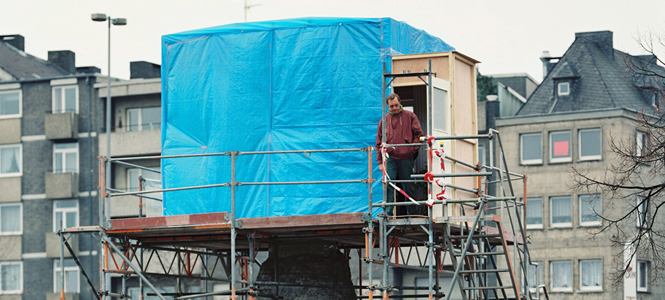
“obdach” Tatzu Niscino obdach, 1997, Cologne, Germany, Photo by Carsten Gliese
He then gathered about one million yen from various people and, in 1997, attempted his first installation in his signature style: “obdach,” which involved “enclosing a stone monument outdoors.” “I built a small, four-and-a-half-mat room myself using plywood.”
Due to the cost of renting scaffolding, the exhibition lasted only about three days. However, his approach of engaging with the city began to attract attention, piquing the interest of curators and leading to larger projects.
INTERVIEW|Tatsu Nishi
The World is Captivated! Inside Tatsu Nishi's Bold Imagination (Part 2)
Art That Engages the City, Possible Only Abroad
“Looking back now, I realize I could only undertake this kind of art because I was in Germany. For installations like mine, I first need to obtain permits from the authorities. While German urban regulations are strict, they are tolerant towards art. They appreciate contemporary art and make exceptions for it. In Japan, art often faces more inflexibility, or rather, outright rejection. If I had stayed in Japan, I could never have started these installations.”
While breaking away from Japanese soil was the right move to become the “global Tatsu Nishi,” he still harbors a sense of regret about the lack of governmental interest in art in Japan.
“The total cost for ‘Discovering Columbus’ was around 200 million yen, and it was organized by the Public Art Fund, a non-profit organization. It was entirely funded by donations. It’s incredible how many wealthy individuals in New York, led by Mayor Bloomberg, donate generously to the arts.”
“Discovering Columbus,” which completely enveloped the statue of Columbus, was an idea that struck him while walking through Manhattan. The statue stands quite high, so unless one looks up intently, it’s barely noticeable.
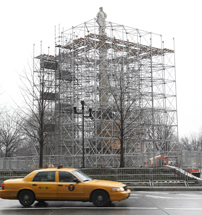
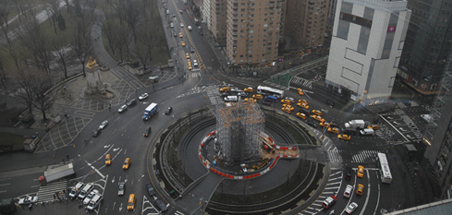
This installation allowed New Yorkers to see the Columbus statue up close for the first time. Seeing it in person reveals its immense scale and offers a new perspective on a familiar monument. The surprise and intrigue generated by the work drew such large crowds that entry had to be restricted, precisely as Nishi intended. “One of the main reasons for presenting work outdoors is to engage people who are not typically interested in art,”
While much of contemporary conceptual art has become detached from the general public, Tatsu Nishi’s art possesses a certain quality that sparks interest even in those unaccustomed to art, making them aware of art’s power to challenge conventional perceptions. Where did such bold, unconventional ideas originate in this Japanese artist?
INTERVIEW|Tatsu Nishi
The World is Captivated! Inside Tatsu Nishi's Bold Imagination (Part 3)
A Childhood Where Imitation Was Impossible
“I was a child who disliked imitating others. When we were made to walk in line, I’d often end up walking in the opposite direction and get yelled at by the teacher. I wasn’t particularly rebellious or a troublemaker. I studied diligently. But I just couldn’t understand why everyone had to do the same thing at the same time, just as the teacher said.”
Young Nishi disliked piano, calligraphy, and all other lessons, but he voluntarily attended art classes. He went on to Musashino Art University, where he became engrossed in Donald Judd’s minimalist art, leading him to an impasse.
“When you get deeply into minimalist art, it becomes difficult to develop your work further. If you take it to its extreme, minimalism leads to doing nothing.”
As mentioned earlier, this led him to go abroad. Surprisingly, he analyzes that a connection to minimalism still underlies his current work.
“What I create is minimalist. When I build a room, I envision an average room in that country. It’s only necessary to alter the context of the monument in the city, so it’s better if people don’t pay too much attention to the furniture or interior design. I don’t alter the monument itself. In other words, it’s a minimalist interior. And the fact that the room is a box connects it to Donald Judd, doesn’t it?”
The concept behind these monument-based installations involves the “reversal of outdoor and indoor / exterior and interior,” and the “reversal of public and private.” This inversion creates an alienation effect. Furthermore, because they are in public spaces, they are characteristically dismantled after a limited period.
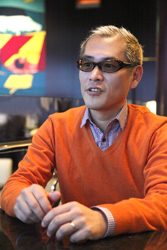
“People often ask, ‘Aren’t you sad when they’re dismantled?’ But they’re good because they disappear. I say my art offers a double pleasure.”
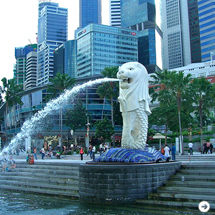
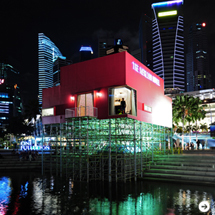
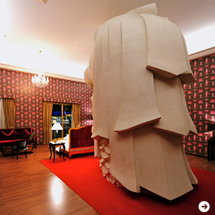
The first pleasure is experiencing Tatsu Nishi’s installation firsthand. However, it is not a permanent work.
“When it’s dismantled, the memory of having been there, of having experienced it, remains – something that can never be replicated. With the Columbus statue, too, there’s probably no other chance to see it up close like that. It might happen again in 100 years, but who knows? And there probably won’t be any other artist doing something like this (laughs).”
Its beauty lies in its ephemerality. This seems to reflect the Japanese aesthetic sensibility, which finds beauty in the transient nature of things like falling cherry blossoms, a sensibility that flows through him.
INTERVIEW|Tatsu Nishi
The World is Captivated! Inside Tatsu Nishi's Bold Imagination (Part 4)
An Artist Creates What No One Has Seen Before
This year alone, about six projects are in progress, but only about half are likely to materialize. This is because some are technically unfeasible, while others may conflict with urban regulations.
Even “Discovering Columbus” in New York took three years from the project's inception, highlighting the long-term nature of urban installation projects.
“I do the production with just a computer,” says Nishi. “I travel the world to see the sites, but I spend most of my time sketching ideas and communicating via email with curators and architects in the respective countries.”
Will his next project also be an installation surrounding a monument? “No, it’s planned to be something completely unseen before. I’ve been building rooms for the past year, so I want to try something different this year.”
Nishi finds the most exciting part of his art projects to be the process of walking through a city, contemplating what to do and how to do it. He enjoys the moment when ideas spring forth from walking through a place with a completely open, unburdened mind.
When asked what art means to him, Nishi replies, “Perhaps freedom.” “An artist is someone who does what others haven’t done. Even if it’s not well-received, something that isn’t imitation has artistic value. There’s value in what no one has seen before.”
When we encounter Tatsu Nishi’s art, our everyday assumptions are overturned, we are surprised by the elaborate mechanisms, and we feel a subtle sense of humor. Nishi, who believes that “value lies in what has never been seen before,” makes us wonder how he will surprise the world next.
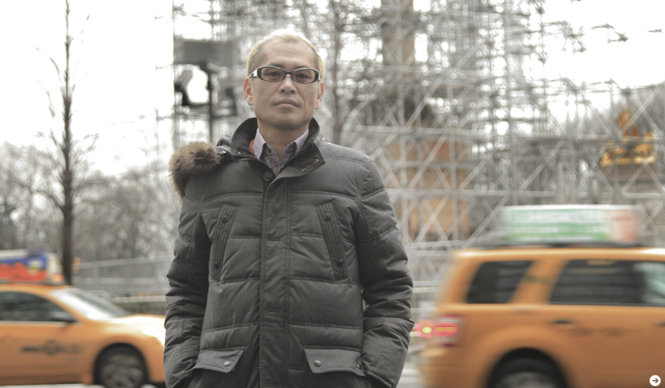
Tatsu Nishi
Born in Aichi Prefecture in 1960. After studying at Musashino Art University, he moved to Germany in 1987. He studied at the Kunstakademie Münster and in 1997 created the installation “obdach” in Cologne, which enclosed a monument. Based in Germany, he has been involved in projects in various countries, including the Museum of Contemporary Art, Los Angeles in 2005, the “Calder Project” (Australia) in 2009, and the “Nantes Biennale” (France). His installation turning the Merlion into a hotel at the Singapore Biennale in 2011 garnered significant attention. Following domestic presentations such as “Chéri in the sky” at Ginza Maison Hermès in 2006 and the “Aichi Triennale” in 2010, his 2012 “Discovering Columbus” in New York attracted a large audience.