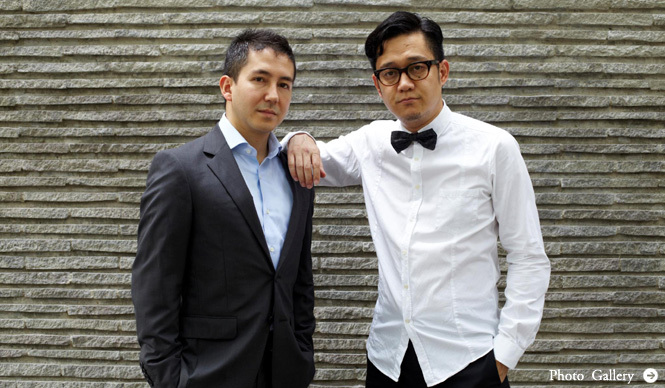
ART | An Interview with Tomohiro Harada, Representative of TOKYO PHOTO: The Potential of Art Photography
ART | TOKYO PHOTO 2012
An Interview with Tomohiro Harada, Representative of TOKYO PHOTO
The Potential of Photography as Art
It has been five and a half years since TOKYO PHOTO was founded. Now in its fourth iteration, the exhibition has steadily grown. TOKYO PHOTO was launched with the desire to make photographic art more accessible and integrated into our daily lives. We spoke with Tomohiro Harada, the representative of TOKYO PHOTO, about the origins of the project, his approach to the exhibition, the richness of a life with art, and his future aspirations.
Interview & Text by MATSUDA Natsuki (OPENERS)
Art is to be Enjoyed Holistically
—What prompted you to turn photography as art into a business?
HaradaTOKYO PHOTO was established in 2009. The impetus came when Paris Photo, the world's largest exhibition held annually in November, featured Japanese photography in 2008. Many galleries from Japan exhibited, and Japanese photography had been gaining significant attention, particularly from Europe and America. While this was gratifying, I questioned why this content, which garnered global attention, was primarily driven by Western initiatives.
Then, in 2007, the Japanese edition of the Michelin Guide was released. Its launch in Japan generated considerable buzz. What struck me then was that people from France had suddenly made these decisions. While it ultimately proved to be a positive development, Western influence is incredibly strong in Asia. I was particularly concerned by Japan's tendency to simply conform to this.
This led me to believe that we needed to create a system for Japanese photography, and for disseminating it from Japan.
Despite having artists, galleries, and an environment capable of gaining international recognition, Japan lacked agency. I felt compelled to establish a system for promotion and dissemination.
Coincidentally, these events—the Michelin Guide and Paris Photo—occurred around the same time they featured Japan. Over the following year and a half leading up to the first event, I, with no prior experience but a deep passion for photography, aimed to merge business with artistic potential, and thus "TOKYO PHOTO" was born.
—What are your criteria for selecting galleries and artists?
HaradaIt's difficult to definitively say what is 'the best' in the world. The major international art fairs—the Art Basel Fair in Switzerland and the Frieze Art Fair in London—are undoubtedly the most dynamic, authoritative, prestigious, and historically significant. Participating in these fairs presents a very high hurdle; it's incredibly challenging. You first need a track record of operating as an art gallery for three to five years. This means you must be recognized by others to be eligible. In other words, galleries exhibiting at Art Basel and Frieze are those whose global standing is firmly established. For Art Basel, for instance, only about five galleries from Japan can exhibit. Across all of Asia, there are only six or seven. This makes participation as difficult as qualifying for the Olympics. Our primary focus is to showcase interesting works from galleries that exhibit at Art Basel, Frieze, and Paris Photo here in Tokyo. The fact that a gallery exhibits at a major fair signifies its quality, and conversely, the fair itself is of high caliber. This is common knowledge among galleries, collectors, and artists alike. Consequently, those who exhibit naturally become selective.
For example, why is Gagosian Gallery, exhibiting in Japan for the first time, considered the world's best? It's because their works, artists, and clientele are exceptional. They also exhibit at major international art fairs. Furthermore, they operate art galleries in eleven locations worldwide. This is no small feat.
To sustain a gallery for three years implies the presence of excellent artists and a market for their work. Without this, operating an art gallery is exceedingly difficult. It cannot be sustained as a volunteer effort. It thrives on external validation and exposure supported by the market, which in turn leads to recognition. It is a remarkably challenging field.
However, from a business perspective, it is challenging. Naturally, the environment in Japan is less developed compared to Europe and America, and photographs do not sell well.
Nevertheless, I wanted to deeply instill a culture that provides enrichment for the mind and soul through art, brings vibrancy to life, and possesses enduring value. In essence, it's about fostering a 'culture of collecting' that allows for a lifelong relationship.
(Insert A-03.jpg)
Humans accumulate knowledge and culture within themselves; similarly, food is consumed, becomes blood and bone, and builds the body. Artworks, however, endure even after we are gone. Things that fundamentally do not cease to exist are rare in this world. Sadly, even favorite clothes and shoes wear out after five or ten years; our bodies change, and despite diligent maintenance, they inevitably deteriorate.
—What do you mean by the 'culture of collecting'?
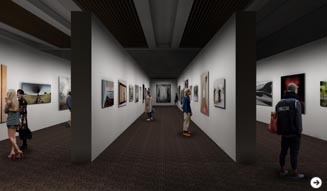
(Image of the 2012 venue)
HaradaThis medium contains an immense amount of information. Photo books, museums, and photography itself are art forms adjacent to our daily lives. I hope that people of a certain age will incorporate art into their lives as a lifelong pursuit. Studying art, visiting international photography exhibitions—these are all valuable. Even simply finding something cool, while not the entirety of appreciation, is a valid way to engage. With artworks, as with photography, the frame is crucial. A frame is not mere decoration; it is about quality. The choice of wood used to present the photograph, and its enclosure behind glass—these elements resonate with the appreciation of jewels and modern architecture. As Le Corbusier suggested, glass and steel define modern architecture, and photography shares a profound connection with this.
When collecting, the first thing I always consider is what will remain after I am gone. Artworks are never discarded. They are also not consumed. In essence, if a piece is well-preserved on the wall, even ten years after purchase, while there may be a psychological sense of consumption, the physical object does not wear down.
—What is the joy of acquiring a piece of art?
HaradaPaul Smith once held a personal collection exhibition in Aoyama. He mentioned that the very first item he purchased was a poster. My own journey began similarly in college, buying posters for around 10,000 yen to decorate my home, so I deeply resonated with his experience. As time passed and I began my career, I started acquiring slightly more refined pieces, such as vintage posters.
It starts with posters. As one grows, their circle expands to include more artists, and as success comes, one might purchase works at auction... Gradually, over perhaps fifty years, one builds a collection. I believe this is how it unfolds.
At "TOKYO PHOTO," with the exception of special exhibits, all pieces are available for purchase, with about 70-80% of the displayed works being acquirable. You can buy and take them home on the spot. The galleries exhibiting here have generally been vetted and recognized in the global market, so you'll be overwhelmed by the sheer quality of the works.
—What are the highlights of "TOKYO PHOTO"?
Among the world's leading art fairs, "TOKYO PHOTO" aims to be an "incredibly cool event." We strive to provide the ultimate stage for photography and invite everyone to experience it. This event is guaranteed to be thoroughly enjoyed by the OPENERS generation, especially those who appreciate cars, watches, and fashion.
However, if no one purchases anything at events like this, international art galleries will cease to participate, and the scene will not flourish. The market only becomes viable when there are buyers. While it is a significant purchase, works by photographers active on the global stage become a source of personal pride. There's no need to sacrifice anything to buy them, nor is there a need to hold back. If you find something you desire, consider purchasing it. Maintenance costs are minimal. If there's a piece that captures your interest, I encourage you to take this opportunity to acquire it.
I sincerely hope you will visit the venue and discover the potential of photography as art, and the exciting, adult pastime of purchasing based on your own values and aesthetic judgment. I eagerly anticipate meeting you all.
Tomohiro Harada
Representative of TOKYO PHOTO
Graduated from the University of Illinois Urbana-Champaign. During his ten years in the United States, he worked at companies including Arthur Andersen. Upon returning to Japan, he worked at Oracle Japan before founding "TOKYO PHOTO" in September 2009 as the first art fair dedicated to photography in Japan. As contemporary Japanese photography gains increasing recognition at international art fairs, he aims to establish a new, internationally competitive market in Japan comparable to those in Paris and New York. He is actively working to foster a "culture of collecting" in Japan, a country with a deeply rooted culture of photography.
TOKYO PHOTO 2012
Dates | September 28 (Fri) - October 1 (Mon)
Hours | 11:00 - 19:00 (Last admission 30 minutes before closing)
Venue | Tokyo Midtown Hall
9-7-1 Akasaka, Minato-ku, Tokyo
Admission | General ¥1,500, Students ¥1,300, Advance ¥1,200
http://www.tokyophoto.org