Jean-Michel Othoniel's Exhibition 'My Way' Comes to Japan
The Past and Future of a Leading French Contemporary Artist
Jean Michel Othoniel: My Way
The exhibition "Jean Michel Othoniel: My Way," which achieved record-breaking success in Paris, drawing 200,000 visitors over three months, is now coming to Japan. The exhibition, held at the Hara Museum ARC in Shinagawa from January 7 to March 11, 2012, will also feature a more extensive children's workshop, "Mysterious Reality," than the one held in Paris. OPENERS had the opportunity to interview Mr. Othoniel during his visit to Japan!
Interviewer & Text: SUZUKI Fumihiko (OPENERS)Photo: JAMANDFIX
A Meeting of a Leading French Artist and an Architectural Gem from Early Showa
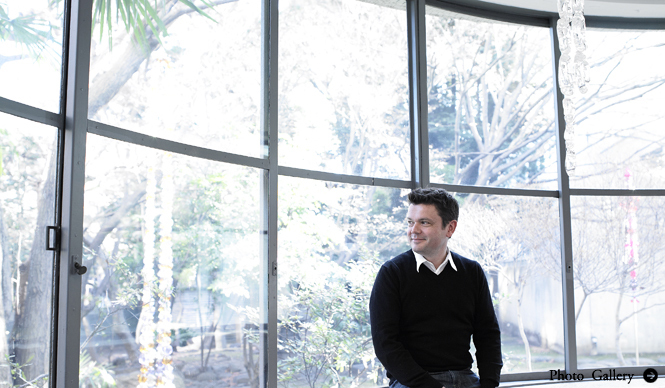
The Hara Museum in Shinagawa, originally a private residence built in 1938, has been operating as a museum since 1979. Nestled amidst a neighborhood of closely packed houses, this elegant Western-style building, with its spacious garden, was serene and bathed in gentle sunlight, like a world apart. There, as if mirroring the sunlight, stood a calm and warm French artist, who had lovingly arranged his works. Jean Michel Othoniel, a leading contemporary French artist known for his work "Kiosk of the Sleepwalkers" adorning the entrance of the "Palais Royal" metro station in Paris, and the outdoor installation "kokoro" at the Hara Museum ARC in Gunma, has reconfigured his Paris exhibition for the Hara Museum.
A Turning Point Arrived with the Use of Glass
──This exhibition is titled "My Way." Does it signify a look back at your career?
Yes. This exhibition covers over 20 years of my work. It's like a comprehensive overview of my journey so far. I've divided the space by periods that were significant for me, allowing visitors to experience them as they walk through. I hope to express my life, or perhaps my way of thinking, through this.
This room (Gallery II) marks a significant transition. It's when I began working with glass. Before that, I used materials like sulfur, steel, lead, and fabric for embroidery. These are soft, mutable materials. When I encountered glass, which transforms from liquid to solid, I felt it was the best material for expressing change. The black glass work hanging on this wall is my first piece made of glass. It's a very important work for me. I spent two years at the French Glass Institute, studying how to use volcanic glass as a material.
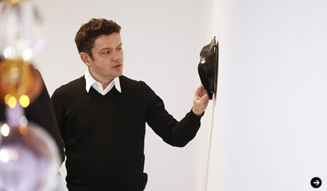
My first glass work, "Le Contrepet," 1992
ⒸJean-Michel Othoniel/Adagp, Paris 2012
──Was this glass black from the beginning?
Yes. It was black and opaque. That was my first challenge. Through creating this, I discovered the world of glass craftsmanship. I felt a potential there, a sense that glass could be used as a sculptural medium.
──Did you create this piece alone, Mr. Othoniel?
I designed the mold. That was a turning point. Until I made this piece, I worked entirely alone. I'd lock myself in the studio, kneading sulfur, completely by myself. But glass works cannot be made alone. It requires teamwork. There are glass artisans, glassblowers, and many others involved.
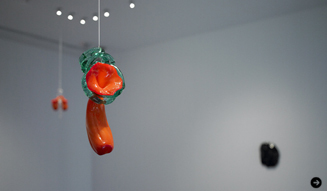
Untitled, 1997
ⒸJean-Michel Othoniel/Adagp, Paris 2012
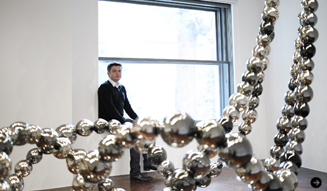
Le Grand Noeud Autoporté, 2011
ⒸJean-Michel Othoniel/Adagp, Paris 2012
And so, I started creating smaller glass pieces—like those hanging over there. They're small, aren't they? They feel very personal. Almost like erotic fruits. My early glass works were like this. I was quite introverted back then. But gradually, I became more confident, and my works grew larger. The last piece from that period is "Le Grand Noeud Autoporté," which is almost architectural in scale. So, this room represents my transition from a reclusive, introverted self to a more open one.
──How many people are on your team?
I conceive the ideas in Paris, with a team of four, including myself. Then, the craftsmanship itself involves a team of 30 to 40 people for large projects. These artisans are from Murano, an island in Venice. The glass made by Murano artisans is superb in color and of the highest quality. Look at the work outside the window. Isn't it magnificent? The weather is beautiful today. It's wonderful.
──Do the irregularly shaped glass rings also have molds?
No, no, those are handmade. The beauty of glass lies in its imperfections, its refusal to conform to strict rules. The process of creating them is quite complex by today's standards. Normally, glass is a material that takes precise shapes. Therefore, giving it organic forms is challenging.
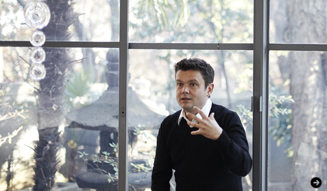
──Is that the charm of glass for you, Mr. Othoniel?
Hmm. It's not entirely that, but I am also very drawn to the technical aspects. Of course, I want to give form to my ideas, create large-scale works, exhibit them to the public, and captivate everyone. That desire is there, but the act of making things is also fascinating. I also draw a lot of inspiration from the artisans.
The Past and Future of a Leading French Contemporary Artist
Jean Michel Othoniel: My Way
The Exhibition as a Single, Grand Artwork
──This one feels a bit different, doesn't it? Like a goldfish bowl...
Haha. I made this when I was in Mexico. I traveled to various countries for several years. In Mexico, in particular, I worked with local glass artisans. They were artisans who created very small and delicate glass pieces, and seeing their work inspired me to create large installations using many of these small elements. The scale of the work is important. This piece, perhaps a microcosm, contains an inner world within the vessel. The exhibition itself is similar; we are within a grand artwork, the exhibition as a whole, as we move from one piece to another. The interplay between small and large scales is crucial.
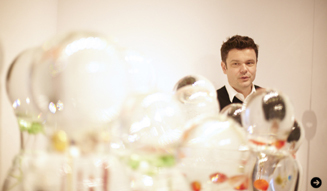
Lagrimas, 2002
ⒸJean-Michel Othoniel/Adagp, Paris 2012
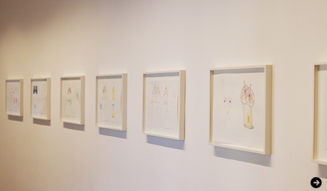
Drawing for "Le Kiosque des Noctambules," 2000
ⒸJean-Michel Othoniel/Adagp, Paris 2012
In Front of a Watercolor Sketch
My work still begins in solitude. It starts with a sketch. I always carry a sketchbook and draw. Of course, not every drawing becomes a piece, but no work is created without drawing. What you see here are sketches made for "Le Kiosque des Noctambules," which adorns the Paris Metro entrance. After sketching, I collaborate with engineers and construction professionals. We simulate in 3D, and then involve the glass artisans. The sketch is the very first step in that process. For the children's workshop, "Mysterious Reality," I wanted children to feel that after drawing, the next step is the three-dimensional world. That is, the work with engineers, the technical work that awaits them. On one hand, the transformation of a sketch into reality is like magic, a wonderful, ethereal process. On the other hand, there is the practical world of production. I want them to understand that behind the seemingly whimsical lies the work of engineers.
For the Metro project, I wanted to bring a festive atmosphere to Paris. Having a vibrant glass structure at the Metro entrance, emerging from the underground world... it perfectly captures the sentiment behind the exhibition title, "My Way." After all, the subway is dark, isn't it? It's a transition from darkness to light. There's an old European print I referenced that depicts day and night, where night symbolizes the dark Middle Ages of Europe, and day hints at the Renaissance. It signifies Europe's own journey from darkness to light.
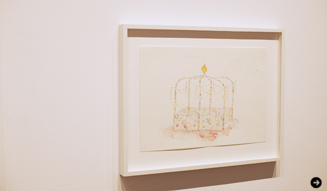
First sketch for "Le Kiosque des Noctambules" (2000)
ⒸJean-Michel Othoniel/Adagp, Paris 2012
This Metro entrance work is based on the same concept: the entrance to the Metro, the "mouth," so to speak. I wanted to emphasize the transition from a dark, narrow world to a bright, expansive one. My works are often based on such simple ideas. From darkness to light. And the entire exhibition follows the same principle. I, who used to create only small things alone, began working with a team, and my works are now placed outdoors—it's enjoyable. It has become joyful. Therefore, light and darkness are not separate entities but exist along a single path.
A Red Necklace Like a Wound
──This red necklace is displayed on the mezzanine, isn't it?
I've placed it separately from other works because it's quite unique. But it's an important piece for me. I once did a performance in Paris where I created 1,000 of these, naming them "Necklace of Scars." I distributed them at Paris "Gay Pride," an event for the gay community. Then, I photographed people wearing the necklace. I believe everyone carries scars within. This work is about transforming those scars into something more positive. After the performance, I felt my message had been conveyed. Since creating this, I've worn this necklace every day. It's a fashion statement, but it also allows me to wear my own work. So, this is a piece with a political dimension.
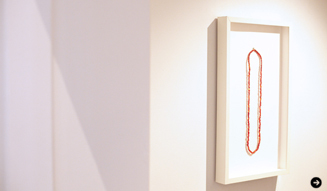
Le Collier-Cicatrice, 1997
ⒸJean-Michel Othoniel/Adagp, Paris 2012
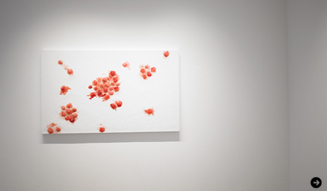
Tits Painting I, 1995
ⒸJean-Michel Othoniel/Adagp, Paris 2012
The Monstrous Quality Necessary for Beauty
──The works on the second floor are not primarily glass, are they?
Just before I started using glass, I had a strong desire to work collaboratively. I created "Glory Holes," a piece using perforated fabric, and exhibited it alongside a dancer's performance. Since the holes allowed one to see through to the other side, it created a dynamic where the artwork not only observed people but also people observed the artwork.
This "Tits Painting I" carries a similar sentiment. I want my works not only to attract viewers but also to push them back. To make them feel a sense of unease, even fear. I want the artwork to become stronger than me, to dominate me. That's how a work gains presence. Artworks are like traps; initially alluring, but once caught, you realize it's a trap and want to escape. This tension, this sense of unease—I believe that beautiful things require not just pleasantness, but also a monstrous, unsettling quality.
The Past and Future of a Leading French Contemporary Artist
Jean Michel Othoniel: My Way
A Diary of Happiness
──Are the works that resemble abacuses also older pieces?
These are more recent. The red glass spheres have an irregular shape, and like the necklace, they evoke a sense of wounds. However, the title is "Happiness Diary." Each combination of red spheres and rods represents a day. If it was a good day, you move a red sphere to the white side; if it was a bad day, to the black side. At the end of the year, you can see your entire year laid out.
──So there are 365 of them?
Yes, exactly. And then, next year, you start over. I tried it myself, and it was a bit tedious. I tend to get very motivated suddenly, or feel very down (laughs). Don't you think most people are like that?
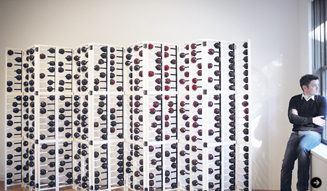
Diary of Happiness, 2008
ⒸJean-Michel Othoniel/Adagp, Paris 2012
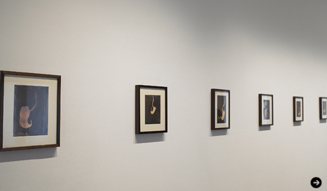
Femmes Intestines, 1995
ⒸJean-Michel Othoniel/Adagp, Paris 2012
Fragile Things. Things to Be Loved.
──The paintings on the second floor are not sketches, are they?
These are a series titled "Femmes Intestines." I paint over reproductions of classical paintings. In French, "intestins" also means "internal." So, this work can also mean "the woman within me." I created it by embracing and embodying the feminine aspects within me. I've used gentle, feminine elements, discarding the masculine aspects like aggression and imposition. In my work, embroidery and drawing are also feminine. Especially drawing, which has traditionally been considered a feminine activity. This series, with its fragility, is an attempt to affirm and clarify these feminine qualities.
──Glass is also a fragile material, isn't it?
Yes. That's why viewers and owners must cherish the artwork. It means pouring love into it. If cherished, an artwork can last for centuries. In Japan, for example, you have beautiful fans displayed in museums. When I see such objects, I feel, "This has been loved for generations. That's why it's here before me now." And I'm moved by that. Large, strong, and hard objects, like Notre Dame in Paris, are naturally durable. But when a fragile object from centuries ago has survived to this day, it means many people have loved it, cherished it. In that sense, glass is also a material that desires love. The final piece, though large like a building, requires careful handling.
Wonderful Reality
──The final piece is a ring-like work titled "Le Grand Double Noeud de Lacan." Lacan refers to the psychoanalyst?
Yes. Jacques Lacan, the psychoanalyst. This work represents the act of creation. According to Lacan, three celestial bodies, revolving without colliding, interact in the creation of things. This work symbolizes that. One is reality, one is symbol, and one is imagination. These three are also important in my creative process. It begins with imagination, followed by commentary, and the desire to be moved by reality.
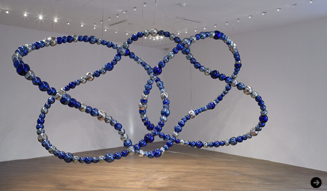
Le Grand Double Noeud de Lacan, 2011
ⒸJean-Michel Othoniel/Adagp, Paris 2012
I placed this work at the end because I wanted to see how Japanese people would react to it. I believe Japanese people have a strong sensitivity to appreciate reality, observing things like trees and flowers, but at the same time, they possess a powerful world of imagination. The reason I named the children's project "Mysterious Reality" is similar: I wanted children to understand that by observing reality and being moved by it, reality itself can become wonderful. I also wanted them to know that there is technology behind the artwork, and that touching the artwork is a positive experience. You can't touch artworks in a museum, can you?
──I experienced it earlier, and it's fun even for adults!
Of course! The Hara Museum exhibition is much larger in scale than the one in Paris, and I want everyone to enjoy it.
Jean Michel Othoniel: My Way
Hara Museum, 4-7-25 Kita-Shinagawa, Shinagawa-ku, Tokyo
Exhibition Dates | On display until Sunday, March 11, 2012
Opening Hours | 11:00 AM - 5:00 PM (Wednesdays until 8:00 PM. Last admission 30 minutes before closing.) Closed on Mondays.
Photography: ASAKO SUZUKI
Experience the Workshop "Mysterious Reality"
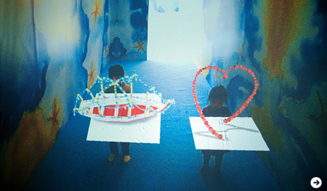
In the workshop "Mysterious Reality," visitors can enjoy Othoniel's works using AR (Augmented Reality) technology.
When you hold a panel with geometric patterns and stand before a large screen, Othoniel's artworks appear three-dimensionally above your panel on the screen!
By changing the orientation of the panel in your hands, you can move the artwork up, down, left, and right. This experience is enjoyable not only for children but for adults too!
There is also a coloring corner for Othoniel's works.
Co-organized by: Bonpoint Japon Co., Ltd.

Jean Michel OTHONIEL
Born in Saint-Étienne, France, in 1964. From the 1980s, he created works using variable materials such as sulfur, lead, and beeswax. He began using glass in 1993. His works are characterized by their decorative and sensual qualities, and he has held solo exhibitions at the Cartier Foundation for Contemporary Art, the Musée des Arts Décoratifs, and the Centre Pompidou. He has also participated in international exhibitions such as Documenta IX, the Gwangju Biennale, and the Istanbul Biennale.http://www.othoniel.fr/