HIROKO TAKAHASHI | #015 Hiroko Takahashi Exhibition “Patterns DOTS & STRIPES” (Part 2)
My patterns may be imbued with a Japanese sensibility.
♯015: The Hiroko Takahashi Exhibition “Patterns: DOTS & STRIPES” (Part 2)
The exhibition “Patterns: DOTS & STRIPES” is being held at SFT Gallery on the B1 floor of The National Art Center, Tokyo, until September 12 (Monday). For this exhibition, I created new patterns inspired by Japanese motifs. This is the second part.
Text byHiroko Takahashi
Patterns Born from Japanese Craftsmanship for the Japanese People
All the patterns I have presented in my previous works have been composed of circles (or arcs of circles) and straight lines, but they do not contain specific motifs or imagined landscapes. While prioritizing the maximum utilization of function and technique, I have created patterns that suit the size and material of the objects they adorn.
Patterns DOTS & STRIPES | New Pattern WAVE
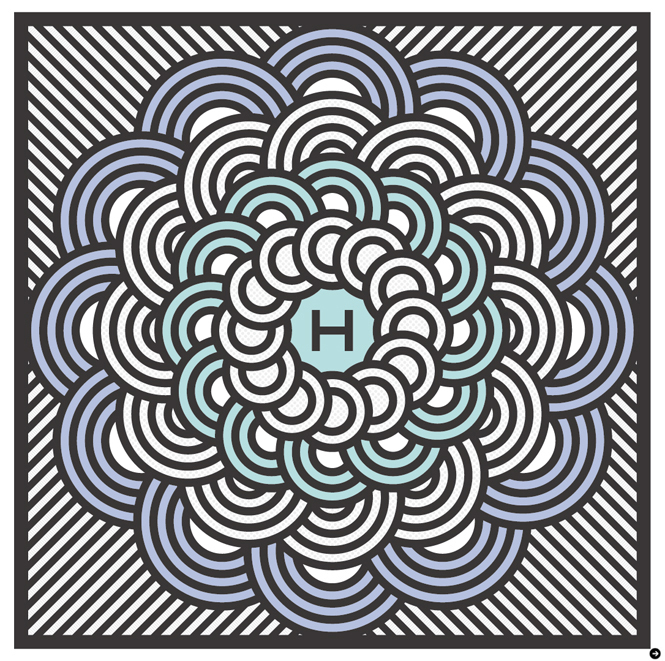
Unlike my previous work, this pattern, created for the current exhibition, is driven by an image. That image is traditional Japanese patterns, perhaps what are called 'Wagara'. Often, 'Wagara' brings to mind designs from the past, but I believe 'Wagara' refers to patterns born from Japanese craftsmanship for the Japanese people, regardless of whether they are old or new.
When created naturally, with an unforced state of mind, a sense of self—that is, a Japanese essence—should emerge. I have never consciously tried to be 'Japanese-style' or 'in a Japanese way,' yet I am often told that my patterns feel familiar, even though they are unfamiliar. This has led me to realize that my patterns may indeed be imbued with a Japanese sensibility.
Patterns DOTS & STRIPES | Original Pattern
Patterns DOTS & STRIPES | Image of Traditional Seigaiha
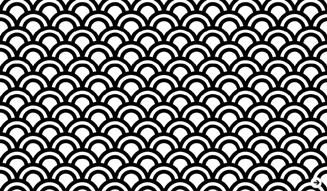
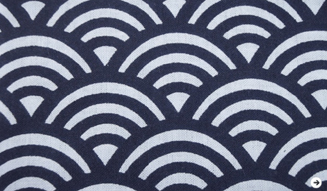
Once, a pattern I casually created by connecting circles bore a striking resemblance to the traditional motif 'Seigaiha,' which led me to realize that Seigaiha is a repetition of circles. Geometric shapes are also frequently used in Japanese patterns. Circles and straight lines are simple figures found everywhere in the world. Why do my patterns, composed of these circles and straight lines, evoke a sense of familiarity for Japanese people? For this exhibition's patterns, I deliberately aimed to evoke that sense of familiarity, composing them with overlapping circles, similar to the elements of 'Seigaiha.'
'Seigaiha' is a motif representing the calm, endless sea, symbolizing peace and prosperity, with the wish that a peaceful life continues eternally and happiness visits repeatedly, like the endlessly crashing waves. Japanese patterns each hold wonderful meanings, and I understand why they have been cherished. My desire is to protect the superb patterns inherited from our predecessors while evolving them, and further, to create new patterns and pass them on to the future. Through the patterns I create, I want to convey the potential and depth of Japanese craftsmanship.
TAKAHASHI HIROKO
http://www.takahashihiroko.com/