ART | Yokohama Triennale 2011 Report (Part 2)
OUR MAGIC HOUR —How Much Can the World Know?—
Yokohama Triennale 2011 Report (Part 2-1)
This is a report on the Yokohama Triennale 2011, an international contemporary art exhibition held every three years in Yokohama. Following the Yokohama Museum of Art in the first part, this second part introduces the latest contemporary artworks exhibited at the other main venue, the NYK Pier Warehouse (BankART Studio NYK).
Photos and text by Takashi Kato
An Expansive Exhibition Space to Savor the Essence of Contemporary Art
Yokohama Triennale 2011 NYK Pier Warehouse (BankART Studio NYK)
The NYK Pier Warehouse (BankART Studio NYK) showcased cutting-edge contemporary art from both East and West. Interactive works that invite visitors to step inside and experience the entire space, as well as monumental pieces reaching towards the ceiling, were luxuriously displayed within the historic waterfront warehouse. Among these, the video works gathered from around the world are particularly noteworthy at this venue. While video art can sometimes be overlooked in contemporary art exhibitions, here a collection of compelling works awaits those who take the time to immerse themselves.
“The Clock”: The Must-See Video Artwork
Among them, “The Clock,” a video artwork by Christian Marclay, a contemporary musician who also won the Golden Lion for lifetime achievement at the 54th Venice Biennale this year, is arguably the first piece to see at the Yokohama Triennale 2011. This 24-hour-long work, compiled from an immense number of film clips from past and present, links together images of clocks ticking, and is screened in sync with real time.
The story unfolding on screen, in real-time with the world, presents a continuous stream of scenes that evoke alternative ways of living, perhaps lives that could have been, or lives lived elsewhere. This work, which touches upon individual memories and the roots of collective imagination evoked by the imagery, can also be seen as a classical artwork akin to the popular spectacles of the modern era, existing through the act of “choosing” and the presence of someone to “watch.” Its recognition in Venice is understandable, as it is a cinematic epic.
A Real Object: A Mountain of Sand
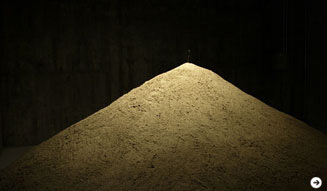
The contemporary art unit Mai Yamashita + Naoto Kobayashi presented a video projected onto a real mountain of sand. The video depicts the artist herself collecting iron sand on a beach. Beside it, a mountain of sand is topped with a single spoon, said to be made from the collected iron sand. This visualizes the process of the iron sand collection crystallizing into a video artwork and converging into a tangible object.
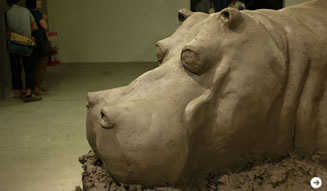
This work by the Paris-based artist unit Dewar & Gicquel features two colossal hippopotamuses sculpted from 20 tons of clay, hand-kneaded by the artists themselves. The sheer scale of these figures possesses a powerful, artistic presence.
A Contemporary Artwork Suggesting an Irreplaceable Symbiosis with Forests
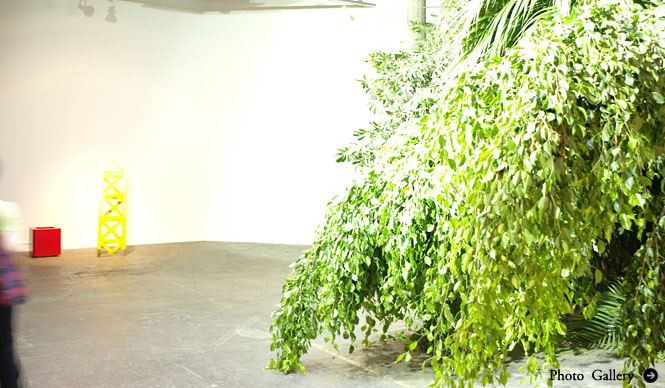
Within the high-ceilinged expanse of the former logistics warehouse, a forest-like space emerged. This conceptual artwork, with its striking contrast between concrete walls and lush trees, was created by Henrik Håkansson, a Swedish artist based in Berlin.
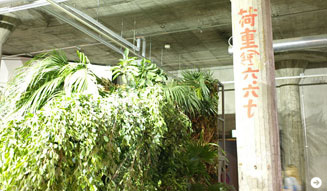
Both Sweden and Japan are nations blessed with abundant forest resources. Forests nurture rich lands and a profound connection to nature, regardless of geographical location, and have long served as an irreplaceable source of creativity for artists. In an era of escalating global deforestation, the symbiosis with forests is a pressing theme for countries worldwide grappling with urbanization. It is a crucial consideration for envisioning a healthy future. Håkansson's work quietly prompts us to recognize this.
OUR MAGIC HOUR —How Much Can the World Know?—
Yokohama Triennale 2011 Report (Part 2-2)
An Ethereal Work Inspired by the Dead Sea
Israeli artist Sigalit Landau presents “Salted Lamps,” a beautiful and poetic sculptural work where salt, harvested from the hypersaline Dead Sea, crystallizes onto barbed wire. The lamps themselves are striking, as are their silhouettes cast on the floor when illuminated.
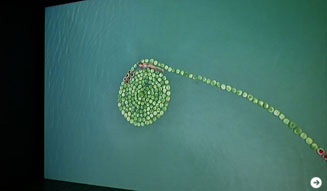
Landau's equally profound video work, titled “DeadSea,” features 500 watermelons arranged in a ring in the Dead Sea, with the artist floating among them. The image of the bound watermelons slowly unraveling, and the artist eventually breaking free to float in the water, evokes a sense of yearning for freedom amidst pain. Like “Salted Lamps,” these works carry a powerful message, imbuing the artist's creations with the healing power of nature.
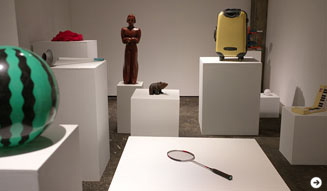
Japanese contemporary artist Taro Izumi created three spaces, each exhibiting objects and videos with distinct concepts. His method of highlighting mundane, everyday objects and presenting them as contemporary art offers a way to engage with others on an equal footing, a capacity that resides within us all.
A Work Metaphorically Representing a Pair of Chopsticks
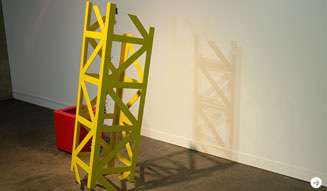
Song Dong and Yin Xiuzhen, a couple who have been exhibiting together since 2002, present “Chopsticks III.” This work is divided into twelve sections, using a pair of chopsticks—essential for eating—as a metaphor. Just as chopsticks cannot function alone, the yellow and red architectural structures, symbolizing their collaboration, are displayed in pairs.
The State of Art in the Post-3.11 Era
Additionally, the exhibition features a wealth of works that hint at a breakthrough for our current rigid society. These include video pieces that meticulously document reality, looking towards the post-3.11 era, and sculptures inspired by nature—wood, forests, and water. These artworks expand the existing perceptions of art and challenge fixed values, offering a glimpse of art's potential to foster new perspectives.
During the Yokohama Triennale 2011, concurrent events include the exhibition "Shin-Minato Village - A Small Future City (BankART Life III)" at the nearby Shinko Pier, where creators from Japan and abroad establish working spaces, and the "Koganecho Bazaar 2011" in the Koganecho area, known for its lively attractions. A special joint ticket offering access to all these events is also available.
Since the Lehman Shock, what was once taken for granted has become uncertain, and this sense of unease has been amplified by the events of March 11th. Artworks, while existing within our daily lives, offer a momentary escape from the ordinary. They serve not only as expressions of individual identity but also as bridges connecting hopes for the future and the small wishes of people around the world. Though each may seem small, the cumulative power of these individual elements allows us to feel the potential of art to foster greater possibilities.
Yokohama Triennale 2011
OUR MAGIC HOUR —How Much Can the World Know?—
Venues | Yokohama Museum of Art, NYK Pier Warehouse (BankART Studio NYK), and other surrounding areas
Dates | Ongoing – Sunday, November 6, 2011
Hours | 11:00–18:00 (Last admission at 17:30)
Closed | Thursdays in August and September, October 13 (Thu), October 27 (Thu)
http://118.151.165.140/