Akira Shimada: Life is Edit. #022 Berlin: A City of Dreams on a Shoestring
Akira Shimada | Life is Edit.
#022 Berlin: A City of Dreams Without the Riches
New “somethings” are woven and born through encounters with people.
New “somethings” are drawn and born through things.
An editor’s job is precisely to create such “encounters.”
And life itself is nothing less than editing.
──Editor Akira Shimada introduces the people, things, and events that have moved him.
This year, I wished to embark on many journeys and meet many people. What awaited me, following New York at the start of the year, was my first visit to Berlin, and Paris, where I frequented in my twenties. This time, I’ll share stories of the wonderful people I met there and the nostalgic cityscape.
Text by Akira Shimada
Stunned by Bauhaus Architecture!?
“You should go to Berlin.”
A well-traveled friend told me this, and not just one, but several.
Berlin has art, music, a sense of freedom, and vibrancy.
And my friends’ advice was spot on. It’s been a long time since I’ve been so exhilarated by a city’s pulse. And this exhilaration came even as the temperature plummeted to minus 13 degrees Celsius (laughs). I truly felt a warmth that blew away the cold in this city of Berlin.
What first captivated me was the Bauhaus architecture.
This visit to Berlin was at the invitation of Hugo Boss. What I wanted to create for “UOMO” magazine was something new born from the mix of Bauhaus and modern design, tradition and modernity. They kindly accommodated my earnest request, and in the freezing cold, I went on a Bauhaus architectural photo-hopping spree with Akemi Kurozaka, a photographer based in London.
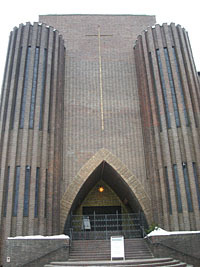
Unlike the churches in Japan, its stern appearance is distinctly German. If I were to hear solemn live music inside, I’d likely be deeply moved (laughs).
For some reason, Bauhaus really appeals to the male psyche. I was so captivated by the design that I felt like a child again, innocently shouting “Cool!” on the street. It’s understandable how the Nazis skillfully used this design to incite people, because it truly is cool.
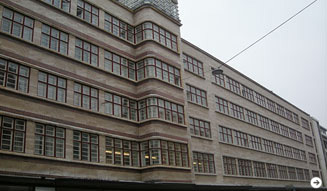
Inside the hotel, it was super clean white and peppermint green. The surprise stemming from this contrast is truly art.
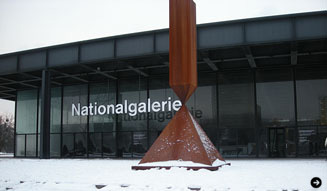
The National Gallery was unfortunately closed. But the ice-covered snow, modern architecture, and artworks were incredibly cool.
The hotel, Heute:Hotel Londengeschafte, built in 1928, had an exterior that completely evoked the Eastern Bloc! But stepping inside, it was super clean and modern, and I was captivated by the contrast. Later, a local told me that the corridors are excessively long, and corner rooms require carrying suitcases for a long time, so one should be cautious when booking (laughs).
The church, Hohenzollerdomm, built in 1933, had a massive, robust Bauhaus exterior resembling a power plant, but the entrance was perfectly staged with a solemn design that made me want to clasp my hands. It was a shame I couldn’t go inside, but the sound leaking from within suggested an orchestra practice, a magnificent live symphony. Amidst the light snowfall, it truly enhanced the intellectual German atmosphere.
Enick Hamann, a chocolate shop built in 1930, is a Bauhaus building that has been in continuous operation ever since. When I asked the shopkeeper about Bauhaus, they seemed to have no idea, responding with “What’s that?” (though it was clearly listed in Bauhaus guidebooks). However, their nonchalance and the sense of it being an extension of daily life were rather appealing.
There seem to be more Bauhaus buildings to see scattered throughout Berlin, but despite a short, two-hour architectural hop, I was so thrilled. Berlin, you are formidable!
Of course, modern architecture by the likes of Norman Foster was also present, and the juxtaposition of old and new was fascinating. Moreover, though their vectors differed, both designs harmonized seamlessly within the city. Such a cityscape is rarely seen in other countries.
Astonished Again by Mountains of Street Art!?
It seems many artists gather in Berlin from all over the world.
The reasons are, first, low rent and affordable prices. Locals said that one could manage to live on about 100,000 yen.
And second, because canvases are everywhere. In essence, the city walls and roads themselves become canvases. New York once had abundant wall art, but due to public regulations aimed at preserving aesthetics and preventing disorder, many street artists lost their platforms. Berlin still retains numerous walls and spaces where free expression is possible. This is one of the reasons why Berlin’s art scene is so vibrant.
Artists like Basquiat and Keith Haring once emerged from New York. However, I couldn’t help but feel during my stay that the potential for new artists to emerge is now higher from Berlin than from New York. It is undoubtedly an important city in the global art market (Gerhard Richter is here, too).
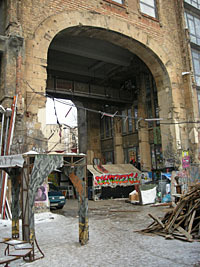
Galerie Tacheles felt like a place where anything goes. Inside the large, paint-covered building, there was a bar, and outdoor spaces for live performances. It would likely be bustling with people looking to chill out during the warmer months. But it was mid-winter, below freezing. Not a soul in sight (laughs).
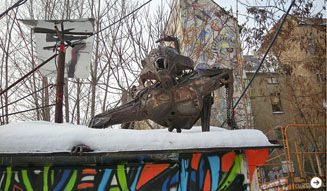
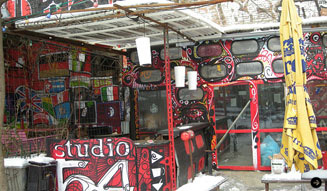
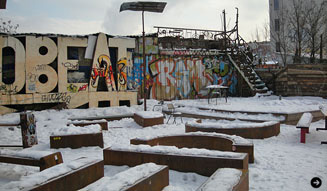
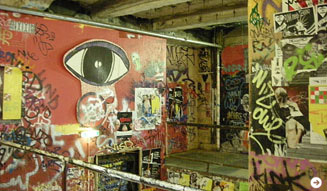
A prime example is a place called Galerie Tacheles. I heard that artists illegally occupied an old building (perhaps a former school?) and have continued to create their works there. Perhaps the city has given up? It has become a place where anything goes, and it’s now a notable tourist attraction in Berlin. Such a situation is only possible due to Berlin’s open-mindedness. It has such a deep capacity!
Encounters with the People Who Live Here: Yousuke
This trip, too, allowed me to meet wonderful people.
On the very day I arrived in Berlin, I had dinner with Mari Matsuyui, a friend of Kurozaka-chan who lives in Berlin and studies art (her uncle is actually Masataka Matsuyui). Wanting to know about the real Berlin, especially the lives of art students, we cut dinner short and made a surprise visit to Mari’s apartment, where she shares a room with friends (laughs). There, we were met by Elie, Mari’s roommate, who had come from New York and works as a DJ. With him joining us, we ended up having a discussion that lasted until morning, covering my simple questions like “Why did you come to Berlin now?” and topics of art and music (laughs).
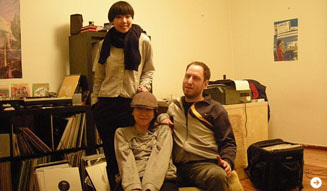
From right: Elie, Kurozaka-chan, and Mari. Elie, a DJ, provided a great soundtrack to help us chill out. Events are few during winter, so perhaps they are hibernating until spring?
Mari and Elie. Both agreed that Berlin’s unique sense of freedom is fantastic (especially in June!), making it an ideal place for creating art or anything new. Bars stay open as long as customers are there, trains run 24 hours, and it’s all very friendly and convenient. It’s also comfortably balanced between rural and urban, and the overall atmosphere of the city is pleasant.
And I could strongly feel their deep affection for Berlin. It’s surprisingly rare to find people who praise their own city so unreservedly. In that sense, I felt the preciousness of Berlin.
And then, I finally met someone I had wanted to meet for five years.
That person was Yousuke Nishioka.
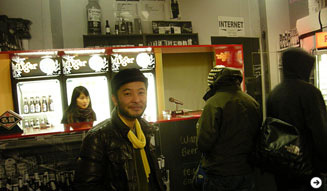
Yousuke-san smiles warmly. His kindness radiates from him. The event was a great success with many attendees. He served hot sake, proclaiming, “This is traditional Japanese hospitality!” (laughs).
Five years ago, there was a shop called ISSA in Brooklyn, New York. MASA, whom I met there and became friends with, told me something, and KEN, with whom I hung out in New York last year, told me something similar, coincidentally:──.
“There’s an interesting person in Berlin. I’m sure you and that person would hit it off, Shimada-san.”
That person was Yousuke-san.
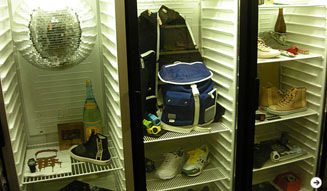
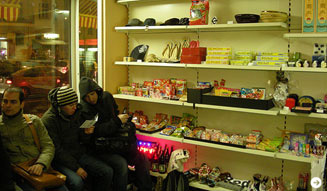
Yousuke-san, who organizes rave parties at the aforementioned abandoned gallery and advises Onitsuka Tiger Europe, was someone we went to meet at a shop in a rather edgy area, temporarily rented and renovated from an old tobacco shop for Berlin Fashion Week. It was a concept shop with a retro Japanese vibe (laughs), displaying Japanese snacks, Onitsuka shoes, Casio watches, and Japanese photo books, while serving hot sake over the counter. From our very first meeting, it was relaxed and fun, just like Yousuke-san himself (laughs), and I immediately understood what MASA-kun and KEN-kun had meant. My current theme is “Bohemian,” and Yousuke-san is exactly that kind of person.
Birds of a feather flock together.
Although I haven’t fully achieved freedom myself yet, I continue to be strongly drawn to the free spirit emanating from bohemian people and cities.
It’s something that connects across borders, races, genders, and generations.
I was able to feel that again in Berlin.
The Berlin Kurino-san Described
I was only in Berlin for a genuine three days, but I was so active, barely sleeping, and met so many people that my experience was incredibly rich. Even the locals were surprised, asking, “How did you manage to see so much in such a short time!” I truly savored Berlin.
Afterwards, I went to Paris for a collection, but the excitement from Berlin lingered. At the Dries Van Noten exhibition, I approached Hirofumi Kurino of United Arrows, who was in the midst of serious buying (my apologies, sweat!), and asked him about my Berlin experience. Kurino-san, who was also interested in Berlin’s energy, described the city in one sentence:
“Berlin is a city that feels like
it has no money but is full of dreams.”
Hearing that, I nodded deeply.
The anachronistic designs scattered throughout the city, the open-mindedness of the people, the dim, non-fluorescent lights of bars and cafes burning late into the night, and the sense of shared happiness among all the Japanese people I met who spoke of Berlin with smiles – all of this felt very comfortable to me.
No money, but full of dreams.
In a way, this felt like Japan’s Showa era.
During the Showa period, there were dreams and excitement.
As children, we felt that a bright future awaited us.
We can’t go back to those days, but in Berlin, I can feel the scent of that era.
I also heard a few years ago that the German film director Wim Wenders had said goodbye to America and returned to Germany.
As the taxi headed to the airport in the light snow, I looked up at the angel of the Siegessäule (Victory Column) and thought of Wim Wenders, the bohemian spirit who is surely still traveling, and I felt a little sentimental.