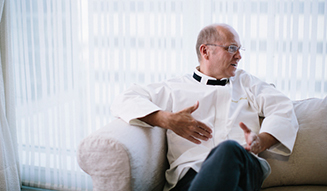
Secrets behind the Success | Series Vol. 10: Heinz Beck, Executive Chef of La Pergola
Behind the Scenes with Business Leaders
Part 10 | Heinz Beck (Head Chef, La Pergola)
The Gastronomy Titan's Dream for Japan (1)
What are the daily lives and thoughts of those who have achieved success in business? In the "Secrets behind the Success" series, we delve into the private lives of successful individuals, rarely seen by the public, through interviews.
La Pergola earned three Michelin stars in Michelin Italy 2006. The chef who achieved this remarkable feat, the first for a Roman restaurant in 29 years, is Heinz Beck. Since 2009, he has opened restaurants not only in Italy but also successively in London, Portugal, and Dubai. And finally,On November 7th, two restaurants with distinct concepts opened simultaneously in Tokyo.What is the "Beck World" envisioned by the chef who captivates the world with his artistic cuisine?
Photographs by JAMANDFIX
Text by NAGASHIMA Kyoko
Wanted to be a painter, not a chef!?
──First, could you tell us about your encounter with cooking?
Actually, I wanted to be a painter, not a chef. From childhood, I wanted to go to art university, but my father strongly opposed it, saying, "How will you make a living as a painter? Keep it as a hobby."
My father, who ran a jewelry business, wanted me to study economics and become his successor. After clashing with my father and struggling with the conflict, I decided I had to forge my own path and left home without going to university.
──When was that?
It was on August 1, 1980. Afterward, to support myself, I attended school while working four days a week at a restaurant. I jumped into restaurant work out of necessity, but the job was incredibly demanding, and days passed without any time to think about anything else. My family and relatives had no one who had ever worked in a restaurant, so it was an entirely new world. Looking back, it was a choice that determined my destiny, but I threw myself into the work with abandon, and before I knew it, here I am today.
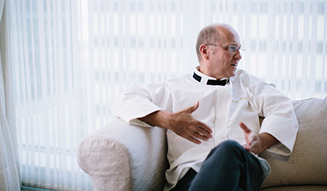
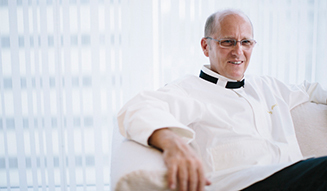
──Did you move from Germany to Italy when you were chosen as the chef for La Pergola?
Yes, it was in 1994, 14 years after I entered the culinary world. La Pergola, which opened in 1963, underwent a renovation and reopened in 1994 with the owner's intention to "renew everything." I was called from Germany at that time. Coincidentally, the year La Pergola was founded is the year I was born. I feel a fated connection.
──Why did you decide to move to Italy?
I had worked at various restaurants in Germany, and La Pergola had already offered me positions multiple times. Meanwhile, my father was also saying, "It's about time you seriously took over the family business." Although I had stumbled into restaurant work, I agonized over which path to choose.
In the end, I decided to take over my father's business. The reason I decided to go to Italy in the first place was to lay the groundwork for my future. Most of my father's clients were Italian, so I thought, "I'll work at La Pergola for two years, learn Italian, and then take over the family business. Going to Italy might be a good opportunity to find future business partners." Somehow, it turned into this (laughs).
──You've been actively expanding overseas since 2009. After the UK and Dubai, what led you to decide to open a restaurant in Japan?
I had visited Japan personally several times. Each time I came, I grew to love Japan and began to envision opening a restaurant here in the near future. Then, I received an offer from the Kato Pleasure Group.
──At La Pergola, you've been using ingredients like katsuobushi dashi in your dishes for some time. Have Japanese ingredients or cooking methods particularly inspired you?
It's not that Japanese ingredients are special; I've been using them for a long time as essential ingredients in my cooking, just like any other ingredient. For example, at my restaurant in Rome, I often use yuzu. However, since fresh yuzu is not always available, I use bottled juice. At the Dubai restaurant, we use fresh yuzu fruit. I also use mirin, soy sauce, wasabi, and kuzu. I often use kuzu in my sauces.
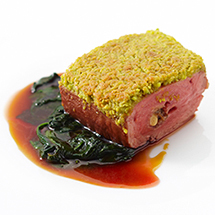
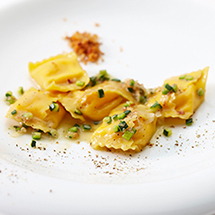
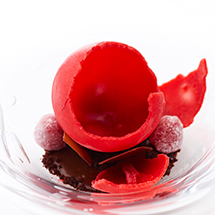
A selection of dishes created by Chef Beck. From left: "Veal Fillet Coated with Pistachio Crust, Stuffed with Onion and Dried Fruits," "Fagottelli Heinz Beck," and "Cold Spherification of Red Berries with Tea Cream and Crystallized Raspberry."
──Kuzu! Using kuzu in Italian cuisine is very intriguing.
I use kuzu in all my sauces instead of butter or cornstarch. Also, "Italian cuisine" is a broad term; there are many types of dishes. Traditional, regional, and creative cuisine. If I had to describe my cooking, I'd call it "distinctive Italian."
However, the same can be said for Japanese cuisine. When people outside Japan think of Japanese food, they often imagine "sushi and teppanyaki," but there are many dishes across Japan that foreigners living abroad may not know. For instance, kaiseki cuisine is wonderful. I want people in Japan to know that Italian cuisine is more than just pasta and pizza.
Behind the Scenes with Business Leaders
Part 10 | Heinz Beck (Head Chef, La Pergola)
The Gastronomy Titan's Dream for Japan (2)
Disciples Are My Future
──Could you tell us about the restaurants you are opening in Japan this time?
We are opening two restaurants with different concepts on two floors of the same building.
The upper floor (mezzanine) houses the fine dining restaurant "HEINZ BECK." Here, we will actively incorporate new techniques and cooking methods. For example, we will use centrifuges, freeze-dryers, and distillation machines. Through these, we will offer a light and innovative Italian cuisine.
The lower floor (first floor) is "sensi by Heinz Beck," an all-day dining establishment. While casual, we aim for a very high level of quality using the finest ingredients. It features an open kitchen, a bar counter, and offers smart food that can be enjoyed easily, including small plates. We hope you will enjoy this "little universe" of Heinz Beck.
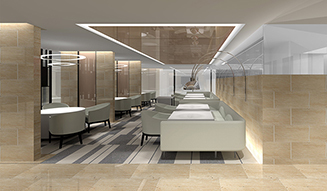
Fine dining restaurant "HEINZ BECK"
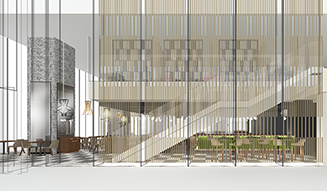
All-day dining restaurant "sensi by Heinz Beck"
──I imagine you are very busy, but how do you spend your days off, and what are your favorite books?
Yes, unfortunately, I have very few days off (laughs). On the rare occasions I do have a day off, I visit museums and galleries, or go to the opera. I also love the sea, so I enjoy swimming and sunbathing. The scent of the sea is good for the nostrils. Actually, going to a hill about 700 meters high is better for health than going to the sea.
As for books, I particularly like"The Leopard (Original Title: Il Gattopardo)"by Giuseppe Tomasi di Lampedusa, an Italian author. It's a wonderful story set in Sicily.
──You travel the world for your work. Do you have any favorite restaurants you frequent?
I only visit the same restaurant once. Why? Because there are countless restaurants around the world, and so many dishes to taste. I don't have the luxury of returning to the same restaurant; I want to visit as many as possible.
──When you dine out, do you always view the restaurant and dishes from a chef's perspective?
No! I don't do that. If I were constantly evaluating as a chef, I wouldn't be able to genuinely enjoy the meal anywhere. And even if the food isn't to my taste, I always finish everything on my plate. That's my respect for the chef who prepared it.
Ah, and if there are any restaurants I would visit multiple times, it would be those opened by my former disciples.
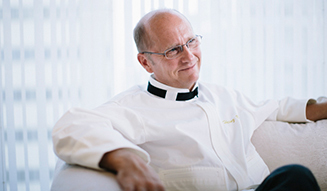
──I understand you are also dedicated to training your disciples.
Yes. I believe they are my future. My kitchen is like a workshop. As new chefs graduate from the Heinz Beck workshop, the world of cuisine will continue to expand.
For example, some chefs get angry when their disciples or other chefs copy their dishes. But I don't feel that way at all. Because being copied means my cooking has been recognized as good. And by being copied, my culinary world expands even further, so I feel no jealousy.
Besides, even if my recipes are copied, new culinary ideas keep coming (laughs)!
──Finally, could you tell us about the seven essential tools for your work?
A spoon. Because a perfect dish cannot be completed without tasting. What kind of spoon? Any spoon will do, as long as I can taste with it! In the Heinz Beck kitchen, we have a large number of spoons scattered everywhere so that all staff can taste at any time.
Beck spoke passionately about his love for cooking, his eyes sparkling throughout the interview. After the interview, he stood before the photographer and put on the "HEINZ BECK" costume designed by Junko Koshino, saying, "Isn't this apron, inspired by Japanese hakama, cool?" We look forward to seeing what innovations he will bring to the Japanese culinary world.
Heinz Beck
Born November 3, 1963, in Germany. In 1994, he was invited to be the chef at "La Pergola" in Rome, Italy. In 2005, he received three Michelin stars in Michelin Italy 2006. He is also actively involved in activities themed around gastronomy and health, launching a project in April 2014 in collaboration with a hospital to support dietary habits. On November 7, 2014, he simultaneously opened the fine dining restaurant "HEINZ BECK" and the all-day dining restaurant "sensi by Heinz Beck" in Tokyo.