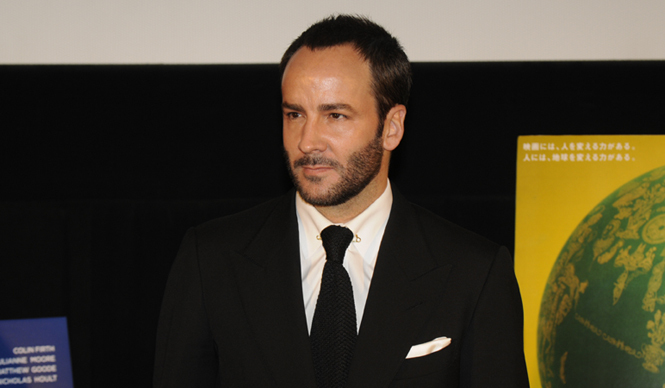
INTERVIEW | Tom Ford and Toshio Matsuura: A Special Conversation
TOM FORD × TOSHIO MATSUURA Special Interview
Tom Ford Discusses His Directorial Debut, 'A Single Man'
Tom Ford. One of the most successful designers in the 1990s fashion business, he single-handedly shaped brand image, from clothing design to visual direction of advertising and boutique interiors, popularizing the title of "Creative Director." He has now realized his long-held dream of "making movies" and participated in the recent 22nd Tokyo International Film Festival with his directorial debut, 'A Single Man.'
In the deepening autumn in Shinjuku, Tokyo. Toshio Matsuura, who is active domestically and internationally as a DJ and producer, and also wears many hats including creative direction for products and representing overseas artists like Gilles Peterson and Tomato, conducts an exclusive interview with Tom Ford, who is working on an extremely tight schedule. What message does his work, which he describes as a bold exploration of his inner self, convey? OPENERS brings you an in-depth discussion, including the film's music. Please enjoy.
Text by Toshio MatsuuraPhotos by Simon Perry / image.net
The Message Within the Film
MatsuuraI saw it yesterday and found it to be a wonderful and deeply moving film. Congratulations.
TOMThank you.
MatsuuraFirst, what are your thoughts on completing your directorial debut?
TOMFilmmaking was enjoyable at every stage, every moment. From writing the script to shooting and even after completion. Editing was also fascinating. Of course, there were times I doubted if it would work, but in those moments, I explored new approaches. It was such a profound experience that it's difficult to put into words. I'm not someone who easily opens up to others, but this film felt like cutting myself open and revealing what's inside. So, while it was enjoyable, it was also quite frightening.
MatsuuraI felt that the film was filled with many messages, or rather, the director's various thoughts. After watching it, I felt a sense of depth but not negativity. What was the core message you wanted to convey?
TOMTo be mindful of the small things that happen in daily life. Because those are the most important things in life.
MatsuuraI wasn't able to read the original novel by Christopher Isherwood, as there is no Japanese translation...
TOMReally? That's strange. It's quite different from the original. The character George is the same, of course, but everything happens within his mind, and the ending is different. I needed to construct the scenes so that the audience could fully grasp George's inner journey. So, it's considerably different, though I believe the core and soul of the story remain the same.
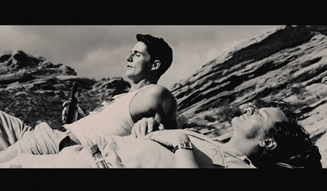
'A Single Man'
MatsuuraVarious characters appear in the film. Are there any characters that are original to the movie?
TOMThe little girl, Carlos the hustler, and the gun shop. These are the main characters not in the original novel, but the overall setting is quite different. So, you should read the original. Poor you... it's terrible that there's no Japanese translation.
Meticulous Direction!?
MatsuuraThis might be a minor point, but the telephones and the Mercedes George drives in the film show signs of use. For example, the rust on the windows or the slightly dirty phone cord – was this intentional?
TOMActually, I noticed that too, and it's quite a story. That Mercedes was released in 1957, so by 1962, it would have been used for about four or five years. But that's fine. The problem was the telephone. We had a limited budget, and it was difficult to find an authentic telephone from that era. In 1962, that phone should have been brand new, so I really wanted to provide a new one, but couldn't. That really troubled me. You've found the film's single flaw. Just kidding, there must be other flaws too.
Ah, but perhaps you're right. Maybe I should say, "Yes, that was intentional." "We spent hours making that cord look dirty." Yes, that was part of the direction (laughs).
MatsuuraFrequent close-ups of eyes appear from the beginning of the film. What did you want to express with this?
TOMOne of the film's themes is "connection." George, who had been living solely in the past, gradually begins to turn his gaze outward, connecting with people through his eyes. For the six to eight months after his long-term partner's death, he hadn't truly seen anything. So, these eyes become a window to connecting with others. Suddenly, George is surrounded by people's eyes. He looks into their eyes, and they look into his, and they begin to connect. I wanted to convey that this human connection is the most important thing in life.
MatsuuraI particularly liked these eye scenes.
TOMThank you.
Men of Virgo
MatsuuraColin Firth's emotional and intense performance, which won him the Best Actor award at the Venice Film Festival, was incredibly striking. As a director, how did you guide him? How did you discuss the emotions you wanted him to convey in each scene?
TOMI once read a director say, "I directed the film by choosing good actors." If you assemble a strong cast, there's not much else you need to do. So, I met with Colin, we talked, and I rehearsed with him for about a week, along with Julian, Matthew, and Nicholas. That was essentially it. Of course, I offered occasional advice during shooting, like, "Colin, remember that you love this person," and he'd respond, "Ah, yes, of course." It was very minimal direction.
Also, this might sound silly, but Colin is a huge fan of Christopher Isherwood. And he's currently the same age Isherwood was when he wrote this novel. Furthermore, Colin is a Virgo, and Isherwood was also a Virgo. I am a Virgo too. Virgos are all very meticulous. So, I believe Colin could deeply understand Isherwood's perspective, and he also understood mine. I think it was a good combination. You must be thinking, "Is he crazy, talking about Virgos?" (laughs). What's your sign?
MatsuuraAries. What does that mean?
TOMEgo. Aries are egoists. Is that right?
MatsuuraYes, I'm currently thinking about how to manage my ego.
TOMI knew it. That's your mission. Aries are very charming, possess wonderful eyes, and often make great leaders, but they struggle with their own egos.
MatsuuraThat's exactly right.
TOMHahaha, that's interesting.
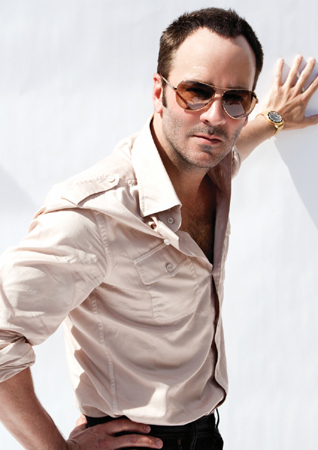
Tom Ford
Thoughts on Film Music
MatsuuraNow, regarding the music used in the film. You've enlisted Shigeru Umebayashi as the composer. Was the music originally created for the film?
TOMThat's correct.
MatsuuraWhy did you choose him?
TOMBecause he's brilliant, of course. I haven't seen Seijun Suzuki's 'Yumeji' yet, but I loved Umebayashi's 'Yumeji's Theme' from Wong Kar-wai's 'In the Mood for Love.' His sound, which can be interpreted as both sorrowful and joyful, felt perfect for George. So, I called him in Tokyo and sent him the script. He then came to Tokyo, watched the film carefully over two or three days, and sent back the music he composed. It was truly beautiful. I believe he is an exceptionally talented composer.
MatsuuraFor the other tracks, did you select them yourself?
TOMAll the other music is also original for the film, except for the pieces used in the dance scenes. I worked closely with the composer to create them. Music in film is another way to convey the characters' emotions to the audience. Therefore, I paid the utmost attention to ensure that the music flowing in each scene accurately expressed the emotions of that particular moment.
For the dance scenes, I went through my iTunes, checked everything released in 1962, and picked what I felt was right.
Additionally, the character of Charlie also served as inspiration for the music selection. She's approaching middle age and facing a turning point in her life, yet she desperately wants to remain young. She spends summers in the South of France, so I imagined she would have been among the first to hear Serge Gainsbourg's music and bring it back to America. I thought she'd likely be listening to the latest music. 1962 was the year Bocatti was released, so she probably had that too. And she was learning modern dance. I felt this would suit her character, her desperate effort to stay at the forefront of the times.
MatsuuraI believe the music selection was superb and perfectly suited each scene.
TOMThank you.
MatsuuraIncluding the dance scenes, the scenes where Charlie and George are dining or relaxing at home felt very natural. Was this a heavily directed sequence, or did you largely leave it to the actors?
TOMWhile I did direct, there are aspects that must be left to the actors. The original novel includes scenes between George and Charlie, but they are entirely different from these. These scenes actually represent my own relationships with women throughout my life. The character of Charlie is also modeled after my grandmother. So, this scene is very personal to me.
I believe good actors can instantly sense what is required of them in the moment. Both Colin and Julian captured my intentions very well. In that sense, they were equally wonderful actors. They are also the same age. They had never met before and this was their first time acting together, yet they had perfect chemistry.
Fashion and Film: Two Careers
MatsuuraWill you continue to make films in parallel with your fashion work? And do you have any desire to pursue other endeavors beyond these two fields?
TOMFor now, these two are enough. For me, fashion and film are entirely separate careers. I intend to make a film every two to three years, but I might go crazy if I only focused on filmmaking. It takes an enormous amount of time to complete a single project.
In that sense, continuing to design clothes allows me to dedicate myself to filmmaking. Who knows, perhaps I'll eventually grow tired of it.
MatsuuraThank you for this enjoyable time.
Despite his undoubtedly demanding schedule during his visit to Japan, Tom Ford answered each question with care. I was completely captivated by his gentlemanly demeanor, his sense of humor, and the gentle aura he exuded, further solidifying my admiration. After the interview, I rushed to a shop to buy a DVD of 'Yumeji,' which he mentioned he hadn't seen, and presented it to him as a token of my gratitude for the inspiration. I hope it may offer some hint for his next project.(Toshio Matsuura)
Toshio Matsuura
Toshio Matsuura Profile
Formed United Future Organization (U.F.O.) in 1990, laying the foundation for Japan's club culture during its nascent stage. Their albums were released in 32 countries worldwide, receiving critical acclaim. After going independent in 2002, he has continued to DJ energetically, leveraging his global sensibility and network to engage in a wide range of activities, including music supervision for fashion brands, event production and consulting, and agent representation for artists like Gilles Peterson and Tomato. His diverse endeavors are certainly worth watching.
released in 32 countries worldwide, receiving critical acclaim. After going independent in 2002, he has continued to DJ energetically, leveraging his global sensibility and network to engage in a wide range of activities, including music supervision for fashion brands, event production and consulting, agent representation for artists like Gilles Peterson and Tomato. His diverse endeavors are certainly worth watching.
worldwide, receiving critical acclaim. After going independent in 2002, he has continued to DJ energetically, leveraging his global sensibility and network to engage in a wide range of activities, including music supervision for fashion brands, event production and consulting, agent representation for artists like Gilles Peterson and Tomato. His diverse endeavors are certainly worth watching.
sensibility and network to engage in a wide range of activities, including music supervision for fashion brands, event production and consulting, agent representation for artists like Gilles Peterson and Tomato. His diverse endeavors are certainly worth watching.
including music supervision for fashion brands, event production and consulting, agent representation for artists like Gilles Peterson and Tomato. His diverse endeavors are certainly worth watching.
agent representation for artists like Gilles Peterson and Tomato. His diverse endeavors are certainly worth watching.
His diverse endeavors are certainly worth watching.
English version
Matsuura:That’s a very superb film. It’s a fabulously deep work. Congratulations on that.
Tom:Thank you.
M:I’m sure you’ve been asked this question many times, but after shooting this work, how did you feel about it?
T:Well, I loved every minute. I loved it when I wrote it. I loved it when I was shooting it. I loved it when I finished with it. Editing was interesting. Because, I loved it most of the time, but I had some days when I thought, “Oh, it’s not gonna work, it’s not gonna work”. Then I had to find a new way to make it work. It’s hard for me to comment on it because it was such an emotional process for me. I usually don’t let people very close to me. And this film is like cuting myself, opening and putting it out. So I loved it, but it was also very scary.
M:You have various messages throughout the film. It was a very deep film, but wasn’t negative. That’s the thought that I had after I’d seen it. What was the message that you wanted most to communicate through this film.
T:To take notice of all the small things that happen to you every day. Because those are the most important things in life.
M:I haven’t read the original book yet. I’d love to, but it hasn’t been translated into Japanese.
T:Really!? That’s strange. It’s very different. Very different. The character George is the same, but everything is in his head and the story doesn't end in the same way. Because, in order to help the audience understand all the things in his head, I had to create external scenes. So it’s quite different, but maybe the heart and souls are the same.
M:Can you tell me about any characters that do not appear in the book, but appear in the film?
T:The little girl, Carlos the hustler, and the gun store… These are the only characters who didn’t appear in the book, but the whole set-ups are very very different and there’re lots of other differences. You probably have to read the book.
M:I’ll try my best to read the English book then.
T:Oh no, I’m sorry it doesn’t exist in Japanese. It’s terrible.
M:I’d like to mention some details in the film. The telephone that you used in the film and its cord were a little bit dirty, and the Mercedes that George was driving looked slightly used. Was that intentional?
T:No, you know the terrible thing. First of all, Mercedes was 1957. So in 1962, it would’ve been used already for 4-5 years. No, the problem is, we had a low budget. It’s very hard now to find authentic telephones. I wanted the phone to be brand-new, because in 1962, it would’ve been brand-new. So I know that actually drove me crazy.
He’s just found one flaw, I’m kidding. There should be other flaws.
But maybe he’s right. Maybe I should say “Oh yes, it was exactly planned. We spent so much time in making the cord dirty perfectly.” So yes, you’re right. It was a detail.
M:From the start of the movie, I noticed that there’re lots of close-ups of eyes. It was very frequent. What was the message?
T:A part of the theme of the movie is connection. George has been living in the past, but he starts looking at everything and connects with people’s eyes. For the last 6-8 months since his boyfriend died, he hasn’t been seeing anything, so the eyes are windows to connection. All of a sudden eyes are everywhere for him and he’s making a connection because he’s looking in their eyes and they’re looking in his eyes. He starts to have these connections with people, which is really the most important thing in life.
M:I love those scenes. Very impressive for me.
T:Thank you.
M:Colin has been awarded for his beautiful acting. He showed very realistic, various emotions in the film. How did you direct him? How did you discuss the emotions that you wanted him to note in the various scenes.
T:Well, I read somewhere, some director said that he did directing of actors by casting good actors. If you cast good actors, you don’t have to do so much. So Colin and I met, we talked, I rehearsed him for about a week, with Julian, Mathew, and Nicholas. That was it. And sometimes when we’d shoot a scene, I’d just have to say a few words to him like, “Colin, remember that you love this person” and he would say “Oh, yes yes”, something like that. That was a very subtle direction.
Also, it might sound silly, but Colin loves Christopher Isherwood. Colin is at the same age as Christopher Isherwood first wrote this book. Colin is a Virgo. Christopher Isherwood is a Virgo. And I am a Virgo. We’re all very precise. So I think it was easy for Colin to understand the brain of Christopher Isherwood and to understand my brain. I think it was a nice combination of things.
He must think I’m crazy, saying Virgo Virgo... What’s your Zodiac sign? Probably doesn’t know.
M:Aries.
T:Oh..
M:What does it mean?
T:Ego. Aries. Ego. Is that true?
M:Yes, I have to organize my ego.
T:I know, that’s your job in your life time. Very charming, great eyes, they make good leaders, but they struggle with their own egos.
M:Exactly.
T:That’s funny.
M:I’d like to ask a question about the music you used in the film. You chose Shigeru Umebayashi as a composer. I understand he exclusively composed for the film.
T:Absolutely.
M:Why did you choose him?
T:Because he’s great. I loved his work for ‘In the mood for love’. I’ve never seen ‘Yumeji’, but I loved the piece from ‘Yumeji’s Theme’ that was in ‘In The Mood For Love’. And the sound was right for George because there’s sadness that can be joy, also. So I picked up the phone, called him in Tokyo, and sent him the script. He came to Los Angeles and
spent 2-3 days in watching the film. He went away, wrote things, and sent them back. It was beautiful. I think he’s a very talented composer.
M:As for the other pieces, did you choose all the music by yourself?
T:The rest was composed. Everything was composed for the film, except for the pieces where the dancing is. So I worked very closely with the composer to achieve the right. You know, music is one more thing to help the audience feel the emotions of the characters. So I made sure that the music expressed the emotion that was happing at that moment in time.
The other pieces for the dancing, yes, I just got on my iTunes, looked on 1962, and went through every single thing until I found the right pieces that worked.
Also, however, I thought about the character Charlie. She’s going through the change of life where she’s becoming older, but she’s trying so hard to stay young. So I thought ok, she’s been through summers in the South of France and maybe she heard Serge Gainsburg before everyone else and brought it back. Maybe she’s trying to listen to the latest music. At that moment Bocatti came out in 1962. She had it. She was learning the most modern dance. That made sense for her character that she’s trying to be very contemporary.
M:I think the music you chose perfectly fit each scenario of the scenes.
T:Thank you very much.
M:Including the dance scenes, the scenes that Charlie and George are having a dinner and hanging around the house seemed very natural to me. Was that all calculated? Or did you leave it up to actors?
T:It was calculated, but you mean, you have to leave something up to actors. There’s a scene with George and Charlie in a book, but it’s not at all that scene. That scene is more the relationships that I had with a few women in my life. The character of Charlie is based on my grandmother. So it’s very personal and I think I wrote it in a very personal way.
I think good actors can easily feel something that works and makes sense. Two of them are also at the same level of actors. They’re both great. Both are at the same age. They’ve never met before in real life nor have worked together, but they’re just perfect together.
M:You're involved in fashion and you’re involved in films now. Do you think the relationship between the two will start changing or is there any other areas you wish to go into?
T:I think I’ve already done enough things. For me, fashion and film are parallel careers. They’re separate things. I hope I can make a movie every 2-3 years. In a way, I’d go crazy if I only make movies because it takes so long to get a movie made. This way, I can go designing some clothes and then I can go concentrating on movies. I don’t know, we’ll see. Maybe I’d be too tired.