Life is Edit. #010 ~Lost in Contemplation of Buddhist Statues~
Akira Shimada | Life is Edit.
#010 Obsessed with Buddhist Statues
New "somethings" are spun and born through encounters with people.
New "somethings" are drawn out and born through objects.
An editor's job is precisely to create such "encounters."
And life itself is precisely editing.
──Editor Akira Shimada introduces the people, objects, and events that have moved him.
Text and photos by Akira Shimada
This time, I'll share about a presence that has captivated me since junior high school, a presence that has long settled deep within my heart, occasionally surfacing gently.
I will convey the existence of "Buddhist statues," a vital part of shaping who I am, through a journey in the ancient capitals of Nara and Kyoto.
My Guardian Spirit is a "Monk in Training"!?
About 15 years ago, at the Men's Club editorial department where I belonged, a few of us staff members would pool our money for a peculiar gathering held twice a year. We'd consult a famous clairvoyant living in Fukushima, in Tokyo. I, too, had a reading, and the first thing she said upon seeing me was, "Your guardian spirit is a 'monk in training.'"
Even now, I remain irreligious, but at that moment, for some reason, it felt accurate, and I was surprised. Because there were so many things that resonated with me (laughs).
No, it's true. Some of those resonant points trace back to my sensitive junior high school days...
Autumn of my 13th year, in junior high. The customary school trip for the Kanto region was to Kyoto and Nara. I, who was part of a carefree group with memories mostly of unruly behavior on the nights of the trip, had a fateful encounter at a certain temple. It was an encounter that truly struck me...
One was the Buddhist statue of Guang-mu Tian (Many-Eyed Heavenly King) enshrined in the Kaidan-in Hall of Todai-ji Temple.
And the other was an encounter with the eminent monk Soen Ozeki of Daitoku-ji Dai-sen-in in Kyoto.
Synchronizing with Guang-mu Tian
First, before I talk about Guang-mu Tian, a basic explanation. Guang-mu Tian is a guardian deity of Buddhism, a guard responsible for protecting the four directions of Mount Sumeru, which supports the Buddhist world. The basic defensive formation is Tamon Ten (North), Jikoku Ten (East), Zocho Ten (South), and Guang-mu Tian (West). What struck me was "Guang-mu Tian," the statue in the Kaidan-in Hall at Todai-ji. While the other Four Heavenly Kings here glare with weapons, Guang-mu Tian stands alone, unarmed, armed only with a writing brush and a scroll (truly, the pen is mightier than the sword!).
His face is full of wisdom, radiating intelligence and coolness! Moreover, the Four Heavenly Kings at Kaidan-in are displayed so you can see them up close, without glass cases or formal fences! As for me, a spiky-haired kid, I tried to get as close as possible, thinking, "He looks like he's breathing!" I was in a state of ecstatic excitement (laughs). In the not-so-spacious hall of Kaidan-in, as I confronted Guang-mu Tian, I naturally began to synchronize with him... That was the precious experience of my 13-year-old autumn.
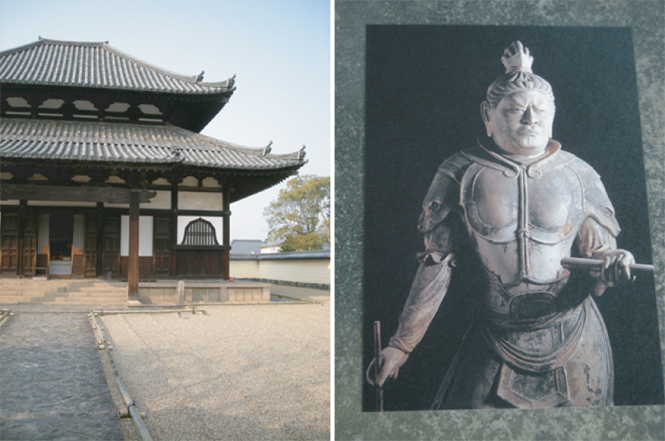
Left: Located next to the Great Buddha Hall of Todai-ji, Kaidan-in is a hidden gem, away from the hustle and bustle. There's a kindergarten nearby, and the occasional cheers of children make me wonder if this is heaven. Right: Photography is prohibited, so this is the statue from a postcard I bought. Guang-mu Tian truly looks as if he could move at any moment, as if breathing. Created in the Tenpyo era, it is a National Treasure. A truly moving sight.
Since then, I have visited this temple to see "Guang-mu Tian" about 20 times. During these visits, there have been coincidental, yet strangely (but somehow understandably?) events.
For example... on a scorching summer day, while resting under the eaves of the deserted Kaidan-in, two lizards appeared and circled me, remaining still. On another spring day, caught in a sudden rain shower, while taking shelter under the same eaves, the sun suddenly broke through, and a single ray of light shone before me. On a quiet, windless winter day, a single camellia flower fell right in front of me, though there was no wind. Oh, and once, when I was staying in Nara but was about to leave without seeing Guang-mu Tian due to lack of time, the night before, Guang-mu Tian appeared in my dream and said, "Why are you in Nara and not coming to see me?" (Of course, I went to see him the next morning). See? Something is definitely going on (laughs).
I learned that Kaidan-in, founded in 754 during the Tang Dynasty of China, was where the eminent monk Ganjin, who came to Japan, administered the precepts to Emperor Shomu and other monks and nobles. It was a sacred dojo, a place for training and ascetic practice, where one vowed before the Buddha to fulfill the duties of a monk. Perhaps my guardian spirit trained here...?
With these old memories (even memories etched in my DNA, so to speak, laughs) resurfacing, I revisited the temple after about a year. The main event this time, the reason for my visit, was the "Omizu-tori" (Water Drawing Ceremony), part of the Shuni-e ritual held at Todai-ji's Nigatsu-do Hall. This was my second time experiencing "Omizu-tori," the first being 13 years ago.
This spring ritual, which began in 752, is now in its 1257th year (without a single interruption!), a testament to its long history. It is considered a form of rigorous ascetic practice, performed by 11 monks known as "renkō-sō" who seclude themselves in Nigatsu-do. Ah, more training here... (laughs).
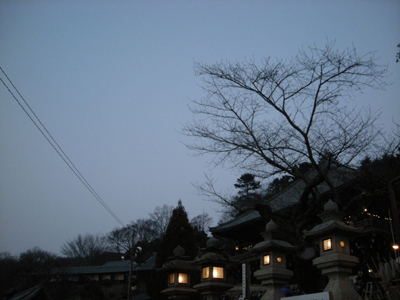
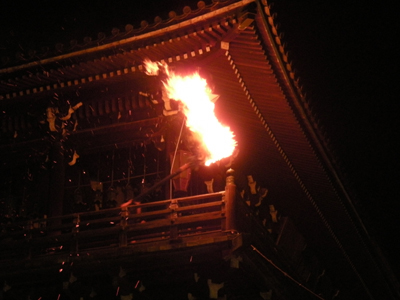
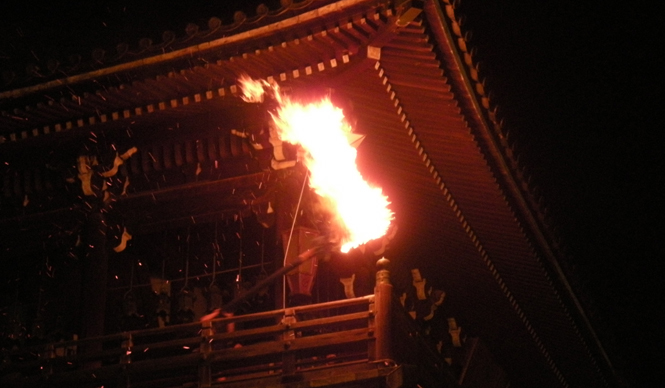
After waiting for three hours at Nigatsu-do, a beautiful sunset painted the surroundings as dusk settled, creating a scene of the eternal capital of Nara before the torches were lit at 7:30 PM (top photo). Then, during the main event, 11 giant torches were carried as monks ran down the steep slope of Nigatsu-do. Even I, whose sense of awe had perhaps dulled, was deeply moved.
As for the Omizu-tori itself, this was the climax night of the 14-day Shuni-e. The number of spectators and police officers for accident prevention was overwhelmingly greater than 13 years ago, and everything was so organized, it felt like a concert venue. Although I was a bit disappointed that I couldn't get as close as I could 13 years ago, where sparks from the torches would fly near me, the value of waiting for about three hours, standing the entire time (something I could never endure in daily life!), was more than enough to be moved. If you ever have the chance, I highly recommend experiencing this truly wonderful Japanese traditional event.
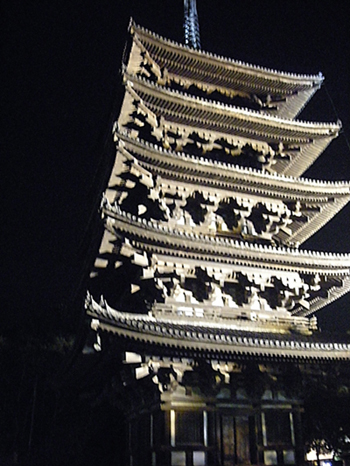
The five-story pagoda of Kofuku-ji Temple, near my usual lodging in Nara, the Nara Hotel. Nara still holds a certain darkness.
The five-story pagoda stands out against that pitch-black darkness. It's as if you could be drawn into it.
Zen Dialogues Continue Unceasingly
And besides Guang-mu Tian, there is another phrase that has been my motto since that time when I was 13. It is the phrase "Issho Kenmei" (One-Pointed Devotion) from the words of Soen Ozeki, the head priest of Daitoku-ji Dai-sen-in.One PlaceDevotion
At the age of 13, facing my high school entrance exams, this phrase helped me immensely.
"Issho Kenmei" - not in the long span of a lifetime, but by diligently putting effort into each moment, each place, people can become happy and fulfilled. It's like connecting dots to form a line.
I was so moved by the explanation given by Abbot Ozeki in simple terms that even a junior high school student could understand, that I was teary-eyed (laughs). As soon as I returned home, still overwhelmed with emotion, I wrote a letter (in my clumsy 13-year-old handwriting), impulsively writing, "If I fail my high school entrance exams, please take me as your disciple!" I remember writing my earnest feelings in such a one-sided manner... Embarrassingly (laughs).
But what surprised me was that I actually received a reply from Abbot Ozeki himself. I was astonished. I kept that letter displayed in front of my desk and looked at it often, drawing courage from it. That was me.
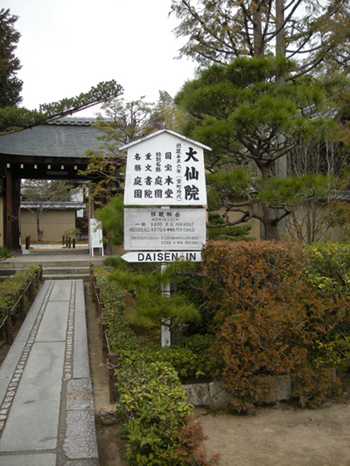
At the entrance to Dai-sen-in. Unfortunately, the roof is currently under renovation, with pipes exposed everywhere, but it had a bit of a modern art feel (laughs).
This was my first visit to Daitoku-ji Dai-sen-in in about 30 years since then.
Unfortunately, Abbot Ozeki was not in, but a monk, who, like Abbot Ozeki, welcomed me with an explanation that was as clear and amusing as it was 30 years ago, listened as I recounted my memories of that time. He simply said, "That is truly fortunate." When asked about my profession, I replied that I worked as a magazine editor. He then beamed and said, "That is a wonderful thing. It is a job like preaching to people. I am sure Abbot Ozeki would be pleased." Oh no, I'm still far from that. I don't even know if my preaching is any good... I felt quite humbled.
And this time, from the "Issho Kenmei" of 30 years ago, I received an even newer phrase that resonated with my heart. It is "Kishin Fuku Jin Ki" (氣心腹人己).One PlaceDevotion
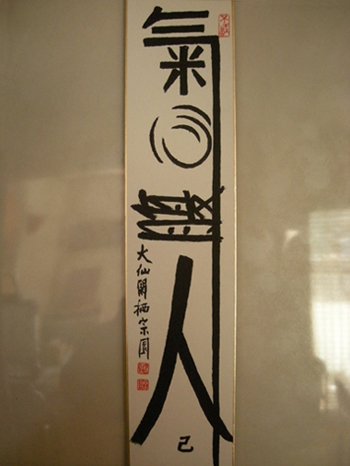
It is truly a small universe of art. I realize that Soen Ozeki is a person full of ideas and talent, and still a practitioner of asceticism.
A Continuous Stream of Encounters, the Work of Editing
As for me, an immature individual, I feel as though I am still in training.
And the work of "editing," which I do for a living, is truly a job like ascetic training, I've come to realize profoundly after being involved in editing for 20 years.
Meeting talented people, confronting them with my own ideas, synchronizing our hearts, and shaping it all in a magazine – this work of editing, precisely because talented individuals are close by, often serves as a mirror, revealing my own powerlessness. And it makes me acutely aware of my own insignificance. In a sense, it is like a training ground where I am tested through encounters with others.
Even before being told my guardian spirit was a monk in training, I think I had a tendency or nature to push myself into difficult situations and test myself (I even joined a sports club in university and wore a school uniform every day, laughs). Is this really a fondness for asceticism...?
Digression.
To suddenly change the subject, I have officially launched a new project this March. It is the launch of a new men's fashion magazine.
I am currently grappling daily with the creation of a completely new style of magazine, starting from scratch. But the thought of the new encounters and inspirations with many more talented people that await fills me with excitement even now. Truly, being an editor is fun.
And so, this trip to Nara and Kyoto was also a journey back to my own origins. What I reaffirmed there was that, after all, I am merely "a monk in training." My training continues...
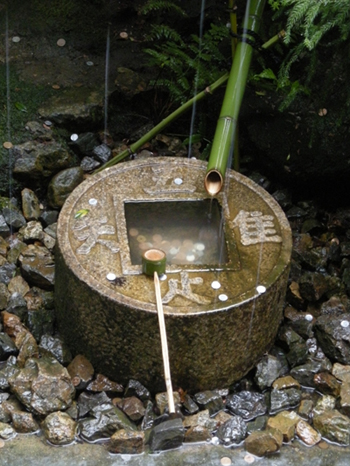
On a rainy day, at the back garden of Ryoan-ji Temple's rock garden. In the center is the character for "mouth," forming the four words "Ware tada taru wo shiru" (I only know contentment). Hmm, profound...