April 10, 2015
An Illustrator in Paris in May: A Special Edition, "Is New Always Good?" (Part 2)
Illustrator and May in Paris (Special Edition)
Is New Always Good? (2)
interview & text by SUZUKI Fumihiko
Illustrator and May in Paris Special Edition "Is New Always Good?" (1)
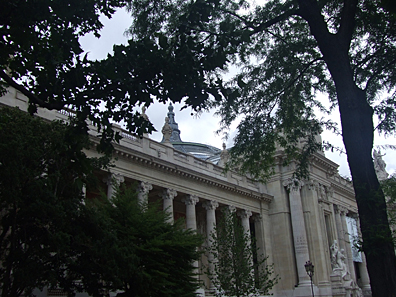
The Grand Palais, built as the main venue for the 1900 Paris Exposition Universelle. At the time, it was said that "a palace befitting the glory of French art, which France can proudly present to the world, has been born."
Constantin Guys: The Cosmopolitan Traveler
Baudelaire said this about artists:
"An artist is, in short, a specialist. If a serf is tied to his land, an artist is tied to his palette."
"Living in the Batignolles quarter, he knows nothing of what is happening across the river in the Faubourg Saint-Germain. Except for two or three names that need not be mentioned, artists today are merely skilled idlers, day laborers, village wise men, or the brains of a hamlet, and it is only natural that their topics of conversation are limited..."
And so on, a rather harsh assessment.
In contrast, the traveler and cosmopolitan Constantin Guys, with his broad knowledge and rich conversation, would not presume that we Europeans are the most advanced and superior wherever he went. While initially surprised, he would observe the ways of each land and behave in a manner that would bring no shame anywhere in the world.
From the following passage, we can roughly imagine what kind of paintings Baudelaire thought of the artists he so thoroughly disparaged.
"It is all very well to study the old masters to learn how to paint. But if your aim is to grasp the nature of present beauty, such study is superfluous. Today, factories produce fabrics like 'antique moiré' or 'queenly satin,' which cover bones and starched muslin to make petticoats that stride through the city. Even if you study Rubens or Veronese and learn how they painted the folds of their garments, you will not learn how to paint these petticoats. The weave and texture of the fabric are also different from those of the clothes worn in old Venice or at the court of Catherine de' Medici."
In other words, the contemporary artists whom Baudelaire despised were too concerned with the old masters and were completely unable to create anything relevant to their own time. They weren't even particularly interested in what was happening across the Seine, let alone their own era.
Baudelaire and Hugo's Remarks
Furthermore, or rather, even before Baudelaire, Victor Hugo, while discussing the contemporary classical theater bound by various rules, said something similar. Classical theater dictates that the scene should be limited to a single act, but what classical theater revered and imitated were, of course, Greek plays. And what about those Greek plays...?
"In the first place, were the Greek plays truly bound by rules that felt unnecessary, as we have just seen? Is there any similarity between Greek plays and the classical plays we are shown today? After all, as stated above, ancient plays did not have rules limiting the number of scenes. Perhaps they were expressed through changes in painted backdrops, but in any case, the playwrights were free to change scenes as they pleased, back and forth, according to the needs of the plot. Is this not a strange contradiction? While Greek plays may have been constrained by the national character and religiosity of the Greeks, they were, in any case, freer. Their primary aim was enjoyment, and if there was any other purpose, it was perhaps to enlighten the audience. The Greeks followed only the rules that were inherently Greek. Yet we, on the other hand, are binding ourselves with conditions that are not essential to us and are irrelevant. In a sense, the former is art, and the latter is a counterfeit."
Indeed, powerful words. It seems that art was not very free at the time. Perhaps there were many restrictions, such as not being allowed to do this or that, and only valuing things from the past. Art may not have been recognized unless it adhered to such constraints.
Returning to the main topic, when we consider "Is new better, or is conservative better?" Baudelaire's and Hugo's remarks reveal another aspect.
Although they lamented the current situation and spoke passionately, they did not actually say that new is better, old is bad, or vice versa. They did not advocate for one over the other.
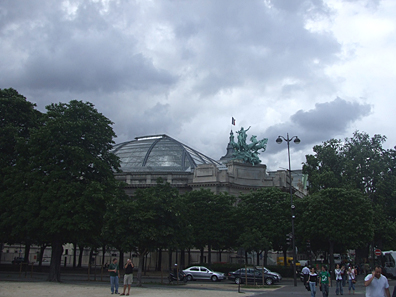
The Grand Palais, which has broadcast major trends in modern art to the world, is now used as a trade fair and exhibition venue.
The Most Important Point
The painters of old Venice strove to depict the weave and texture of Venetian clothing of their time. The Greeks aimed to stage enjoyable plays. They are simply stating this, not criticizing the past.
On the contrary, one could even say they were highly appreciative. They are simply saying that for us too, just as for the Greeks, we should study the weave and texture of the clothes of our own era and depict them in our paintings, and that we should create plays that we find enjoyable in our own way.
Well, this has become quite long, but having reached a rather obvious conclusion, I will stop introducing what people of the past said without delving any deeper.
Certainly, comparing a computer from five years ago with today's computer, the latter is more powerful. However, not everything can be discussed in terms of computer performance. We should question the essence, and it would be unsightly to merely cling to the wonderful things created by people of the past without making any effort. Saying so makes one feel as if they've said something profound.
By the way, Baudelaire also said this while looking at a collection of prints featuring fashion from the late 18th to early 19th century:
"Perhaps, in the not-too-distant future, we will see a day when such costumes are revived in some theater. Our fathers, dressed in such costumes, were as attractive as we are in our pathetic contemporary clothes (or rather, our clothes certainly have a certain elegance. That is true. But that elegance is rather an elegance of the spiritual dimension). If intelligent actors and actresses were to wear these costumes and bring them to life, we would be astonished at how carelessly we had laughed at them."
This feels rather indecisive. Aren't the hesitant words in parentheses and "pathetic clothes" unnecessary?
Certainly, Baudelaire's point might be understandable. The late 18th and early 19th centuries were flamboyant eras for fashion, with the French Revolution and the Bourbon Restoration. However, in the 1860s, when Baudelaire published this, it was the heyday of black tailcoats and frock coats. While the former might look gaudy and comical from one perspective, the latter, being dark in color, might be somewhat less visually appealing. However, for him to push his argument, he couldn't back down too much here. It seems there are always many difficulties in earnestly asserting that our current lives are as good as those of the past.
Still, it is a bit strange. After all, this was written by Baudelaire, the pinnacle of French poetry. Isn't it a bit odd that he would insert a remark that weakens his own argument in such an awkward way? The main point should be that people of the past and people of today are equally attractive. But with it written like this, the entire passage seems to take on a completely different meaning...