
May 1, 2015
Part 6: Where Do Cigars Come From?
The 6th: Where Are Cigars Born?
The country where the raw tobacco leaves are grown and the country where they are finally assembled into cigars are often different. So, where are cigars born?
Text & Photo by Mamoru HIROMI
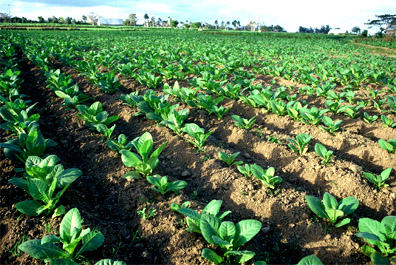
One month after transplanting the seedlings to the field, they grow to about 30 centimeters in height.
Where Are Cigars Made?
Machine-made cigars require large-scale manufacturing facilities, so they are produced in developed countries such as Europe and the United States. However, handmade cigars are rolled entirely by hand, making it impossible to compete on price without being produced in countries with low labor costs.
The raw tobacco leaves used for cigars are cultivated in subtropical regions such as the Caribbean, Central America, and Southeast Asia. Handmade cigars are manufactured in locations that offer both low labor costs and proximity to tobacco-growing regions.
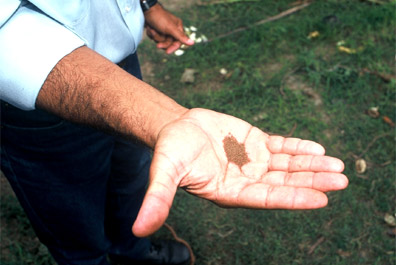
Tobacco seeds. A fruit about 1 cm in size contains approximately 3,000 seeds.
Tobacco Growing Regions and Cigar Manufacturing Countries
Handmade cigars are made purely from tobacco leaves. The country where the raw tobacco leaves inside are grown and the country where they are assembled into the final product are often different. Generally, when referring to a cigar's origin, it means the manufacturing country. This is because a certificate of origin is required for exporting and importing products, making the manufacturing country more significant in international trade.
However, what is truly important for enjoying the taste and aroma of a cigar is the origin of the raw tobacco leaves blended inside, rather than where it was assembled. More specifically, it is the origin of the leaves used for the 'filler,' 'binder,' and 'wrapper' that form the internal structure of each cigar. The blend of these leaves is crucial. Knowing the recipe allows us to imagine the approximate taste. This is the same principle as how the ratio of grape varieties determines the taste and aroma in wine, or the blend ratio of beans determines the taste and aroma in blended coffee.
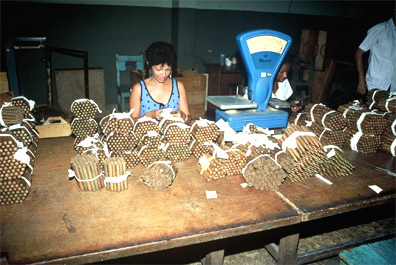
The cigars rolled by the cigar rollers are sent to the 'inspection' section, where they are checked for size, weight, and consistency of the roll. After this, the process moves on to 'aging,' 'color sorting,' and 'boxing.'
100% Cuban!
For handmade cigars, those made in Cuba are produced using 100% Cuban tobacco leaves, with no admixture of leaves from other producing countries. However, in countries other than Cuba, it is common to blend tobacco leaves from various origins. Cuba uses a single origin, while other countries use blends of multiple origins.
There are many types of handmade cigars, but the finest are produced in the countries of the West Indies and Central America. The following four countries are particularly highly regarded internationally for their cigars.
○ Cuba
○ Dominican Republic
○ Nicaragua
○ Honduras
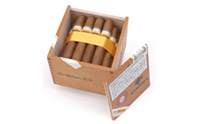
*Photo shows a top brand from Cuba
Cohiba's 'Robusto'
Until the last century, Cuba, the Dominican Republic, and Honduras were said to be the world's three major producing countries. However, in this century, cigar experts worldwide began to highly evaluate Nicaraguan cigars. Cigar manufacturers with factories in Honduras were drawn to the land in neighboring Nicaragua that produced full-bodied tobacco, and gradually began to shift their manufacturing operations to Nicaragua.
Eventually, the global reputation of Honduras and Nicaragua was reversed.
Even so, the chronic political instability in Latin American countries remains unchanged, and in reality, many companies have factories dispersed across both countries.