March 3, 2015
Rinbow Sensei OPENERS Interview (2)
Rinbu-sensei: An OPENERS Interview
A Candid Conversation on Love and Song: Part 2
interview & text by TAKEDA Nanakophoto by IDEGUCHI Keiko
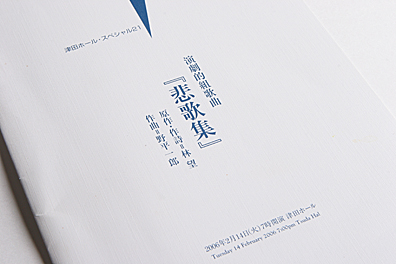
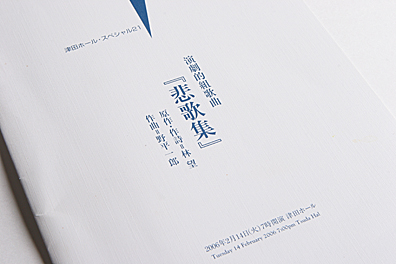
The Theatrical Song Cycle 'Hikan-shu'
The Motivation Behind 'Hikan-shu'
—So, the impetus for creating 'Hikan-shu' was the state of Japanese art songs since the Meiji era?
“I had several ideas. I considered using the love poems from the Manyoshu as a theme, or perhaps focusing on love stories from Japanese literature. I drafted and discarded many concepts. Then, I realized that borrowing from others' worlds wouldn't yield anything truly profound. I decided to write something more emotional. Otherwise, it wouldn't become poetry. I resolved to move beyond mere prettiness.
How could I truly engage a rare genius composer like Ichiro Nodaïra? I felt I had to present him with something that would make him think, ‘Huh? I’m supposed to compose this?’ I wanted Nodaïra-san to break a sweat, too. I believed something new would emerge when he was given something outside his usual repertoire.
If I put something like this out there, it means I’m not holding back either. Isn’t literature about revealing something so raw it bleeds when cut? I believe that when music is set to a literary text, it’s then, and only then, that the world of Japanese art song can take a step forward.”
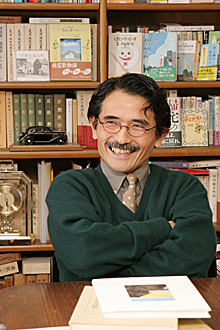
At the author's office
—The piece is being performed again this May at Tsuda Hall and AOI Concert Hall in Shizuoka, isn't it?
“This piece demands incredible virtuosity, and currently, only the musicians from the premiere in Japan can perform it. Mr. Umetsu from The Mainichi Shimbun highly praised this song cycle, writing last year that it was ‘a masterpiece of Japanese art song that has appeared after a long time.’”
—To what extent do you feel your intentions were realized in the music through Nodaïra-san's composition?
“It’s natural for there to be some divergence between my lyrics and Nodaïra-san’s world. That is, Nodaïra-san’s view of love is reflected in the music. When different personalities clash, a certain tension is created. I trusted that the ‘world-renowned Nodaïra’ would always throw the ball back, no matter what I wrote. You can’t take bold steps without that kind of trust. In that sense, I think it turned out wonderfully.”
—There are songs from a female perspective among them.
“I’m often asked, ‘How can you understand a woman’s feelings?’ In a way, I might have a bit of an androgynous side myself. After all, I did write a book titled ‘I Want to Be a Woman’ (laughs).”
—How do you hope people will receive 'Hikan-shu'?
“For many people, opera and art songs are something they listen to, moved to tears by the beautiful performance of skilled artists, or experience catharsis. I hope my songs are received in that way.”
—Or, do you hope that listening to this will awaken something like humanity's inherent 'nature' (saga)?
“Yes, that’s part of it. Many people suppress their true feelings due to social conventions. I believe humans possess more materialistic, erotic impulses. If people can listen to this song cycle and think, ‘Ah, this is also valid,’ I would be happy.”
To be continued in (3)
The Theatrical Song Cycle 'Hikan-shu': Upcoming Performances
May 30, 2007 (Tue) Tsuda Hall
June 1, 2007 (Fri) AOI Concert Hall, Shizuoka