May 12, 2015
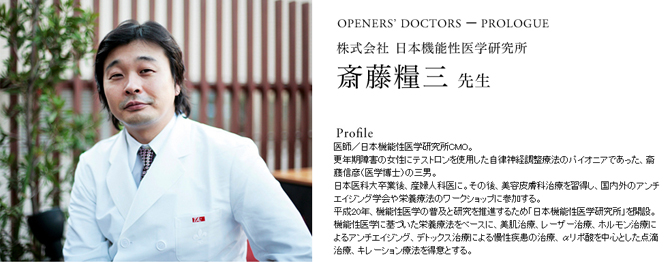
Feature: Pioneering Medicine! Prologue | Navigator: Dr. Ryōzō Saitō

In our special feature, "Pioneering Medicine!," our guide is Dr. Ryōzō Saitō, who will lead us into the world of future medicine. Functional medicine is a new field, barely over 20 years old. Dr. Saitō encountered this medicine six years ago in America, was deeply impressed after it resolved his own health issues, and now dedicates himself to its popularization in Japan.
Text & Photograph by TANAKA Junko (OPENERS)
Resolving Chronic Illness from the Root?
— What sparked your interest in next-generation medicine?
My father was an obstetrician and gynecologist who practiced hormone therapy. I believe hormone therapy is the only form of anti-aging treatment currently covered by insurance in Japan, and my father was practicing it about 50 years ago. I wanted to pursue that line of thinking further and study international approaches, which led me into the field of anti-aging.
Around the time I started going to the U.S., hormone replacement therapy was at its peak globally. While learning these techniques, I also incorporated Japan's unique strengths to establish my own treatment methods.
I realized that many people are not technically ill but not truly healthy. If the metabolic processes preceding illness aren't properly managed, anti-aging efforts become like building castles in the air. Through my studies, I understood that much more needed to be done. Recently, in addition to hormone therapy, my treatments focus on optimizing nutrition, environmental factors, and lifestyle habits.
— And that led you to study "functional medicine." Was there a specific trigger?
It was a personal experience. A few years ago, I developed a severe intestinal issue after eating moldy smoked food, which led to weeping sores on my feet and hands, and eventually pain in my knees. At the time, the mainstream medicine in Japan couldn't even address this condition, let alone treat it. Symptomatic treatments lack an approach to regulate the gut for systemic health.
Around that time, at an anti-aging seminar in the U.S., I encountered "functional medicine." They discussed how imbalances in the gut environment could lead to systemic illness. I learned that by addressing these issues, chronic diseases could be fundamentally resolved. I realized this was the path forward and decided to promote it in Japan, where such treatments were virtually nonexistent. That was in 2006.
— Could you explain what this field entails?
Functional medicine is a discipline that began around 1990 when Dr. Jeffrey Bland proposed, "Let's integrate basic and clinical medicine to build a treatment model for the growing problem of chronic diseases." It's only about 20 years old.
Before the IT revolution, researchers worked in isolation, with scientific journals as their only source of information. After the IT revolution, searching with keywords brought up a flood of research papers. This dramatically accelerated the pace of scientific research and information dissemination. As new knowledge emerged, the idea arose to integrate it and build a new form of medicine.
Chronic diseases persist because they are merely suppressed by medication rather than fundamentally treated. These conditions consume about 80% of healthcare costs. Functional medicine's core principle is that focusing on the root causes of disease and treating them fundamentally is more cost-effective and leads to higher patient satisfaction.
The current mainstream, classical medicine is diagnostic. Once a diagnosis is made, treatment follows. However, it rarely considers the internal state of the body or how to guide it. In contrast, functional medicine is pathologistic. It examines the mechanisms and processes within the body that lead to disease. It's a form of treatment that addresses the fundamental roots.
Blood Sugar and Insulin: Key to Health
— So, lifestyle habits become crucial?
Precisely. Our food culture has changed due to industrialization. While we say, "Rice is the heart of the Japanese diet," agriculture only began about 10,000 years ago. Tracing human history, our ancestors are believed to have become carnivorous around 2.5 million years ago. Eating meat is thought to have significantly increased brain size. Those who didn't eat meat apparently went extinct. Considering this 2.5-million-year history, humans have only recently begun consuming highly palatable, high-yield carbohydrates. It's important to reconsider whether our current dietary habits align with this human history.
People who feel sleepy after eating rice are experiencing a sharp spike in blood sugar followed by a steep drop. This indicates that their bodies cannot cope with such a surge in blood sugar. Insulin is excessively secreted to lower it rapidly, causing it to drop too much—a state of completely lost blood sugar control. Those who feel sleepy daily are in this condition, which is not aligned with human history.
Continuous insulin secretion can eventually lead to reduced production, increasing the risk of diabetes. Furthermore, insulin secretion contributes to obesity. When insulin lowers blood sugar, it triggers hunger, increasing appetite. Essentially, obesity issues like metabolic syndrome stem from modern diets not fitting our metabolism.
— So, blood sugar and insulin levels dictate our health.
There are various causes of feeling cold, one of which involves insulin secretion. When insulin is released to lower elevated blood sugar, the autonomic nervous system becomes excited. This system is designed for 'fight or flight' responses. In such situations, a survival instinct kicks in, causing peripheral blood vessels to constrict. When blood sugar rises during a meal and the autonomic nervous system is activated, the extremities like hands and feet, where peripheral blood vessels are located, become cold.
There's a genetic pathway for overcoming famine, often called the "longevity switch." This switch is activated when the body is burning fat. While aging progresses in various ways as the body oxidizes, activating the longevity switch makes the body more resistant to oxidation. By understanding these bodily mechanisms and adjusting our diet and nutrient intake, we can prevent diseases and maintain optimal health.
— It's like awakening dormant functions within the body.
Exactly. We can, to some extent, control gene expression through diet and lifestyle habits like exercise. This leads to a body that is less prone to oxidation and aging.
Vitamin D: Enhancing Bodily Functions
— In recent years, you've been very enthusiastic about vitamin D research. Is vitamin D truly that versatile?
Vitamin D was initially thought to be essential only for calcium absorption. However, in the last 20 years, research has rapidly advanced, revealing its crucial role in regulating immune responses.
With the onset of the Industrial Revolution, air pollution became a major issue in Europe and America, preventing sufficient UV rays from reaching the ground. Previously, we relied on the sun to produce vitamin D. However, when air pollution blocked UV rays, vitamin D production ceased.
— What happens when vitamin D is deficient?
It increases the risk of breast cancer and susceptibility to influenza... In essence, vitamin D regulates the immune system. Our immune system combats pathogens entering the body and eliminates cancerous cells. We've learned that vitamin D is essential for these normal bodily functions.
The best way to address vitamin D deficiency is through sun exposure to synthesize it naturally. However, sun exposure carries risks like skin aging and skin cancer. In such cases, supplementation is the easiest and most effective method. While opinions vary, I recommend 2,000 IU daily for individuals who do not get regular sun exposure.
Vitamin D is highly valued in functional medicine circles today. Our bodies have cells that detect antigens—signals from foreign invaders like viruses, bacteria, pollen, or even cancerous cells—and trigger appropriate responses. These responses can lead to cancer or allergic reactions. Normally, once the body encounters an antigen, it develops immunity and blocks subsequent encounters. However, this immune response can sometimes go awry. Vitamin D helps restore these functions to their proper state, ensuring they operate correctly.
— As our guide, you will lead us into the world of next-generation medicine. Please share your aspirations for this series.
I believe there is a growing need for next-generation healthcare. We will introduce researchers and clinicians at the forefront of this field who are correcting errors and incorporating new, essential concepts. Please look forward to it.
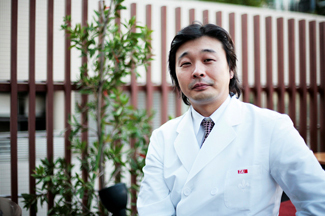
Nihon Functional Medicine Kenkyujo Co., Ltd.
6-6-21 Minami-Aoyama, Minato-ku, Tokyo 9F
Tel. 03-6427-7654
Affiliated Societies
Councilor, Japan Society of Intravenous Therapy
Certified Physician, Japanese Society of Anti-Aging Medicine
Certified Physician, Japan Society of Obstetrics and Gynecology (until 2008)
Director, Japan Society for Orthomolecular Medicine
Member, Japan Society of Anti-Aging
Member, Japan Hydrogen Research Society
Member, The Institute for Functional Medicine
http://www.ifmj.jp/aboutus.html