Secrets behind the Success | Series Vol. 9: Michihiko Kei, President of Fairfax
Behind the Scenes of Business Professionals
Part 9 | Michihiko Kei (President, FAIRFAX)
Universal Style Learned from America (1)
What are the daily lives and thoughts of successful business professionals like? In the series "Secrets behind the Success," we delve into the private lives of these accomplished individuals through interviews, revealing aspects rarely seen by the public.
Founded by Michihiko Kei, an eternal Ivy League enthusiast whose name is synonymous with the Japanese menswear industry,FAIRFAXis a tie brand that has achieved such popularity that it is now not only found in major department stores across Japan but also re-imported to Barney's in America. What does Kei, the founder, consider most important in business? We asked him everything, from where he shops for his wardrobe to his favorite bars and how he spends his days off.
Photographs by NAKAMURA Toshikazu (BOIL)Text by TSUCHIDA Takashi
Today's Trends Show a Lack of Authenticity
—Could you start by showing us your business tools?
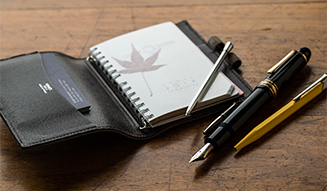
My only cherished item is an Hermès planner. I've been using the same one for about 30 years, buying a new one when the old one wears out. This is probably my third cover. I write notes on sticky notes, attach them to my schedule, and discard them when done. The cover pocket perfectly fits business cards.
Then there's a Montblanc fountain pen and a Caran d'Ache ballpoint pen. I own three or four of these ballpoint pens in different colors. These are truly my only work tools. As the president, I don't carry a bag.
—Besides the ballpoint pen, do you also carry a fountain pen?
Yes. Sometimes I feel like writing with a fountain pen. I like fountain pens because they allow me to express my individuality; the writing gains character. I always use a fountain pen when writing letters to people I've worked with.
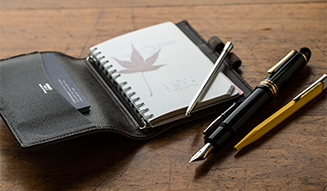
My work tools: an Hermès planner, a Montblanc fountain pen, and a Caran d'Ache ballpoint pen.
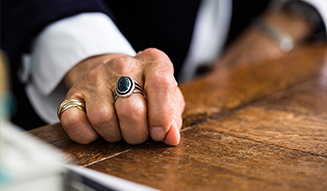
He says Native American accessories are his lucky charms.
—What are your lucky items, Mr. Kei?
I always wear Native American items. The ring features Lander Blue, a rare type of turquoise. The bangle is a collector's item made from crushed genuine silver coins, known as 'coin silver'.
Ralph Lauren's depiction of Western trad style had a profound impact on me, and I began to admire Native American items from America. I felt compelled to wear something from that aesthetic.
—Where did you purchase the ring and bangle?
I bought both at a shop called "GOD TRADING" in Daikanyama. I believe it's the best Native American jewelry shop in Japan. These are all one-of-a-kind pieces that I happened upon in the store. In that sense, I suppose they are my lucky items? Unlike women's jewelry, I wear them every day without changing them.
—Could you also tell us about your usual wardrobe?
All my clothes are custom-made. I primarily have them tailored at "Tailor Caid" in Shibuya. My shirts are ordered from "Stephen Lachter" on Savile Row in London (Note: he established a new company with fellow artisans and relocated in 2011). My hats are custom-made by request at "KIJIMA TAKAYUKI."
And my glasses are from "GROSS." These frames are also my own original design.
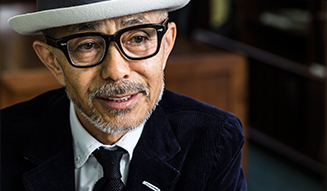
Kei, who says he prefers clothing with a masculine aesthetic.
—Why do you insist on custom-made items?
Well, it's because the world doesn't cater to me (laughs). Honestly, ready-to-wear is better in terms of cost-effectiveness. But there's a mismatch in size and sensibility.
First, there's the size. Manufacturers of ready-to-wear don't really cater to short people like me. Additionally, in terms of sensibility, current fashion is too modern for me. It's too fashionable, which I dislike.
This might sound subjective, but the designs are geared towards women. They're all about appealing to women.
—They seem to be trying too hard to please.
Yes. At times, they're too Italian, and at other times, too British.
I prefer clothing with a masculine perspective. That is to say, a universal style. It's the kind of attire seen in Shochiku and Toho films from the 1950s and 60s. It's clothing that looks cool from a man's point of view.
—Does this commitment to your own style connect to why you founded FAIRFAX?
Yes, it does. I feel I've been pursuing that kind of aesthetic all along.
GOD TRADING
Business Hours | 12:00 PM - 9:00 PM
Closed Wednesdays
Address | New Ebisu Heights 103, 2-11-11 Ebisu, Shibuya-ku, Tokyo
Tel. 03-3770-7271
http://sokuza.com/3452/
KENT HASTE & LACHTER (formerly Stephen Lachter)
Business Hours | By Appointment
Address | 7 Sackville Street, London, W1S 3DE United Kingdom
Tel. +44-20-7734-1433
http://kenthaste.co.uk
GROSS
Business Hours | 11:00 AM - 8:00 PM
Address | Ginza Shirai Bldg. 1F & B1F, 2-5-18 Ginza, Chuo-ku, Tokyo
Tel. 03-5579-9890
http://www.gloss-eyes.com
Tailor Caid
Business Hours | Monday-Saturday 11:00 AM - 8:00 PM, Sunday & Holidays 11:00 AM - 6:00 PM
Closed Thursdays, 2nd & 4th Sundays
Address | Nakajima Bldg. 2F, 42-15 Udagawa-cho, Shibuya-ku, Tokyo
Tel. 03-6685-1101
http://www.tailorcaid.com
KIJIMA TAKAYUKI
Business Hours | 12:00 PM - 8:00 PM
Address | East Daikanyama 1F, 2-17-4 Ebisu-nishi, Shibuya-ku, Tokyo
Tel. 03-3770-2174
http://www.kijimatakayuki.com
Behind the Scenes of Business Professionals
Part 9 | Michihiko Kei (President, FAIRFAX)
Universal Style Learned from America (2)
Joining a Long-Standing Tie Company, Encountering Ralph Lauren
—You were a student during the peak of the Ivy League boom, weren't you?

Yes, I started wearing ties around the age of 18, around 1967, when the Ivy League look began to gain attention. All the Ivy League enthusiasts back then wore ties. It was a rite of passage for boys becoming men.
My first ties were a black knit tie and a poplin regimental tie from a now-defunct long-standing tie shop called "Hishiya." I eventually ended up working at "Hishiya." It was a difficult time to find employment due to intense student activism. So, I started as an apprentice.
Tie shops back then were like sneaker shops today. There, I recommended the same ties I had first bought myself to customers, and they became a huge hit. I sold a lot of them at the store.
Looking back, that was my origin.
—I heard that Hishiya was the first company in Japan to contract with Polo Ralph Lauren, and you were the person in charge of finalizing that agreement.
Yes. In 1971, I took a business trip to NY and Washington and encountered the Polo Ralph Lauren brand for the first time. While the brand was already a huge hit in America at the time, it was not yet known in Japan. Even though I was only familiar with Ivy League style, I experienced a kind of culture shock from Ralph Lauren's "new trad" world.
Two years later, we signed a short-term contract, solely for ties, to sell the Polo Ralph Lauren brand in Japan. Ralph Lauren started as a tie brand, so he had a deep personal connection to ties. He probably thought a long-standing tie shop would be a good partner.
This might sound like bragging, but I'm probably the only person in Japan who knew Ralph Lauren's office and delivery house back then.
—After successfully completing that major project, you left Hishiya in 1976 and established your own company, correct?
Yes, that's correct.
We Want to Be Luxurious, Even if Small
—The company name FAIRFAX was inspired by a hotel in Washington D.C., wasn't it?
Yes. Initially, it was "RyuFashion," but I felt that wasn't right. Three years after going independent, in 1980, I saw an article about a hotel in the August issue of "GQ" and immediately changed the company name (laughs).
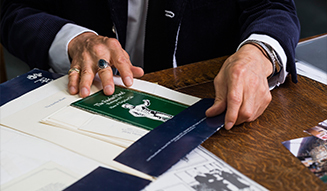

The company name originates from a hotel in Washington D.C. that he coincidentally found in "GQ" magazine.
—Was it a so-called 'small luxury hotel'?
Yes. I visited many times to grasp the hotel's atmosphere. At the time, not many people traveled to Washington, so it was a valuable experience.
If you want to understand the adult world in America, you inevitably encounter class society. Washington had the White House, and class society remained. The easiest way to grasp that atmosphere was through hotels. Hotel bars, in particular, are the gateway to adulthood. The Fairfax Hotel building still stands today and operates as a Ritz-Carlton.
We want to be luxurious, even if small. That's the sentiment I wanted to convey with the company name.
—It sounds like you're striving for a higher level of spirituality.
I don't have any cool mottos. What I have is 'knowing my place' and 'enduring with dignity.' I don't aim for the mass market. I don't want to become a mass-produced apparel brand. I operate within my own means, endure with dignity, and focus on the core spirit. That's my approach.
Although our company currently handles apparel, it's purely to enhance the spirit of our ties.
—By the way, what do you find appealing about America?
In a word, 'standard.' In the sense of not being overly eccentric, I think it differs from Britain or Italy. They retain customs from their aristocratic societies. In America's case, they've completely generalized it. I like that.
—Pursuing high quality within mass production. High quality for the masses...
Exactly. I feel that approach reveals a more refined simplicity, which I like. While tastes vary, perhaps a slightly less ostentatious style suits me better.
Behind the Scenes of Business Professionals
Part 9 | Michihiko Kei (President, FAIRFAX)
Universal Style Learned from America (3)
There's Something Men Should Learn at Bars
—Are there any favorite bars that are still in operation today?
Currently, I like the jazz bar at "The Lowell Hotel." It's on the Upper East Side in NY. I also enjoy the bar at the "Four Seasons Hotel New York."
Among city bars, I frequent "Tender" in Ginza. This is my place for mental training. Lately, good hotel bars have been disappearing. They've become a bit too stylish, which I find off-putting. That's why my interest is shifting towards city bars that retain a classic ambiance.
Mr. Ueda at Bar Tender is a seasoned veteran who has been shaking cocktails for nearly 50 years. He makes the world's best martini. I love martinis. I don't have a high alcohol tolerance, but I love strong drinks. It's American Trad, so one must drink martinis (laughs).

—Are bars a place for adult socializing?
Yes, there are older gentlemen there. You can learn a lot in such places.
—Are there any restaurants you'd rather not tell people about?
I'm not particularly particular about food, but I am a bit discerning about wine. Similar to how I focus on bars within hotels, my attention goes to the wine list rather than the food. Moreover, I only drink Pinot Noir. In France, that means Burgundy wines.
—Isn't the taste of Burgundy quite complex?
It's like me. Light yet rich (laughs). Japanese people prefer Bordeaux, but I dislike it. Since I'm not a sommelier, I leave the details like grape varietals and producers to the restaurant. I go to a place I like and drink at the counter. That's all.
Regarding your previous question about restaurants, I'll mention two: "Kissako" in Nishi-Azabu and "Bistro un coup" in Hiroo.
Both are small establishments. However, they focus on Burgundy wines. I'm currently fond of wines from a village called "Nuits-Saint-Georges," which is next to the village of Romanee. As for the taste? Since I'm not a sommelier, I can't describe it in words. Please try it if you have the chance.
At these two places, you can enjoy excellent wines even by the glass. That's what I appreciate. It's important to me that I don't have to order a full bottle, as I can't finish one. Also, I haven't had the chance to drink with a lovely lady recently (laughs).

"Kissako" in Nishi-Azabu. The name implies that guests should leisurely enjoy dishes made with seasonal ingredients and wine.
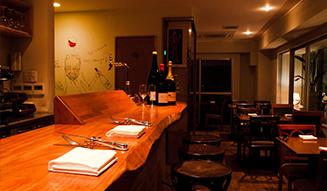
"Bistro un coup" in Hiroo. A restaurant where you can enjoy natural wines and colorful bistro cuisine.
—How do you spend your days off?
I enjoy physical activities, so I play golf from spring to autumn and engage in winter sports in the winter.
If it rains, I either relax on the couch at home or go to the movies. People from my generation loved movies. Nowadays, there aren't many good films, which is a shame for young people. Things created with digital technology are like manga. Old movies depict ordinary life, which is why they are good.
—What is the connection between the books you brought and your favorite reads?
Related to "On the Road," there's Jack Kerouac, a representative writer of the Beat Generation. There used to be cafes where they'd recite his poetry. I'm not from that generation, but I admired that scene.
Their movement had a significant impact on jazz, film, and art. In fact, it's as if they created subsequent American culture.
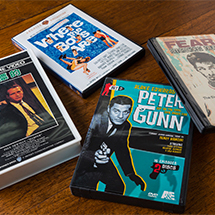
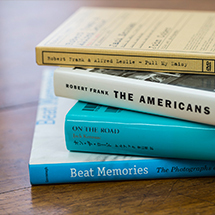
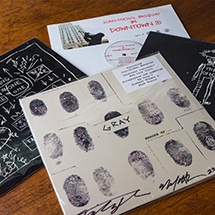
—Are these records related to Basquiat?
Yes. I love Basquiat. He first debuted in music with a band called "Gray." However, they weren't very successful. Because they weren't successful, not many records remain. Therefore, these now command a premium, perhaps around 100,000 yen each?
I bought them all for about $5 each. I became a fan when Basquiat debuted in New York in the 1980s and bought them then. The content is 80s techno, with some hip-hop mixed in.
My generation was all influenced by America. Most people then move on to Italy or Britain. However, my heart remains in America.
—Are there any information sources you regularly check?
I visit New York twice a year without fail. The information I gather there is the correct information for me. I observe everything in NY with my own eyes and feet.
For instance, in the morning, I watch news programs. I study the attire of the news anchors. By watching different networks, I can gather about 50 coordination photos in a day.
Then, in the evening, I go to a three-star restaurant. There, too, you can understand current fashion trends. Of course, I also conduct market research during the day. Encountering such firsthand information is the most important thing.
—In other words, information that hasn't been filtered by media editors.
Yes. Of course, I also check magazines, newspapers, and the internet. However, it's essential for me to feel something myself.
The Lowell Hotel
Address | 28 East 63rd Street New York, NY 10065 United States
Tel. +1-212-838-1400
http://www.lowellhotel.com
Tender
Business Hours | Monday-Saturday 5:00 PM - 1:00 AM (Last Order 12:30 AM)
Closed Sundays & Holidays
Address | 5F, Nogakudo Bldg., 6-5-15 Ginza, Chuo-ku, Tokyo
Tel. 03-3571-8343
Bistro un coup
Business Hours | Lunch 11:30 AM - 2:00 PM, Cafe 2:00 PM - 3:45 PM, Dinner 6:00 PM - 10:00 PM (Wine bar until 12:00 AM)
Closed Sundays
Address | 2F, 4-2-49 Minami-Azabu, Minato-ku, Tokyo
Tel. 03-6277-0889
http://www.bistro-uncoup.com
Four Seasons Hotel New York
Address | 57 East 57th Street New York, NY 10022 United States
Tel. +1-212-758-5700
http://www.fourseasons.com/newyork/
Kissako
Business Hours | 6:00 PM - 3:00 AM (Last Order 1:30 AM)
Closed Sundays, Holidays, and the 1st Monday of the month
Address | PLAZA KAY 2F, 5-1-1 Minami-Azabu, Minato-ku, Tokyo
Tel. 03-5475-5920
http://www.kissako.jp/kissakoHP/welcome.html
At the end of the interview, Kei stated, "My work is to continue contemplating the ideal V-zone." Embracing the unpretentious masculine style learned from America, the 'eternal boy' will likely continue to pursue his core values. How cool. It's truly a hard-boiled world.
Kei is currently focusing on Brooklyn in NY. He is particularly interested in how American Trad will evolve in this area, where many artists have moved from Manhattan, forming a new cultural hub.

Michihiko KEII
Founded the tie brand "FAIRFAX" in Aoyama in 1976. With a "Bold Traditional" approach originating from Tokyo, the company now also handles dress shirts. The name FAIRFAX was inspired by the Fairfax Hotel in Washington D.C. at the time, aiming for a brand that embodies intellect, dignity, and history, even in its smaller scale. Currently, he exclusively introduces carefully selected items that enhance suit styles.FAIRFAX's Proposalsis a series on OPENERS.