
Secrets behind the Success | Series Vol. 7: Colin Scott, Master Blender for Chivas Regal
Behind the Scenes of Business Success
Part 7 | Colin Scott (Chivas Regal Master Blender)
Guardian Connecting Past and Future (1)
What are the lives and thoughts of successful business professionals like on a daily basis? In our "Secrets behind the Success" series, we delve into the private lives of these accomplished individuals through interviews, revealing aspects rarely seen by the public.
"Whisky is a gift from nature," says our guest with a smile. He is Colin Scott, Master Blender for the quintessential Scotch whisky, Chivas Regal. These are professionals who create the golden liquid of whisky by combining malt, yeast, and water. Among them, the blender plays the crucial role of harmonizing dozens of different whiskies to achieve a complexity of aroma and a dazzling taste experience unattainable by any single malt. We invite Mr. Scott, who has dedicated nearly 30 years to this art, to guide us into the profound world of Scotch whisky.
Photographs by NAKAMURA Toshikazu (BOIL)
Text by TANAKA Junko (OPENERS)
Raised by Whisky?
—What does Scotch whisky mean to Scottish people?
While there are many types of whisky worldwide, the name "Scotch whisky" is a title bestowed only upon whisky produced in Scotland. It's cherished by millions globally, from the young to the old, men and women alike. For Scots, Scotch whisky is a source of pride and holds a very special place in their hearts. After all, the same methods have been preserved for centuries.


Whisky is broadly categorized into three types: malt whisky, made solely from malted barley; grain whisky, produced from grains like corn and wheat along with malt; and blended whisky, a combination of the two. Each possesses a distinct character. Blended whiskies, like Chivas Regal, are particularly known for their rich flavor. The moment it touches your palate, a complex aroma envelops your senses.
—What sets Chivas Regal apart from other whiskies?
It's undoubtedly its rich and mellow flavor. This is achieved through an artistic blending technique developed over 200 years ago, and by using the spirit from the Strathisla Distillery, known as the largest producer of single malt whisky in Speyside. The single malt from this distillery, with its fruity and floral notes characteristic of Speyside and a dry, nutty finish from maturation, imparts these qualities to Chivas Regal.
—Whisky is appealing because it can be enjoyed in various ways, whether neat or mixed with soda. Do you have a preferred way of drinking it, Mr. Scott?
As a blender, my work is essentially finished the moment you pour Chivas Regal into a glass (laughs). After that, it's up to you – whether you add water, ice for a rocks pour, mix it into a cocktail, enjoy it neat, or even have it as a highball, which is popular in Japan. My greatest satisfaction comes from seeing everyone enjoy it according to their own preferences.
However, I personally recommend the method known as "twice up." This involves mixing equal parts whisky and natural spring water in a glass. It's the best way to fully appreciate the whisky's aroma. This is also how we taste the whiskies when we are blending them. On a hot, sunny day, perhaps adding a couple of ice cubes to the glass would be nice.
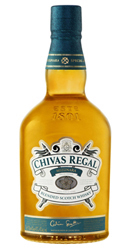
—What is the allure of making whisky, in a nutshell?
My father worked in the whisky industry, so whisky was always around me from a young age. It's no exaggeration to say I was 'raised by whisky' (laughs). Even after all these decades, what continues to captivate me is the distinct personality of each Scotch whisky, despite them all falling under the same umbrella.
Scotland is home to over 100 distilleries. While the basic process of fermenting, distilling, and maturing malt remains the same, the resulting whiskies from each distillery are entirely different. They range from light and floral to fruity and nutty medium-bodied whiskies, and even rich, dry, full-bodied ones, or intensely smoky varieties.
Furthermore, even whiskies from the same distillery can vary from cask to cask, especially malt whiskies. Our job as blenders is to select the best among them and combine them. We first marry malts with strong characters to further enhance their individual qualities, then envelop them with the mellow notes of grain whisky to create a harmonious blend.

However, blending doesn't automatically guarantee a delicious outcome. The combination of specific whiskies creates entirely different tastes and aromas. Some malt whiskies are versatile and harmonize well with others, while some possess such intense personalities that they require careful blending to truly shine. To me, this is the magic of Scotch whisky – the ability to create myriad aromas, like vanilla, herbs, fruits, and nuts, from just three natural ingredients: barley, yeast, and water.
Behind the Scenes of Business Success
Part 7 | Colin Scott (Chivas Regal Master Blender)
Guardian Connecting Past and Future (2)
An Unexpected Turning Point
—What kind of person do you think is suited to be a blender?
This profession demands a high level of expertise. Firstly, the ability to distinguish and identify various aromas is essential, much like a sommelier. Secondly, you need a keen sense of smell and taste to observe how whiskies mature over time and to judge the resulting blend.
Above all, the sense of smell is paramount. It can take about ten years to master distinguishing the aromas of different whiskies, and further training is required to accurately assess changes over time and the nuances of a blend.
—When did you realize your sense of smell was "superior to others"?

Honestly, when I joined Chivas Brothers, I never imagined I would be working with my sense of smell. For many years, my role was in production and quality control. After gaining experience in bottling and distillation in the production department, I moved to quality control, overseeing packaging. It was when I began working with alcohol quality control that a significant turning point occurred. I underwent a scent test, and based on the results, my superiors asked if I would consider becoming a blender. That was when I first became aware of my olfactory abilities.
After joining the blending department, my predecessor taught me the intricacies of Chivas Regal. When he retired in 1988, I succeeded him as Master Blender.
—You must have been surprised when you first received the offer.
Immensely so. I wondered if such good fortune could truly be mine (laughs). Although I underwent a scent test then, we are required to take one every year, so there's no guarantee I can continue in this role. Even after years, there's always a possibility of failing. Therefore, maintaining a consistent level is crucial. In that sense, it's a demanding world where skills take precedence.
The moment I truly felt the joy of this work was in 1997, when I created "Chivas Regal 18 Year Old." My signature appears on every bottle, much like an artist signing their masterpiece. It's a deeply fulfilling experience.
—Since then, Mr. Scott has introduced other masterpieces such as "Chivas Regal 25 Year Old"and "Chivas Regal Mizunara Special Edition."On the other hand, blenders have the significant responsibility of not only developing new products but also preserving the taste of existing ones. Between creating new whiskies and maintaining established flavors, which do you find more challenging?
Both are incredibly difficult, making it hard to choose. Take "Chivas Regal 18 Year Old," for example. It uses over 30 different whiskies, each matured in casks since 1989 for over two decades. Their taste and aroma evolve annually. The whisky used next year may not be in the same state as the one used this year.
Therefore, we adjust the recipe for each blend. The benchmark is not a past recipe, but the taste of "18 Year Old" itself. We fine-tune the proportions of the year's available whiskies to achieve the final "18 Year Old" flavor. It's quite demanding work (laughs). While challenging, each time brings new discoveries, ensuring it never becomes monotonous.
Our mission is to continue preserving the taste of Chivas Regal. We aim to encapsulate not only the flavor but also the surprise and emotion experienced with each sip. In essence, we are guardians.
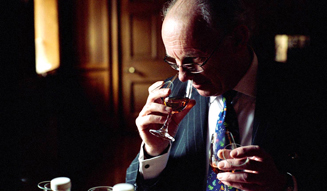
Scott tasting with a "nosing glass" in hand
—Is your nose your most essential tool at work?
Besides the nose, the essential tool for a blender is the "nosing glass," a special glass for tasting. It has a tulip-like shape, with a weighted base and a stem that tapers upwards. This design concentrates the whisky's aroma at the rim of the glass.
For tasting, we pour a mixture of equal parts whisky and water into this glass, resulting in an alcohol content of 20%. We then fill several glasses with the same amount and concentration of different whiskies and proceed with tasting them one by one. Despite the identical conditions, each taste is unique.
Then there's the blending room. It has no telephones or computers. Only the tulip-shaped nosing glasses and a comfortable chair. It's a vital space where I can focus solely on the taste and aroma of whisky, undisturbed by anything else.
Behind the Scenes of Business Success
Part 7 | Colin Scott (Chivas Regal Master Blender)
Guardian Connecting Past and Future (3)
What Habits are Essential for a Blender?
—Do you have a favorite bar you frequent when you go out for a drink, Mr. Scott?
I live in the suburbs, so I don't go out very often, but I have a favorite bar in Edinburgh called "The Dome." It's housed in a converted old bank, with a classic exterior but a strikingly modern interior. I find the balance between tradition and modernity there to be superb.
Traditionally, pubs were more popular in Scotland than bars, primarily for drinking beer. However, recently, cocktail bars, where cocktails are the focus, have been increasing. People are gradually shifting from pubs to cocktail bars.

The Dome
14 George Street, Edinburgh EH12 2PF, Scotland
Tel. +44-131-624-862
The Dome, which follows this trend, features a very classic building. I appreciate that blend.
—Do you have a favorite pub as well?
In Glasgow, there's a place called "The Horseshoe," named after the horseshoe used for a horse's hoof. The bar counter is actually shaped like a horseshoe. Of course, you can enjoy Chivas Regal there too.
—Just as opera singers take care of their voices, what precautions or habits do you maintain to protect your precious sense of smell, Mr. Scott?
I don't smoke. On weekdays, I avoid spicy foods, garlic, and other strong-smelling or taste-altering foods. I also refrain from using scented aftershaves or perfumes, and I don't use soaps with fragrances. By minimizing external influences, I strive to keep my sense of smell consistently fresh.
It's also important to continue tasting regularly. This involves smelling the aromas and tasting the flavors daily. However, I never swallow. Since everyone drives home, drinking is not an option. Responsible enjoyment of alcohol is crucial for anyone involved in the spirits business.
—Even without swallowing, can you still perceive the taste of whisky?
Absolutely. Tasting is primarily about the nose. The tongue can only distinguish four basic tastes: sweet, sour, bitter, and salty. When you pinch your nose while eating, you can't identify what you're consuming because the nose is responsible for everything else. When you eat a banana, it's your nose that identifies it as such.
Try this at home: pinch your nose and take a small bite of a banana. You'll only perceive a faint sweetness. Then, release your nose, and the distinct flavor of banana will flood your palate.
—How do you spend your days off to relax?
I spend time with my family and enjoy gardening. I have a vegetable patch, flower beds, and a small greenhouse at home where I spend my time. While I don't tend to them constantly, it's a cherished pastime.
I also enjoy golf and frequently walk my dog. However, my absolute favorite activity is salmon fishing. I love the entire process: going to the river and waiting for the salmon. Sometimes, I catch a large one, around 10 kilograms. Most catches are typically around 5 kilograms.


—Do you have a lucky charm that you always wear during important occasions?
It's a small green jade pendant I received as a child during a family trip to New Zealand. I always wear it around my neck. It's said that buying jade for oneself brings bad luck, so it's best to have it gifted by someone else. According to Maori tradition, jade brings good fortune, health, and peace.
Additionally, for significant events, I often wear traditional Scottish attire. This is a habit born from my deep affection for my homeland.
He is both a "craftsman" who inherits flavors passed down through generations and a "creator" who produces entirely new tastes. The force behind these dual roles is none other than his own nose. Armed with a rare olfactory talent, discovered unexpectedly one day, he continues to pursue the new taste of "Chivas Regal" every day.
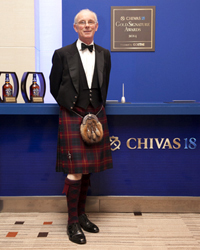
Colin Scott
Born in 1950 in the Orkney Islands, Scotland. Joined Chivas Brothers in 1973, apprenticing under blender Jimmy Lang to learn the fundamentals of blending. Appointed "Master Blender," the highest position in blending, in 1989. Launched "Chivas Regal 18 Year Old" in 1997 and "Chivas Regal 25 Year Old" in 2007. In 2013, he crafted the Japan-exclusive "Chivas Regal Mizunara Special Edition." While upholding tradition, he continues to create new and captivating flavors.