January 7, 2015
INTERVIEW | Tokyo Skytree Lighting Designer Hiroto Tō (Part 2)
INTERVIEW | Lighting Designer Hirohito Totsune
Illuminating Skytree (Part 2)
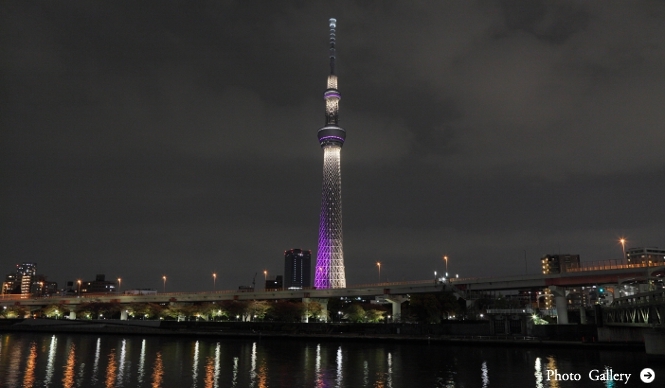
The illumination of Tokyo Skytree (hereafter, Skytree) was designed with the image of a “nighttime Mt. Fuji” gently floating in the sky. It’s a light that evokes delicate nuances, favored by the Japanese aesthetic. The design was handled by young lighting designer Hirohito Totsune. What were Totsune’s aspirations for Skytree, as he stated, “I wanted to express Japanese sentiment”?──.
Photographs (portraits) by JAMANDFIXPhotographs (Tokyo Sky Tree, Tokyo Hotel) by PanasonicInterview & Text by JUNKO TANAKA (OPENERS)
What LED Can Do
“Until now, light sources could only express white, incandescent colors, or flashy colors like red and green, reminiscent of pachinko parlors. But with the advent of LEDs, we can now create colors arbitrarily. For example, with blue LEDs, there’s a method of blending phosphors to emit light in a desired color. If you say, ‘I want this pink,’ you can achieve it by mixing multiple types of phosphors, specifying the percentage of each color.”
Totsune, who aimed to “change the common perception of light colors” using such LEDs, decided that all 1,995 lighting fixtures for Skytree’s illumination would be LED-based after a year of various verifications.
“When we decided to go all-in with LEDs, I wanted to change the conventional wisdom about color. I wanted to convey that there are more delicate and beautiful colors. I wanted to show that there are ‘Japanese colors’ that are hard to define. Lighting design originally developed in the West, but it would be boring if it were the same everywhere in the world, wouldn’t it? Western lighting design tends to focus on ‘light and shadow.’ But for us Japanese, it’s about ‘yin and yang’ (shadow and light).
“If you ask us ‘yes or no,’ we tend to be indecisive, don’t we? In the West, there’s a tendency towards ‘black or white,’ but we think, ‘No, gray is also good. Why not just blend them?’ (laughs). That’s precisely ‘yin and yang’ in terms of light. It’s like fully utilizing the spectrum between black and white, as in sumi-e ink painting. We Japanese have always found beauty in that.”
The gentle light emanating from Skytree was a product of the uniquely Japanese sensibility that finds beauty in subtle nuances.
“Illumination can have a Western beauty of illuminating everything brilliantly and majestically, but doing so would mean constantly using maximum energy. I was thinking about how to address this. At that time, by using ‘yin and yang,’ instead of painting everything, we create areas that are illuminated and areas that are not, with some areas subtly lit. This way, while aiming for a perfect overall appearance, we can achieve it using about half the energy required to illuminate everything. I wanted to challenge that. If you look closely, you’ll notice many areas that aren’t illuminated at all, but we connect them in a way that makes it hardly noticeable.”
“Energy saving” is also a theme for Skytree as a whole. Totsune, who approached energy saving with his own unique philosophy, seems to have greatly reflected that philosophy in his lighting design.
“When we talk about energy saving, the image of reduction is strong. While reduction is important, ‘What are we using energy for?’ Isn’t it to spend enjoyable and fulfilling time? The most energy-saving approach for Skytree would be not to illuminate it at all, but no matter how much energy we save, people would be terribly disappointed. That’s meaningless energy saving. Ultimately, a sense of balance is crucial. How to achieve the maximum effect with the minimum amount of light. I believe finding that balance is important.”
This is where LEDs come in. It’s a Japanese-born lighting technology that enables energy saving by “achieving the maximum effect with minimal light.”
“LEDs, when combined with reflectors that gather and project light over long distances, produce a strong beam. Although the LED light source itself is small, its beam is powerful, so by creating a large reflector, the light travels incredibly far with sharp definition. It appears to shine as a symbol of illumination, but it uses very little light, maximizing its efficiency. Because the lighting fixtures are highly efficient, energy saving is achieved.”
LEDs were the savior that could achieve both beauty and energy saving.
INTERVIEW | Lighting Designer Hirohito Totsune
Illuminating Skytree (Part 2)
Five Years to “Not Disappoint”
The path to realizing Skytree’s lighting was a true journey of “ups and downs,” taking a full five years from when Totsune submitted his design proposal in 2007.
“I don’t think it took more than a day to come up with the design. The direction I wanted to take emerged instantly. There was no creative struggle. Rather, I realized how much energy and time it takes to bring a design to fruition. Also, given the scale of the project, I moved forward with the aim of bringing joy to as many people as possible. For example, with the transition to LEDs. If we had used conventional discharge lamps, it might have been completed in a shorter time. However, despite the difficulties, by using LEDs, we could demonstrate ‘Japanese technology is here’ to the world, and it ultimately led to energy savings. The ability to adjust brightness through dimming also greatly expanded the range of expression. The same applies to color. In that sense, the fact that the pace of Skytree’s development and the advancement of LED technology coincided perfectly was a truly fortunate encounter.”
While Totsune states he “didn’t feel pressure” looking back on the five years, the project, which had generated much discussion with completed image CGs circulating for two years prior, meant that the desire “not to disappoint” those eagerly awaiting it was always at the forefront of his mind.
“Spending this much time on a single project was a first for me. I grew considerably through this project, as it involved so many people. However, I didn’t really feel pressured. From the moment I was chosen, I believed that ‘it would likely be well-received,’ and I worked with that conviction. I had expected to face more criticism, but surprisingly, that wasn’t the case. It was fortunate to feel so much support as I moved forward.
When the test lighting took place on April 17th, many people took photos and posted them on blogs and Twitter. Seeing that, I felt a sense of relief, realizing, ‘It’s being accepted.’”
The biggest “mountain” encountered during the five years was after the Great East Japan Earthquake in March of the previous year, a time when news was dominated by calls for power conservation. However, that mountain turned out to be less daunting than expected.
“When the earthquake struck, I thought Skytree might not be illuminated, but immediately, we received many voices from the media and the public saying, ‘Please do illuminate Skytree.’ Amidst the daily news about ‘power saving,’ people urged, ‘Please don’t stop illuminating Skytree; it’s a symbol of hope.’ When we discussed what to do, the consensus was, ‘We’ve been proceeding with the concept of maximizing effect while considering all possible power savings, so let’s confidently move forward with this.’ The concept remained unshaken even after the earthquake.”
What emotions welled up in Totsune when he saw Skytree completed, after overcoming numerous challenges?
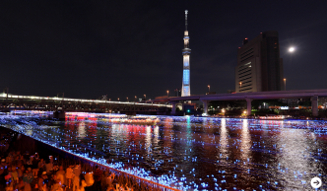
“On May 6th, there was an event called ‘Tokyo Hotaru’ where fireflies made of LEDs were released into the Sumida River, and I went to see it. During the first half, Skytree wasn’t illuminated, but everyone seemed eager for it to light up, waiting with cameras in hand. As time passed, people grew impatient, asking, ‘When will it turn on?’ When it finally illuminated, a huge cheer erupted, and for me, that was incredibly moving. It showed me how much they anticipated Skytree, how this scenery comes alive only with its presence. At that moment, it had already become everyone’s Skytree, and that made me very happy.”
Totsune, who has always loved gazing at the moon and stars, seems to have incorporated the serene light of celestial bodies, which he describes as providing a “sense of soothing the body,” into Skytree.
“I called the color illuminating the main structure ‘gold.’ A slightly yellowish white, I thought that color would be nice. Recently, there was a supermoon, wasn’t there? When I saw it, it was the exact same color as what I called ‘gold.’ Thinking about Skytree floating in the night sky, I realized then that while I wanted its form to resemble Mt. Fuji, the color I envisioned for it floating in the sky was an incorporation of the moon’s radiance.”
Totsune, who has always strived to “do his utmost for what he believes everyone would want,” quietly hopes that his lighting will become “a source of encouragement, making people feel they can face tomorrow with renewed vigor.”
──INTERVIEW | Lighting Designer Hirohito Totsune (Part 1) here
Hirohito Totsune
Born in 1975. From Tokyo. Graduated from the Department of Architecture, Faculty of Engineering, University of Tokyo. Drawn to lighting design, he transitioned from architect to lighting designer. Joined Lighting Planners Associates in 1997. Established Sirius Lighting Office in 2005. Selected as the lighting designer for Tokyo Skytree in 2007. Major works include the chapel “Lucemare” at Hotel Nikko Tokyo and “Mid-Autumn Moon Viewing and Light Play” at Hamarikyu Gardens. He is a young lighting designer currently garnering significant attention for his designs that capture Japanese sentiment.