Twiggy | Vol. 10 Miho Matsuura's Choice of Inns (Part 1)
Twiggy
Vol. 10 Miho Matsuura's Choice of Lodging (Part 1)
Miho Matsuura, a popular hairstylist, has been at the forefront of fashion trends for years with her salon "Twiggy," which she has led since 1990. Last year, a project she had been nurturing for several years finally came to fruition: her own line of "organic shampoos and treatments." In an era of remarkable scientific leaps in the cosmetics industry, why has a leading figure in fashion consistently focused on "organic"? This series will unravel the secrets behind it.
Narration by Miho MatsuuraCompiled by Yuka KobayashiPhotos by Koji Sato
From the deep mountains of Kumano to Africa, Matsuura's travels are remarkably diverse. And when a pioneer of fashion travels, one naturally wonders, "Where does she stay?" While I deliberately avoided mentioning accommodations in previous travelogues, Matsuura explained that she separates the act of "travel" from the lodging itself, experiencing a different kind of inspiration at the places she stays. Matsuura, who once experienced luxury hotels in her thirties and felt satisfied, now prefers "high-end minshuku" where one can feel the owner's way of life within the space. She clarifies that "high-end" here doesn't just mean luxurious, but rather a place where guests can comfortably immerse themselves in the owner's lifestyle, feeling as if they live there.
—What are your criteria when choosing a place to stay during your travels?
The accommodation I choose when traveling naturally aligns with the purpose of the trip. So, as I mentioned before, I was most interested in luxury hotels like Aman in my thirties and stayed there about 10 years ago. In Palermo, Sicily, I stayed at the "Grand Hotel Villa Igiea," which was the setting for the movie *The Godfather*. In Andalusia, Spain, I stayed at the "Parador de San Francisco," a state-run hotel within the grounds of the Alhambra. It was a castle converted into a hotel, and the price was quite high, but at the time, I strongly felt that "a woman in her thirties should go to places like this."
However, staying in such places makes you realize that "expensive things have a reason for being expensive." Conversely, you also come to understand what is "good precisely because it is inexpensive." This is another lesson I've learned from my travels. It's like saying, "I wouldn't buy work clothes at Uniqlo, but I do buy pajamas and Heattech for home wear" (laughs). As a side note, the collaboration between Jil Sander and Uniqlo was surprising in that sense. Jil Sander's appeal lies in the high quality of its materials and its delicate, subtle designs, so I was full of questions about how it could be done at Uniqlo (laughs). Ultimately, it's about where you place the value of cost performance, isn't it? Everyone's values are different, and that's perfectly fine.
—You seem to choose your accommodations with a unique approach, even on the Spanish island of Ibiza, famous for its luxury beach resorts and nightlife, and in Jamaica.
Ibiza is where the hippies of the 70s eventually ended up. Many people started something there, so the villa cruises are fascinating. You see rows of villas belonging to people who have achieved great business success, while at the same time, there are also quiet villas belonging to those who have abandoned Paris or London. On this island, rather than the cafes (clubs), it's more interesting to gaze at the various villas and observe the individuality and life choices reflected in them. The way houses are built to showcase lifestyles is truly intriguing.
The place I stay in Ibiza is a high-end minshuku called "La Terrrazza." The owner here is also a former hippie who has lived in Ibiza since the 70s. While running the inn, she also works with local real estate agents to arrange rentals of villas when the owners are away. Although villa rentals are mainly available in the off-season, if you request a villa rental from her, she will also introduce you to villas owned by architects, interior designers, and music artists... Some of these villas are incredibly cool.
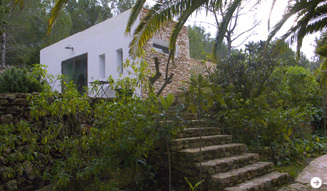
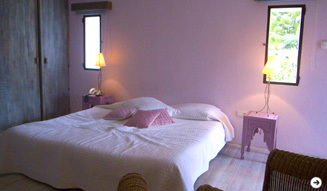
The hotel "La Terrrazza" on the Spanish island of Ibiza. It's located in the villa district on the opposite side of the island, a completely different face from the image of Ibiza's cafes (clubs) and rave parties. The hotel's French owner's taste is evident in every detail. The cuisine focuses on dishes made with local vegetables from nearby fields and fish, prepared with care by the owner, like a mother's cooking. There's a pool, tennis courts, and a living area for everyone to gather... The clientele is also very good, creating a space where energies can be exchanged.
Vol. 10 Miho Matsuura's Choice of Lodging (Part 1) 2
—I didn't know there were high-end minshuku with a 70s vibe in Jamaica too.
In Jamaica, "The Caves," a high-end minshuku near the Negril Lighthouse, is wonderful. They bought the entire cliffside, gathered artists, and dug caves to create a restaurant – they're doing truly interesting things.
Of course, it's obvious that a lot of money has been invested, but it's not gratuitously opulent; the way the money is spent shows excellent taste. They've created a space that is wonderful and pleasing to everyone.
Seeing this style, I feel the "life lessons" of those who have lived through the 70s, and I think, "Ah, that's wonderful." ... I really like the hippies of the 70s (laughs).
They are like older siblings I look up to. The intelligence of the hippies, the very process of becoming a hippie, forms the basis of their lives. I love the unique sense of resolution and the clear boundaries they established after overcoming their struggles and hardships, which are conveyed through the things they created. And there's a strong rebellious spirit, emblematic of the 70s (laughs).
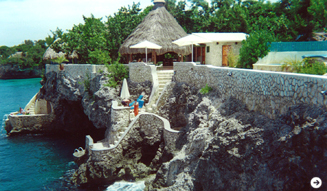
"The Caves" in Jamaica is a hotel built on a cliffside. The caves below the cliff serve as the restaurant.
—Did you have a similar discovery with accommodations in Morocco?
Yes. "Riad Zarka" in Marrakech is one such place. Talented Italians, French, and Spanish individuals have renovated old Moroccan houses according to their own tastes and are operating them as accommodations. Although it's a small inn, the owner's sense of style shines through, creating a space that makes you think, "They live with such good taste."
A lifestyle that has successfully satisfied one's ego doesn't need words to convey "this is how they've lived," does it? It makes you want to meet the owners and talk to them. Isn't the ability to connect with the owners in that spirit the essence of a "high-end minshuku"? It feels like you're connecting with the "country" or the "village"... And that "not too close, not too distant" sense of distance is also wonderful!!
And these individuals, almost without exception, contribute to society in various ways. They communicate subtly with many people and don't live solely to satisfy their own egos. I find that truly admirable. The sensibility of these people connecting with each other, not necessarily becoming powerful but simply linking through what they can do, resonates with my idea of self-expression and personal taste, which I appreciate.
It's not that I dislike or am tired of luxury hotels. The appeal of luxury hotels is still endlessly fascinating. However, I often feel, "For this much money, is this all you can offer?" (laughs) There's a lot of style that's just for show. So, when I travel, I might stay at a slightly larger hotel – one that everyone calls wonderful – just for the first day when I'm tired from the flight, and then move to a high-end minshuku the next day. I sometimes stay at such hotels before returning home, as a way to reset before going back to work. In those hotels, I'm looking for something like, well, simply "service that doesn't fuss over the guest."
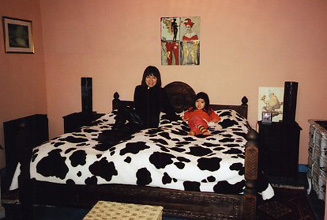
Guest room at "Riad Zakka" in Marrakech. The interior design differs for each room.
Minshuku are full of thoughtful touches. "What are your plans for today?" "Did you eat?" "Need laundry?" (laughs) Of course, I love that. Hotels where I can almost mistake myself for living there are my form of "escapism," and a time to get to know the country or town a little more deeply. By doing so, I believe I can discover my own scale, both large and small, and reset myself.
—What is the appeal of high-end minshuku that luxury hotels lack?
More than just liking a place, it's the encounters there that make me feel excited and interested in my own lifestyle. And there's so much to learn, truly. It's not as straightforward as "this coordination would be a reference for my home interior," but rather, through what I see and the space, I connect with the mindset of the creators, and that resonates with my own sensibilities. I find the inns called "high-end minshuku," where you can feel the owner's kindness, their personality, and their history, to be the most relaxing places to stay.
...However, of course, it can be difficult to determine if a place is the environment I'm looking for without actually being there. Warmth and the natural scents of a living environment... these things are crucial for "relaxation," but naturally, one can also get tired of them. I've also stayed in private homes in several places, but sometimes the closeness to the owner made me tired due to the need for consideration. In those moments, I miss the liberating feeling of being left alone in a luxury hotel.
I mostly get information about accommodations through conversations with my daily clients. I actively share my preferences and interests. Then, they might suggest, "In that case, you might like this place too, Matsuura-san." To keep the excitement going, I feel I need to free myself. So, from the time I thought, "I have a family now, and I'm no longer falling in love with men," my travel and accommodation choices have become increasingly detailed (laughs). I think it's the easiest and most straightforward thing to do.