OPENERS Declaration: Let's Make Japan a Better Place to Live!
What kind of eco-friendly, sustainable society have we glimpsed in the post-3.11 era?
Let's transform Japan into a more livable place, now!
Text by NAKAMURA AkikoIllustration by MORII KENGOPhoto by Andrea Carter-Bowman / People Tree
We had already begun our journey towards realizing a "sustainable lifestyle"
Eco, organic, LOHAS, ethical… For a long time, we tended to view these terms within the context of our everyday lives. Waking up and applying makeup with cosmetics made from organic ingredients, commuting to work or school by walking or cycling whenever possible, choosing pesticide-free natural foods that are gentle on our bodies and the planet. When shopping, we'd check if purchases contribute to charity or if they were made without the exploitation of children or women, carefully selecting items based on solid criteria. We'd pay more attention to brands making efforts to reduce CO2 emissions, such as prioritizing sea freight over air freight. Instead of chasing trends, we'd choose good quality items that we like and can use for a long time. In the past few years, haven't the number of people making discerning choices steadily increased?
It seems we were in a transitional phase, where by everyone contemplating "What is true richness?", we were practicing sustainable living and society as if it were the most natural thing in the world.
Now is the chance to focus on the larger societal structures themselves and bring about change!
The event in March,the Great East Japan Earthquakeleft deep scars on Japan, but it also provided us with an opportunity to consider what kind of new society we should aim for.
First, as you've all surely noticed, the "criteria for consumption" has further shifted. In addition to the long-standing issue of "realizing a sustainable lifestyle," we've begun to deeply consider "how to support the reconstruction of the disaster-stricken areas while keeping the economy moving." When it comes to food, clothing, shelter, and anything related to daily life, let's choose items that contribute to the disaster-stricken regions—This sentiment has spread. Haven't the concepts of recycling and sharing also expanded further?
What does it take for us to "remain safe"?
Even now, more than three months after 3.11, radiation continues to be released from the Fukushima nuclear power plant, and we are left watching helplessly, in a state of near resignation. What has happened cannot be undone. However, it is possible to build a future that prevents this from happening again. We are at a major turning point, questioning the validity of nuclear power plants, which have been called "clean" precisely because they do not emit CO2, and fundamentally shifting our society from its roots.
What OPENERS is now focusing on is this new societal structure centered around "energy." What kind of future vision does it paint?—Electricity, which we previously only bought from power companies, can now be generated by ourselves, enabling more interactive exchanges. Homes and communities can generate their own power from natural energy sources like solar and wind power. In this system, EVs (electric vehicles) can act as batteries, allowing electricity to be drawn when and where it's needed. If your home generates surplus electricity, you can even sell it back to the grid. It's entirely conceivable that neighborly exchanges of "lending and borrowing electricity" could become commonplace. At the core of this energy supply system seems to be a deep-rooted sense of "sharing."
The wave of "sharing" spreading from interactive exchanges
Energy, which we previously only received, can now be exchanged bidirectionally. This is said to be very similar to the phenomenon that occurred with the spread of the internet. For example, someone who was merely a consumer can become a buyer on online auction sites. Those who were previously information recipients can now become media themselves, disseminating information through blogs, Twitter, Facebook, and YouTube. Countless small communities are formed, and information is shared within them. What has happened in the information society over the past few years is now happening in the energy sector.
Towns kind to people and the environment = "Smart Cities"
Cities that have realized this system are often called "Smart Cities." So why is the ability to mutually exchange electricity in these "Smart Cities" a good thing? It's because Smart Cities are "societal systems that minimize the need for offsets." Unnecessary electricity is naturally cut off, and surplus power can be supplied where needed. Because the system is designed to minimize CO2 emissions from the outset, you can naturally act in an eco-friendly way without consciously trying. It becomes easier to continue the eco-friendly actions we've cultivated. And it deepens connections with people and the community——it's possible to realize such a lifestyle.
What we wish for is very simple. For example, the dew-kissed flowers glistening in the morning, the sunlight filtering through deep green foliage, the sunset painting the sky in shades of red. If we can feel such ordinary happiness with the people we love, simply by seeing something beautiful and thinking "it's beautiful"——in other words, "living in harmony with the beauty of the Earth in a safe environment," that's all there is to it, I believe. The happy scenes that we humans have felt since ancient times. If we can move closer to our ideal life while maintaining our current one, wouldn't that be wonderful?
Finally, let us share a quote from the great writer, Tolstoy.
"When we are thrown off the track of our usual life, we think it is all over."
"But it is only then that the new and the good begins."
"As long as there is life, there is happiness."
by Tolstoy
"But it is only then that the new and the good begins."
"As long as there is life, there is happiness."
by Tolstoy
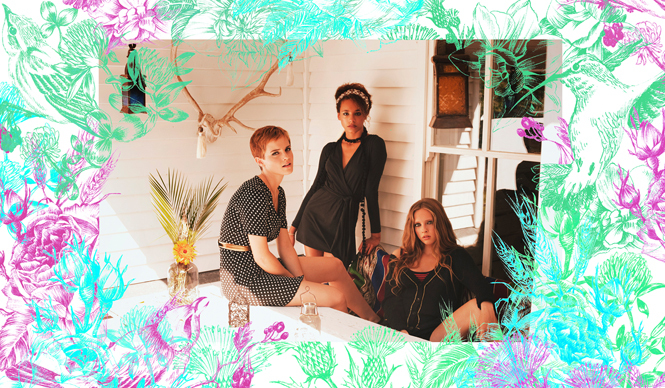
*The top image is from "SoFT," a collection created through a collaboration between People Tree, a brand leading fair-trade fashion, and British actress Emma Watson. Emma herself was involved in every planning stage of the collection, including item colors, fabrics, silhouettes, and the handcrafted details.