JOHN LOBB | The Making of a Perfect Pair of John Lobb Shoes (1)
Full Factory Report: From Leather Inspection to Cutting
The Making of a Masterpiece (1)
John LobbNorthampton, the spiritual home of British shoemaking, is home to factories for brands including John Lobb, Edward Green, Crockett & Jones, Church’s, Cheaney, and Tricker’s. John Lobb’s factory stands on Oliver Street, in the heart of the town located northwest of London. In a surprisingly modest and aged brick building, far from the image we hold of “John Lobb,” we present a photo report on the creation of a “masterpiece,” spread across four installments. Each installment reveals the manufacturing process with 40 photographs, totaling 160 images.
Text by KAJII Makoto (OPENERS)Photographs by ARAKI Ryuji
Unceasing Innovation and Meticulous Quality Control
This factory handles all aspects of ready-to-wear production, from last development to design. It is also where the “By Request” shoes, familiar to John Lobb aficionados, are made.
While John Lobb’s pinnacle, bespoke (fully custom-made shoes), are crafted in Paris, the staff at this Northampton factory are less artisans and more specialists in their respective fields.
For instance, Mr. Martin, whom we will introduce later, has been with John Lobb for 26 years and is a specialist in “skin stitch,” a traditional British hand-sewing technique. He also doubles as the cutting manager, responsible for cutting all new samples for ready-to-wear shoes.
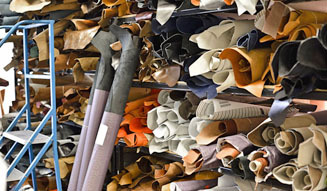
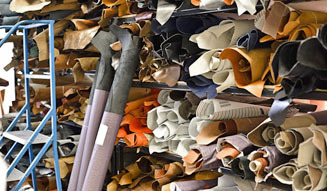
The New Leather Inspection Area, Added with the Factory Expansion
Recently, during an interview with Creative Director Mr. Andres Hernandez,Creative Director Andres Hernandezwe inquired about the factory expansion. Visiting the newly established leather inspection space, we were able to experience firsthand the exceptional quality of the "leather," one of John Lobb's greatest appeals.
It is well known that John Lobb primarily uses “full-grain” leather. Full-grain leather possesses the characteristic of retaining its shape and a tendency to return to its original form. “Without this property of the leather to return to its original shape, shoes would simply stretch out with wear. Full-grain leather, which remembers the shoe’s three-dimensional curves while retaining its ability to revert, is ideal for footwear. Furthermore, the inherent beauty of the leather is undeniable,” explains the head of leather management. “It’s akin to the relationship between a woman’s skin and makeup. For the beautifully polished shoes of the Prestige line, we require fine-grained leather from young calves.”
He is responsible for everything from leather procurement to inspection. He checks the hides at the tannery before they are delivered to the factory, and then conducts another inspection before the clicking (leather cutting) process. Incidentally, the popular “Museum Calf,” a staple of John Lobb, is a result of joint development with an Italian tanner, finished with a mottled effect by hand at the tannery.
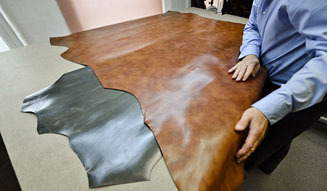
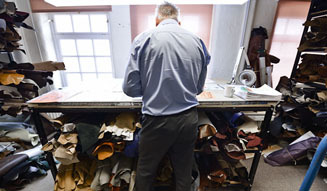
Here, the leather is meticulously examined for cuts, scratches, insect bites, visible veins, and neck wrinkles known as “gloss marks.” Observed in natural light, this process truly felt like the very first step in shoemaking.
Raw leather hides are about 6 millimeters thick from the side, and this thickness is reduced through various processes. John Lobb specifies the top 1 to 1.4 millimeters. John Lobb uses three different leather thicknesses, varying according to the model.
The size of the leather is also notable. For the Prestige line, the pinnacle of ready-to-wear shoes, only one pair of shoes is made from a single hide. In particular, for models with large patterns,CHAPELa single hide is used for each pair, a testament to its luxurious cut.
We also saw buffalo, lizard, and crocodile leather in this area. For cutting the “CITY” model, three pieces of lizard leather are required from the belly. Since the scales of crocodile leather are matched for cutting, a minimum of two hides are used to create one pair of shoes.
Additionally, John Lobb'sCashmere Suedeis made by turning full-grain leather inside out, resulting in an exceptionally fine and beautiful texture.
Traditional Stitching Incorporated into the Design
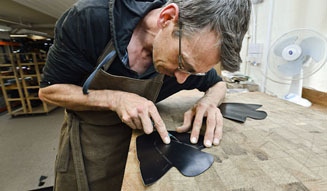
We move to the hand-clicking (leather cutting) section. The basic principle of clicking is to cut the leather symmetrically, starting from the center of the hide. At the time of our visit,JOHN LOBB 2013was being cut.
“While design takes precedence in everything, the absence of unnecessary seams is a point of pride for John Lobb shoes,” states the craftsman. The finest leather is used to maintain a consistent texture throughout the shoe, and cutting is performed logically. Furthermore, “To preserve the shoe’s proportions, John Lobb has patterns for all sizes, including half sizes.” This meticulous approach, which goes beyond simply scaling up or down existing samples, is standard at John Lobb.
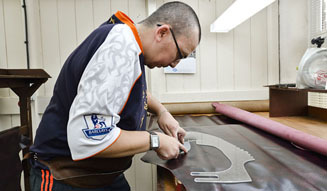
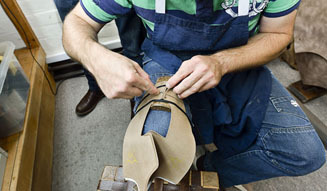
We spoke with Mr. Martin, who is in charge of this section. In addition to cutting, he also performs stitching. For the highly skilled skin stitch, he uses a thread wound around a boar’s bristle. He even makes the thread himself. “Skin stitch is a traditional sewing method in Britain that does not use a needle. Please look at this‘JOHN LOBB 2011’model. It requires advanced skill, but at John Lobb, we incorporate it into the design at the direction of Creative Director Andreas,” says Mr. Martin. He demonstrated the skin stitch. The charm of hand-stitching is irresistible.
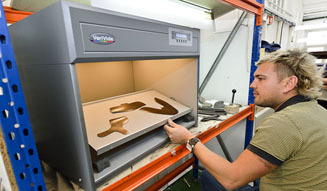
After the leather is cut, each part is checked for flaws using machinery introduced with the factory expansion. The craftsman meticulously inspects each piece by eye.
The Making of a Masterpiece (2)to be continued
John Lobb Japan
Tel. 03-6267-6010
http://www.johnlobb.com/jp