Yasuhiro Mihara | Japanese Craftsmanship Vol. 7: Hosoo's Nishijin-ori x TUMI (Part 2)
MIHARAYASUHIRO
Advance Orders Now Open on the "rumors" Web Store!
Part 7: MIHARAYASUHIRO × HOSOO × TUMI (Part 2)
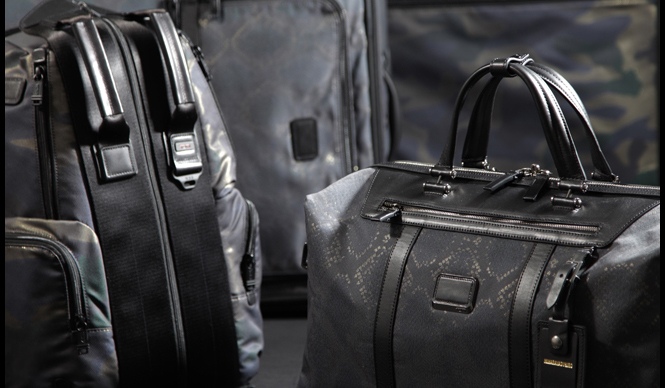
This is the groundbreaking series "MEANING MADE IN JAPAN MIHARAYASUHIRO (MMM)", where fashion designer Yasuhiro Mihara visits Japan's proud factories and artisans to create new products unique to Japan. In this seventh installment, we feature a collaboration bag with TUMI, using original fabric created with HOSOO Corporation.Part 1In the first part, we looked back at how Mr. Mihara and Mr. Hosoo met, and discussed the history and present of Nishijin weaving. In this second part, they both share the story behind the completion of this bag collection.
Photographs by MIKAMI MakotoText by IWANAGA Morito (OPENERS)

The Challenge of Using Nishijin Weaving in Apparel
HOSOOMr. Mihara's initial request was quite complex: to weave fine Japanese patterns within a camouflage base, and then to add auspicious Japanese motifs like waterfalls and plum blossoms as if embroidered on top. It was something we had never attempted before.

Yasuhiro Mihara
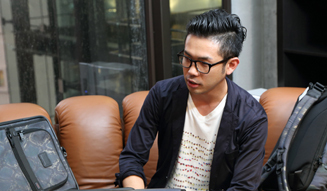
Masataka Hosoo, 12th Generation of HOSOO Corporation
At the first sample stage, we could only weave about one meter per day. We wondered if it would truly be possible to produce it in mass production. From there, we went through numerous exchanges. We conducted experiments daily, puzzling over it with our artisans, and when it was finally finished, we felt a significant sense of accomplishment.
MiharaWhat we found difficult about Hosoo's fabric was that we had never worked with such a material before. While it has improved considerably now with more warp threads, back then it was too thick for apparel. Clothing fabric requires a certain degree of thinness. I believe the biggest challenge was to keep it as minimal as possible.
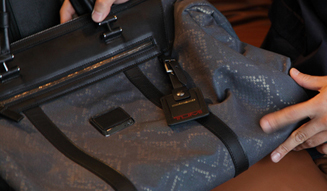
To achieve these complex layers while making it usable as apparel fabric, Hosoo put a great deal of thought into it. There must be an incredible complexity in the structure of the warp and weft threads.
Whenever we made requests, Hosoo was willing to do whatever it took, but the fabric became thicker, introducing flaws as a product, and unsuitable for clothing. Although it has been improved now, we faced such challenges at the time.
The "Japanese Black" Born by Chance
MiharaWith the camouflage and snake patterns used in this collection, we made an interesting discovery while working with Hosoo. The pattern's appearance changes depending on the angle, creating a phenomenon where a black layer filters over it. It was an accidental discovery; it was actually the texture on the back of the fabric, but we found it intriguing and decided to use it. It evoked a "Japanese black" reminiscent of lacquer.
It's truly fascinating how the pattern's expression shifts with the direction of light. Furthermore, this time, Hosoo applied not only gold foil but also green and blue colored foils. We've achieved an even greater brilliance by using glossy foil to represent colors previously expressed with silk threads. It doesn't shine garishly; rather, it's an elegant hue, like light emerging from darkness, difficult to put into words. Perhaps it's because we are Japanese that we perceive such beauty in Nishijin weaving.
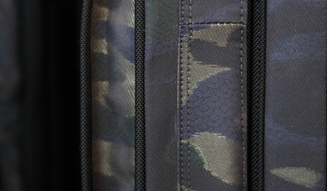
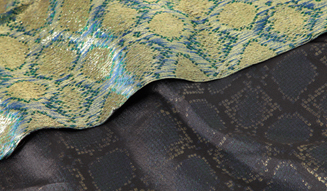
The reverse side of the fabric used this time
HOSOOThere are about ten layers of filters. Within these, there are green and gold foils in the lower layers. This must be what creates that indescribable depth. To bring out the green that appears from the depths, as you can see from the back of the fabric, we've run threads across the back to lay a vibrant green in the lower layers.
We've overlaid deep black on the warp threads to create that fleeting glimpse of light. This is calculated based on the angle of the light and how it appears. Therefore, this fabric is more vibrant on the reverse side than the front. It would be difficult to achieve this depth with dyeing alone. Our challenge lies in designing the structure of the woven material to create an unprecedented fabric.
International Reactions
MiharaJournalists have described the collaboration between Hosoo and us as a "wonderful marriage," and that this was a creation only Mihara could achieve.
They praised our innovative approach to inheriting Japan's ancient traditions in this form. I also heard through the grapevine that a certain maison, after seeing Nishijin weaving in their collection, became interested and consulted with Japanese fabric manufacturers. Some companies directly contacted Hosoo, and there were also instances of them researching other suppliers. In that sense, I believe it had a significant impact, even internationally.
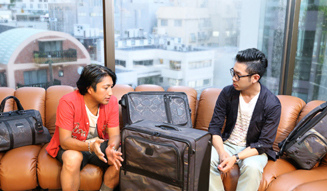
HOSOOYes, we did receive inquiries from truly top maison brands. We were contacted immediately the day after the January 2011 (Autumn/Winter 2012-13) show. It seems overseas was quite attuned to it.
However, this is a fabric that would never have been created solely within our own capabilities. As Mr. Mihara said, it was realized for the first time through this "wonderful marriage." All the members of our workshop also said they were becoming addicted. We too must constantly evolve.
MiharaFor this bag collection project, I believe both we, Hosoo, and TUMI are satisfied with the finished products. We would like to continue this as much as possible.
MIHARAYASUHIRO TOKYO
Tel. 03-5778-0675
http://www.miharayasuhiro.jp/
