
Celebrating 30 Years: Takeo Kikuchi and Tomoyasu Hotei in Conversation
TAKEO KIKUCHI
30th Anniversary: TOMOYASU HOTEI × TAKEO KIKUCHI Collaboration Items Released!
Takeo Kikuchi and Tomoyasu Hotei Discuss "Britain" Extensively (Part 1)
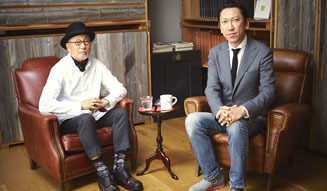
To commemorate the 30th anniversary of the menswear brand "TAKEO KIKUCHI," a special talk session themed around "Britain" between the brand's creative director, Takeo Kikuchi, and his close friend, guitarist Tomoyasu Hotei, has been realized! We also draw attention to the limited "TOMOYASU HOTEI × TAKEO KIKUCHI" collaboration items, which incorporate Hotei's iconic "Gitarism pattern" and the Takeo Kikuchi logotype, applied to items like suits, shirts, and ties that evoke Britain.
Text by Makoto KAJII (OPENERS)
The Talk Begins with How the Two Met
Tomoyasu Hotei, a leading Japanese guitarist, and Takeo Kikuchi first met around 2012 when Hotei relocated to London. Introduced by a mutual acquaintance, they had a chance to dine together and hit it off over their shared love for Britain. They also connected on Facebook, and their collaboration was decided with unprecedented speed due to their mutual trust. The "TOMOYASU HOTEI × TAKEO KIKUCHI" collaboration line will be available at TAKEO KIKUCHI stores, and pre-order events for select items will also be held at Hotei's official website and tour venues.
The talk session was moderated by Joe Yokomizo, senior writer for "Rolling Stone Japan."
──Today, I'd like to hear from both of you in a relaxed manner, sharing stories that will inspire everyone. Are you two close in your daily lives?
Takeo Kikuchi (hereinafter, Kikuchi)I attend his concerts and we have dinners.
Tomoyasu Hotei (hereinafter, Hotei)Our first meeting in London was also through a connection where your friend was my senior.
KikuchiThat was at that person's home, wasn't it?
HoteiWhen I meet you in London, you're usually in the middle of a trip...
KikuchiI think you probably feel very relaxed.
HoteiYes. The other day, you came to see my live performance at a small pub in London called The Lexington. And you were there, in the front row, about two rows back. It was a surreal scene. Also, you attended my recent live performance at Blue Note Tokyo, which was a bit different with a trio.
KikuchiIt was rock with a very jazzy feel.
HoteiYes. When I started listening to rock, I listened to British rock, but when I started playing guitar, I liked Black funk guitar. I was into funk before rock.
KikuchiListening to it, I can kind of understand that.
HoteiAfter I started rock, going through the punk and new wave eras, and while I was in a band, there were no opportunities to play funk music. So, the other day was very refreshing.
KikuchiIt was refreshing and surprising.
──Did you two properly meet in London?
KikuchiNo, before that, I recall you attending my show in 2003.
HoteiThat's right. When I was introduced, I was so nervous I couldn't speak.
──So, what was the trigger for becoming so close?
KikuchiProbably London. Meeting in London is a bit different from meeting in Tokyo. In London, I feel like I can be my true self. I go to London twice a year, and we meet each time.
HoteiYes. It's a city where everyone can truly open up to each other.
KikuchiRight, your new album "New Beginnings" is excellent. It's very exciting. It's thrilling and conjures up images.
HoteiThank you. I was very conscious of making it cinematic, so your feedback, Mr. Kikuchi, means the most to me.
British Culture That Influenced Them
──I'd like to focus our conversation on British creation and culture, which is a common ground for both of you as top creators. I'd like to hear about how you both encountered British culture and what kind of influence it had on you. What captivated you?
First, please tell us about that.
KikuchiPerhaps if I hadn't gone to London, I might not have had the opportunity to enter this world or be where I am today. I like clothes, but I can't just see them from a purely "design" perspective. I have a sense of viewing clothes as part of our lives. When I visited London, I had an intense feeling of the extraordinary, but I realized that for them, this was their everyday life.
I first went to London at the end of the 60s. At that time, the entire culture seemed to have been turned upside down, and its influence spread worldwide. However, information didn't reach Japan as it does now.
So, the first thing I noticed when I went to London was that the old things were incredibly old. The way old and new things coexisted so well was different from other cities. The newness felt more intensely symbolic. It was something that became quite addictive.
HoteiI started listening to rock and playing guitar around the age of 14. Back then, I'd buy records one by one with my allowance, and before I knew it, most of my record collection was UK rock. What drew me in was something different from the calls for freedom in America. For example, David Bowie wore baggy pants in "Station to Station," and Roxy Music and Bryan Ferry stood on stage in tuxedos. Rock and roll and dandyism are opposites, but I felt a great sense of romance and philosophy in that. At that time, American hard rock was at its peak, and long hair with jeans and a T-shirt was the icon of rock. In contrast, UK rock was played in suits. It was very striking. I think I was drawn to dandyism, masculine charm, and philosophy.
At that time, American hard rock was at its peak, and long hair with jeans and a T-shirt was the icon of rock. In contrast, UK rock was played in suits. It was very striking. I think I was drawn to dandyism, masculine charm, and philosophy.
At that time, American hard rock was at its peak, and long hair with jeans and a T-shirt was the icon of rock. In contrast, UK rock was played in suits. It was very striking. I think I was drawn to dandyism, masculine charm, and philosophy.
──The British culture of the 60s and 70s that you both experienced also feels like a reaction to the hippie culture of the time in America. Rather than natural things, it was an artificial image, like David Bowie. What are your thoughts on this?
KikuchiIt was indeed strange. America gave an impression of being straightforward and natural, even in its people. But Britain has a reverence for the old. There are also strong elements of being bound by a class society. I strongly feel that they are subverting this by using it to their advantage within their culture. The artificial image you mentioned might be a manifestation of this strong rebellion against things and society. That's precisely why adventurous movements emerged.
Japan also originally had an adventurous spirit, but it has gradually changed. I think it would be better to create things while feeling history and culture, like in Britain. In that regard, Hotei, you have a very unique quality, and I feel a strong sense of "Japanese-ness" or the oriental in your music. That aspect is very ideal. What you do and what exists in your music are perfectly aligned.
──Mr. Kikuchi, you brought the inspiration you received from London into fashion and founded "MEN'S BIGI." Why did you focus on British fashion?
KikuchiAt that time, it felt like being hit by a punch, and I thought, "This is it!" First of all, it was fun. When I was young, I had no desire to do something small or contained. Regarding music, I loved modern jazz since I was a child, and I grew up in an environment where I listened to music quite seriously and quietly. Coming to London with that sensibility, the intensity and impact of rock were immense. Fashion was also incredibly cool.
HoteiThere was a sense of playfulness too, wasn't there?
KikuchiAbsolutely. They were playing around.
About British Rock
──Mr. Hotei, you mentioned being drawn to things like David Bowie and dandyism in music. Could you elaborate further on the appeal of British rock?
HoteiThe Stones and The Beatles probably had that rebellious spirit you mentioned, Mr. Kikuchi. Rock and roll might have been born in America, but I feel it truly became rock and roll when it came to Britain.
While there's tradition, the rebellious spirit that breaks free from it also connects to music like the Sex Pistols later on. Also, the irony and critical elements embedded in the lyrics, small guitar riffs, and melodies are interesting.
And it's theatrical, isn't it? The strong theatrical culture must have influenced the music. Queen and Roxy Music are examples of this.
Also, fashion, of course. In London, there's the Victoria and Albert Museum, which exhibits the beauty of tradition in fashion and decoration. When I go there, I feel a glam rock atmosphere even in old fashion.
KikuchiExactly. I'm sure.
HoteiIt's not about dressing up, but self-expression, yet there's a traditional beauty in it, making it feel very chic. It's hard to summarize the excellence of Britain in a single word, but even in the way a suit is worn, there's playfulness, yet the tradition is firmly upheld, which I find wonderful.
──Compared to American culture, British culture might be easier for Japanese people to understand. It might feel more compatible with the Japanese sensibility.
HoteiIt's often said that British people and Japanese people are quite similar. For me, it's a comfortable place to be.
──Does that connect to why you chose to go to Britain rather than immigrate to America?
HoteiAmerica is vast, and it differs greatly whether you're in New York or Seattle. In Britain, everything is in London. It's not a huge city, but it's a mixture of various things, and that energy still exists, I think.
TAKEO KIKUCHI
30th Anniversary: TOMOYASU HOTEI × TAKEO KIKUCHI Collaboration Items Released!
Takeo Kikuchi and Tomoyasu Hotei Discuss "Britain" Extensively (Part 2)
British Fashion and MEN'S BIGI
──Let's delve deeper into British fashion. Mr. Kikuchi, you established "MEN'S BIGI" with a British style, and Mr. Hotei, you apparently wore MEN'S BIGI clothes when you were a student.
HoteiYes. My first MEN'S BIGI item was a sweatshirt. It had "BIGI" written on the chest. I think it was around the beginning of high school. Back then, the word "brand" wasn't even used.
KikuchiThat word wasn't in use then.
HoteiI was very proud to wear that sweatshirt in a small town called Takasaki. I bought several sweatshirts in different colors and wore them with various scarves around my neck. Dressing up felt like getting closer to adulthood, and rather than just looking cool, it was a way of asserting myself, like, "I like this, something different from others." At that time, it was an era where people thought, "If you wear BIGI, you can't go wrong."
KikuchiPerhaps I was fortunate with the timing. I was able to feel the British style a little ahead of others. If I hadn't liked music, it might not have gone so smoothly. At that time, London's fashion and music were two sides of the same coin, or rather, they had become one. I believe that's still the case, but recently, things have become too diverse to narrow down. They are already individual.
I think the rock musicians of that era were global leaders in fashion. Before I first went to London, I also saw America, but ultimately, I feel my heart has always been drawn to the British way of thinking.
Therefore, MEN'S BIGI, in a way, was modeled after British culture. It's a culture that doesn't exist in Japan. Over time, I myself began to realize BIGI's own style. It's a culture that was completed from there.
At first, even as I was doing it, I felt it was somewhat of a copy. After all, it's seen as originating from British style, isn't it? Initially, it wasn't often called Japanese style. That's why I felt even more strongly that I needed to establish originality, my own style.


My Own Originality
──Is it difficult to establish your own originality?
KikuchiBut you, Hotei, have complete originality, don't you? 100 percent.
HoteiInitially, my admiration for the music I loved led me to emulate British styles to some extent, and I wanted to convey that to Japanese music fans. However, when I moved to London and started working with a global perspective, there was no point in a Japanese person trying to act British.
KikuchiThat's true.
HoteiUltimately, I can't help but retain something oriental. I wasn't consciously aware of it, but it seems to be present in my guitar style.
KikuchiI believe that's at the base of it. That's probably why it resonates so deeply with foreigners when they hear it, isn't it?
HoteiSpeaking of oriental, when people in Britain think of Asia, they first associate it with India. Japan, Korea, and China are still often lumped together. So, when they hear Japanese scales, Chinese scales can sometimes be included. While it's not something ingrained in me, I do incorporate Okinawan scales into my guitar playing. The guitar solo in the intro of "Kill Bill" has a shamisen-like feel, and perhaps what's within me, like sweat and scent, comes out naturally. Maybe that's enough.
KikuchiYes. It's much better when it comes out naturally, without forcing it.
HoteiPerhaps because it's the guitar, what comes from within me naturally manifests in rhythm and scales. I'm the type who likes to hold it at my hip like a sword and strike with it, so maybe it's a kind of samurai spirit...
KikuchiThat might be it. A sense of strength comes through.
──Transitioning from admiration to establishing one's own style seems simple yet incredibly difficult. Is it established through repetition or by relaxing?
KikuchiI'm not sure if it becomes natural, but perhaps there's an awareness. I've been working with a British styling group called Buffalo, and I clearly feel the difference in their way of thinking compared to the British. When I say, "I think this way," they don't quite understand. In such situations, when I do what I think naturally, "something Japanese" emerges. While consciously expressing it is good, I also want to affirm the Japanese qualities that emerge unconsciously. I think there's room for various types.
For example, Kansai Yamamoto's clothing is Bowie-esque. Because it was created with a clear image of Japanese culture, it has a very strong appeal. I, on the other hand, am more of a street-style person. Clothing isn't fun without reality. Therefore, I always want a degree of reality that I can immerse myself in. Since everyone lives differently, I believe both styles are good.
For example, Kansai Yamamoto's clothing is Bowie-esque. Because it was created with a clear image of Japanese culture, it has a very strong appeal. I, on the other hand, am more of a street-style person. Clothing isn't fun without reality. Therefore, I always want a degree of reality that I can immerse myself in. Since everyone lives differently, I believe both styles are good.
──Mr. Hotei, how do you perceive the aspect of reality?
HoteiIn our case, the sound that comes out is the answer. I feel like I've finally grasped the distance between the guitar and myself recently. Lately, I've been performing a lot in away games, and I'm starting to enjoy that feeling of being the outsider. When I was active in Japan, I think I confined myself within a frame that I had set for myself. Recently, I feel like I've been able to liberate myself greatly. My music also feels more unrestrained. I feel my music is more expansive.
KikuchiI also feel that sense of expansion when I listen to it.
HoteiBefore, I think I used to assume that this is what everyone wanted. I love jamming with various musicians and even being defeated sometimes. By enjoying myself and honing my skills, I feel I've finally arrived at my own style. Now, without thinking, I face Stones if it's Stones, or jazz if it's jazz. Even then, I remain unchanged.
Hotei's Music Transcends Borders
──Generally, it's said that music has no borders, and surely fashion also has no borders, with everyone operating globally. Is it truly possible to transcend borders?
KikuchiI think you, Hotei, were able to do it because it's you. Many have tried before, but I doubt anyone has been able to enter in the way you have. While many perform globally, in terms of music seamlessly integrating into the local scene, I believe you are number one. That's why you clearly have originality. You probably possess something that foreigners can understand. For some reason, your music has a mysterious magic that allows it to enter any country. This applies to both melodies and performances. There's a sense of excitement there. I believe it's a similar feeling regardless of the country. Therefore, it penetrates people's hearts purely through sound, without needing logic. Among Japanese musicians who have gone abroad, I believe you are the first in this regard.
I think you possess something that foreigners can understand. For some reason, your music has a mysterious magic that allows it to enter any country. This applies to both melodies and performances. There's a sense of excitement there. I believe it's a similar feeling regardless of the country. Therefore, it penetrates people's hearts purely through sound, without needing logic. Among Japanese musicians who have gone abroad, I believe you are the first in this regard.
HoteiI'm truly humbled. Thank you.
──You mentioned liberation earlier. How do you perceive your own music? It might be difficult to speak after Mr. Kikuchi's high praise...
HoteiIt's a great honor to have a senior creator like you feel that way. However, as you say, the guitar itself has a dimension that transcends language. It's difficult for vocalists to share a microphone and convey things. The guitar is both a melodic and rhythmic instrument. Furthermore, it can be aggressive and romantic. Perhaps that's why it has such depth.
Also, in our era, we were able to absorb diverse music like jazz, progressive rock, and American rock into our bodies. I think that's significant.
Although it was a slightly late start, I moved to Britain at the age of 50. Japan is very prosperous, so perhaps focusing solely on the Japanese market for music would be sufficient. But the world is vast. I believe we should feel the world more. Instead of thinking "Japan and the world," think "Japan within the world." If you approach it with that mindset, your expression will change. So now, when I think about where my home is, I feel like Britain is my home. However, in terms of enjoying the feeling of being an outsider, I want to have no home and feel like an outsider everywhere.
KikuchiThat's good. That is.
HoteiI think it's important to maintain that sense of tension.
KikuchiThat's tremendous courage. To have established your position in Japan and then to completely reset and work in Britain.
HoteiI wouldn't say I had established it. However, I felt a sense of crisis that I couldn't grow any further if I stayed as I was. I was getting bored with myself, so to speak. Even when creating works, I felt I couldn't surpass a certain line. That became a bit of a stress for me...
I realized I had to break free, to discard something, to do something big. A band can break up, but I thought "oneself" couldn't easily break up, but I managed to do it.
KikuchiWatching you, it seems completely achieved.
HoteiWith the album I just released, I feel it's a "re-debut." I debuted solo 25 years ago, and for the first time, I sang. I've been singing for 25 years since then, but from this album onwards, I've stopped singing and returned to just playing guitar after 25 years. I've become incredibly free. It took courage, but above all, it's fun. It doesn't feel painful. I think I felt more pain when I was fulfilled. I feel I've finally reached my own style.
KikuchiWhile not to that extent, I do feel pressure. It's a kind of defense mechanism. When something new is created, the power to break through it doesn't always continue. I always feel that pressure. I envy musicians for the sense of liberation that comes with playing music. I believe there's an energy in what they do that allows them to express themselves. We don't have that. It's always halfway. Even when I finish something, I immediately reflect on it. It's difficult because so many elements are intricately intertwined. That's why working abroad makes things more straightforward. It's like, "only good or bad."
When I'm in Japan, it's hard to even know if something is good or bad, or where the answer lies. It's like, "only good or bad."
When I'm in Japan, it's hard to even know if something is good or bad, or where the answer lies. It's like, "only good or bad."
Collaboration Project
──You two have achieved a dream collaboration with this project.
HoteiIt's a surreal feeling. For me, who used to wear MEN'S BIGI sweatshirts. It's truly strange and wonderful to have Mr. Kikuchi's name on my trademark pattern.
KikuchiWe proposed this collaboration. Many of my brand's staff are huge fans of Hotei. Some are even fervent fans. So, if we were to do a collaboration, it had to be with Hotei! Everyone was excited about it.
HoteiWhen we met in London, I also mentioned to you, Mr. Kikuchi, that if there was anything we could do together, I would be grateful. But to be able to collaborate so soon and in this way is truly wonderful.
TAKEO KIKUCHI
30th Anniversary: TOMOYASU HOTEI × TAKEO KIKUCHI Collaboration Items Released!
Takeo Kikuchi and Tomoyasu Hotei Discuss "Britain" Extensively (Part 3)
Takeo Kikuchi from Tomoyasu Hotei's Perspective
──I (moderator Joe Yokomizo) was born in 1968 and have known MEN'S BIGI since my 20s. You have a strong image as a pioneer who has been active globally, being one of the first to showcase at Paris Fashion Week. In an industry with rapid ups and downs, few brands last 10 or 20 years. Mr. Hotei, what is your impression of the appeal of "Takeo Kikuchi," a designer who has maintained such consistency?
HoteiIf I hadn't become a musician, I might have wanted to be a fashion designer, so you are someone I admire. Clothes have the magic to make everyday life even more so, and to make a person more themselves. However, I can imagine it's a strict and difficult world, including the fine details that go beyond just design.
Every time I meet you, Mr. Kikuchi, you are impeccably dressed and clearly enjoy it. Even when we meet in London, you seem to be enjoying your travels. And you are always so neutral. You are an ideal adult figure, embodying dandyism.
While there's certainly a sense of tension, you are also very charming. More than as a designer, as a man and as a senior, I admire your magnanimity, kindness, and the aura that, while intense, puts those around you at ease.
KikuchiThank you. I'm happy to hear that.
The Adventures of Our Predecessors
KikuchiAfter work, when I'm having a meal or a drink, I don't want to talk about work. I've lived for these 75 years with the desire to enjoy things that are enjoyable. So, when I'm with someone, I don't want them to feel tense. While making an effort to do that, I've only thought about enjoying myself naturally, so I have fun wherever I go.
HoteiThe other day, I had the honor of meeting Mr. Kikuchi, Mr. Kenzo Takada (designer of KENZO), and Mr. Issey Miyake. Was this perhaps the first time the three of you met?
KikuchiYes. The first time.
HoteiI was also invited to that gathering, and it was like being in the presence of Mozart, Beethoven, and everyone else together. Even there, Mr. Kikuchi created a relaxed atmosphere. Mr. Takada and Mr. Miyake were chatting as naturally as if they had met yesterday. I thought that was Mr. Kikuchi's magic again. That night was incredible!
KikuchiIt was fun. Truly. Everyone said whatever they wanted. It was interesting.
HoteiI believe everyone has undertaken many adventures. Like taking a train and going in search of something from scratch... We have been able to wear the results of those adventures and feel the philosophy. I think we owe it to our predecessors who bravely embarked on adventures. We can't afford to fall behind, can we?
KikuchiThose words make me incredibly happy. Since we are older, we have lived our lives first, experienced things first, and come this far. As you said, Hotei, our predecessors did various things, and as they are passed down, times change. I think that's wonderful.
In Japan, it feels somewhat sad that there doesn't seem to be much respect for our predecessors, even though they are supposed to be respected. It's always just about the present moment. I believe there are some people who hold strong respect, but generally, people don't view it that way.
HoteiLike, "the present is the best."
KikuchiYes, the feeling that "the present is the best." When you go abroad, even young people know about the people who were active in different eras.


Inheriting Tradition
KikuchiI feel that if things like what you just said, Hotei, were said in various places, Japan would become a more mature culture.
HoteiBritain truly values tradition, and it's wonderful. They have continued to pass it down.
KikuchiWhen it comes to progress and change, they do it readily, but people overseas have a sense of pace. In Britain, there are still quite a few young people who shave with foam, you know.
HoteiIt's important to pass down things like that. For example, with suits, in Japan, wearing a tie might be associated with constriction and discomfort, perhaps seen as a uniform for salarymen. In Britain, when invited to a formal occasion, one wears a bow tie and tails. This isn't just about "dressing formally." It's something essential for existing within that culture.
Wearing a suit shouldn't be painful. On the contrary, as the word "suit" suggests, you must be able to wear a suit properly (fit it well). Anyone can dress down, but if you can't dress up, you can't dress down properly either.
Especially for rock musicians, there aren't many opportunities to wear suits, and they often look out of place at weddings. However, I believe a black suit should be worn most stylishly by a rock star.
KikuchiThat's right.
HoteiFor example, my style is influenced by Bryan Ferry, and I feel I must inherit that coolness and pass it on through myself. I am also at an age where I am a respectable adult, so I must be a cool adult.
KikuchiIn that regard, you, Hotei, are amazing.
Performing with The Rolling Stones
──In March of this year, you performed with The Rolling Stones, your idols, during their Japan tour.
The Stones were formed in 1962, and their band name comes from Muddy Waters' song "Rollin' Stone." Muddy Waters sang in the song, "Blues gave birth to a child. A child named rock and roll." The Stones are essentially born from the blues. And for you, Hotei, who inherits British rock, to perform with the Stones must have felt like a moment of tradition being passed down. What was it like to perform with your idols from the past?
HoteiIt's indescribable. Mick Jagger was there. It was an incredibly surreal event. Since I was invited, I wanted them to think, "It was good to have invited this guest."
This is like a rally, isn't it? I believe I understand the etiquette of jamming. I'm glad everyone seemed to enjoy it.
I've performed with David Bowie, Bryan Ferry, Roxy Music, and The Rolling Stones, all of whom I love, and even Iggy Pop on my new album. There aren't many guitarists who can say that.
I understand why people wonder why. Perhaps my guitar has something that liberates others. I also enjoy seeing people feel good. I like elevating vocalists while playing next to them, and when jamming, I find more joy in making others happy than in myself. I believe I've learned guitar communication through various experiences, including this kind of hospitality, if you will.
──I was also at the venue that day, and I was so excited. I was very happy.
HoteiAfter it was over, I received an email from Hiroshi Kamayatsu. It was just one sentence, but it said, "Thank you for fulfilling our dream." That made me very happy. It's my dream too.
KikuchiIndeed, it's everyone's dream.
HoteiYes. With a sense of tension, I must play well and produce good sound, otherwise, it would be embarrassing.
Working with Idols
──Mr. Kikuchi, what about you? You've had many moments working with people you admire. What was that like?
KikuchiIt's a pleasure. When I held a show in Paris some time ago, Lucien Pellat-Finet, famous for his skull motifs, assisted me. He handled the entire show's progression with me. He was someone who made accessories for various shows, and I thought he was interesting to work with. Then, over time, his style became distinct.
I was very happy to have had the surprise of discovering, "Wow, this person I worked with turned out to be like this!" on multiple occasions.
TAKEO KIKUCHI
30th Anniversary: TOMOYASU HOTEI × TAKEO KIKUCHI Collaboration Items Released!
Takeo Kikuchi and Tomoyasu Hotei Discuss "Britain" Extensively (Part 4)
The Power to Realize Dreams
──Mr. Hotei, this year marks your 25th anniversary as a solo artist, and for your anniversary album "New Beginnings" (released October 1, 2014), you collaborated with Iggy Pop. Iggy Pop has also produced for David Bowie and produced his own band, The Stooges, so I believe this collaboration is with someone close to your roots. On the other hand, Mr. Kikuchi, for TAKEO KIKUCHI's 30th-anniversary project, you collaborated with Britain's "MONTGOMERY."
On the other hand, Mr. Kikuchi, for TAKEO KIKUCHI's 30th-anniversary project, you collaborated with Britain's "MONTGOMERY."
For fans of your respective fields, these are dream experiences. Everyone must wonder how they are realized. Is there anything you do to get closer to or achieve your dreams?
KikuchiIn my case, I think it's luck (laughs).
HoteiWhile attracting luck is also a skill, it doesn't come by waiting. The saying "hit it and break it" is apt; you have to go for it to start. Isn't that kind of courage necessary?
Also, in my case, I don't think I could have asked Iggy or played at the Stones' concert if I lacked confidence. If I am true to myself, I believe I can seize various opportunities.
KikuchiThat's correct. You need confidence. It's problematic if you're always embarrassed.
HoteiIt would be a waste to hold back when presented with such an opportunity.
──As you both say, is confidence also a result of battling with oneself? I personally believe in the quote, "Talent is the ability to keep dreaming," and I strongly believe in it. Perhaps that's what's important?
KikuchiI'm not sure about that. Since childhood, there have been many things I wanted to do that haven't been realized yet. I have the desire to make dreams come true, so I still hold onto them as dreams. It might sound strange to say this at my age.

Dreams for the Future
HoteiCould you share one of them?
KikuchiI really love car design. I also love looking at old cars. However, looking at the past 10 years or so, there haven't been many designs I find appealing.
Technologically and in many other ways, there has been tremendous development, but I don't feel the excitement that cars originally possessed. I've been thinking about designing in that area for a long time.
I even made models and thought about actually building one, but it costs an enormous amount of money just to build a car. In that sense, it remains a dream.
Also, I have a dream of writing my own script and directing dramas or movies. I once discussed creating something with Kenichi Hagiwara (Show Ken), but he stopped me, and I abandoned the idea. Ultimately, those dreams also relate to clothing. Although it might not be realized, there are still countless things I want to do.
HoteiBut I feel like both could come true.
KikuchiNo, it's not that easy.
HoteiIn that case, leave the car stereo music to me. And the movie scores too. Let's collaborate on those as well.
For me, it feels like a door is finally opening overseas, so this is just the starting point. After a long runway, I've just begun to take off, so the real challenge starts now. However, I believe that not only soaring but also steady, diligent effort is necessary. I need to connect with each and every one of my music fans.
KikuchiI feel that very strongly too. The effort to make each person truly understand is always necessary, no matter how long it takes.
HoteiWhile a big opportunity like spreading worldwide through a movie or something is important...
KikuchiYes. The effort to deepen understanding is far more important, I think.
HoteiIf the dream is to tour the world, it doesn't have to be in large venues. Even if no one knows me, if I perform a few times in a place, those who initially didn't pay attention will be enthusiastic by the end. Seeing that makes me want to believe in such moments. The world is still vast.
KikuchiThat's right.
HoteiThe battle with time differences during world tours is immense. You can't do it without stamina, and you can't do it without passion. You can't do it without having a dream for it. But I want to make it come true.
KikuchiIt will come true.
──At that time, won't you have some kind of gift from Mr. Kikuchi?
KikuchiIf I'm alive.
HoteiMr. Kikuchi is a rock 'n' roll person. When we had drinks together in London, you drank quite a bit, didn't you? At the end, when your friend asked, "Would you like some water?" you replied, "No, it would dilute the buzz I've got."
KikuchiI love drinking. Isn't communication while drinking good? I also love the atmosphere of such occasions. It's a shame to sober up from that.
To Succeed Globally
──I hope you both continue to succeed globally.
In the age of the internet, we can feel the world more closely, yet the actual world is vast. So, how can one succeed globally, and what is necessary? Among those watching this talk and video, there are likely many who want to strive globally. As a hint for them, could you share any insights you have?
KikuchiMy own desire is to convey a sense of "resonance" to as many people as possible. It would be ideal if I could convey that through design. This might be related to what you said, Hotei, about conveying it to each music fan. I believe clothing is the same as music.
I feel like I'm doing this for that resonance. I want to continue to possess the ability to convey it, so that individuals can resonate with it.
HoteiIn terms of "globally," I think it's important to maintain the awareness that you are in the world, even when you are in Japan. You shouldn't think that you are only in Japan, not the world. Just by having the awareness that this place is also part of the world, your perspective, what you hear, and what you feel can change quite a bit. I didn't suddenly become British, you know. (laughs)
However, by traveling around like this and feeling that everywhere is both an outsider's place and home, I can also see the good aspects of Japan. I can also feel the thrill of life being a journey. Every day is exciting. I think it's a matter of that slight shift in awareness within oneself.
──Watching you both, it feels like you are not only rocking but also rolling, responding to Keith Richards' words, "Rock is good, but what about roll?" I am very much looking forward to seeing how far you will continue to roll. Perhaps, in a few years, it might become a reality that you, Mr. Kikuchi, will create the soundtrack for a movie directed by Mr. Hotei.
HoteiAbsolutely. Thank you very much for today. I look forward to your continued support.
KikuchiThank you.
Tomoyasu Hotei
A leading Japanese guitarist. He was active as the guitarist for the legendary rock band BOØWY, which greatly influenced the Japanese rock scene, and made his solo debut with the album "GUITARHYTHM" in 1988. His talent as a producer, lyricist, and composer is highly acclaimed. Quentin Tarantino's offer led to "BATTLE WITHOUT HONOR OR HUMANITY (Theme from New Battles Without Honor and Humanity)" becoming the theme song for the film "KILL BILL," receiving worldwide recognition and continuing to be loved globally. Since moving to the UK in 2012, he has successfully held two London concerts. In 2014, he performed with The Rolling Stones at the Tokyo Dome, and Iggy Pop collaborated on his new album "New Beginnings."
http://www.hotei.com/index2.html
Takeo Kikuchi
Born in Chiyoda-ku, Tokyo, in 1939. He began making bespoke clothing in 1964. After studying abroad, he established the women's brand "BIGI" in 1971. In 1975, he founded "MEN'S BIGI." He expanded to Paris and opened the first men's shop by a Japanese designer. He designed the costumes for Kenichi Hagiwara in the NTV drama "Kizu Darake no Tenshi" (Angel with Scars), which became explosively popular. In 1984, he moved to World and launched the "TAKEO KIKUCHI" brand. He retired as creative director of the brand in 2003. In 2005, he launched a new brand for his generation, "40CARATS&525." He returned as creative director of "TAKEO KIKUCHI" in 2012.
TAKEO KIKUCHI
Tel. 03-6324-2642
http://store.world.co.jp/s/takeokikuchi/