An Interview with Hiroyuki Honda of HSW (Part 3)
photo by Jamandfix
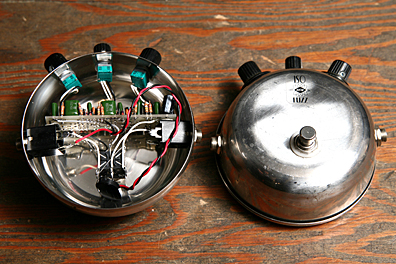
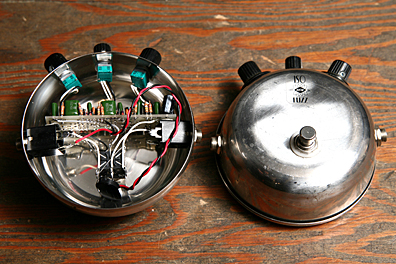
The best-selling effector, "MAD FUZZ"
Price is the price of sound
– Introducing the Masterpieces of Honda Sound Works –
Yui MochizukiRegarding Honda's effectors, it all starts with "MAD FUZZ," doesn't it?
Hiroyuki HondaThis was the very first sound production from Honda Sound Works. I went to Korea to buy vintage effectors, and there was a time when I found treasures like Eastone rhythm boxes, Morley echoes, and Elehums. We went out to eat, and there was a rice bowl lying around, and the idea sparked: "Wouldn't it be interesting to turn this into an effector?"
MochizukiSo you actually used it...
HondaI'm very interested in the magnetic field surrounding analog components, and of course, the sound changes depending on the casing.
MochizukiWhat kind of sound does this produce?
HondaThe concept was to improve the separation and enhance the sound pressure of an early Big Muff model called the "Triangle Knob." The high-frequency harmonics are brighter and more beautiful than in a standard casing.
MochizukiIts unique shape must be popular with foreigners too. How much does it cost?
HondaIt's 18,000 yen.
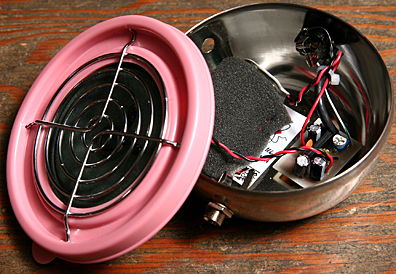
Guitar amplifier "WALLMAN"
MochizukiSpeaking of foreign musicians loving your products, "WALLMAN" comes to mind.
HondaThis is a guitar amplifier, but despite being transistor-based, it sounds like a tube amp.
MochizukiSo it sounds analog even though it's digital?
HondaIt runs on a single 9V battery, and people are always surprised, asking, "How can it produce the sound of a vintage amp?!"
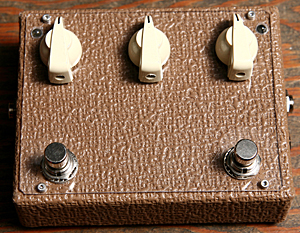
Guitar amplifier "FUJIYAMA DRIVE"
MochizukiAnd another masterpiece from Honda Sound Works is "FUJIYAMA DRIVE."
HondaWhile I was tuning up vintage amps, I realized that the balance between high and low frequencies is ultimately what's most important. I thought that if there were a guitar amp with an effector's concept that could create that balance, any guitar would sound great through it.
MochizukiAround what year was it completed?
HondaAccording to a friend's memory, it was May 2000. This one took quite a long time.
MochizukiWhat is the price?
HondaThis one is 120,000 yen. The price is the price of sound. The biggest challenge was achieving the amp's harmonics. So, I used wiring from Western Electric telephones, a company known for audio and telephone equipment. This was the result of trying various resistors and capacitors.
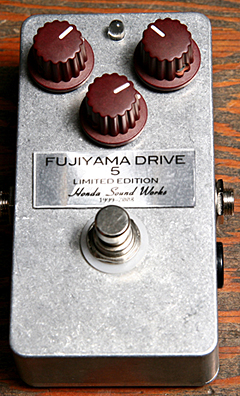
Effector "FUJIYAMA DRIVE 5"
MochizukiWhat about this "FUJIYAMA DRIVE 5"?
HondaThe "5" in this case means the fifth stage of the mountain, representing half the price and an easier-to-handle effector. While most effectors typically achieve their drive sound in the preamp section, I believe the drive sound in the power amp section is what defines rock. So, I created a version that's easy to handle within that context. It doesn't produce as many harmonics, giving it a more robust feel, and the compression provides sustain.
MochizukiIt makes me want to play it (laughs).
HondaWhile "FUJIYAMA DRIVE" aims for a live-like sound pressure, this "5" is for recording. It brings to mind the early drive sounds of ZZ Top.
MochizukiIt's that specific, then.
HondaI have the sounds stored as data within me. Overseas musicians call me a "sound tailor." The guru of "sound tailoring" (laughs).
MochizukiTruly a guru (laughs).
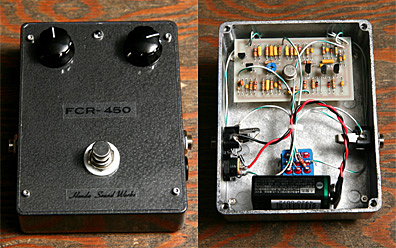
Compressor "FCR450"
HondaI created the compressor "FCR450" because there weren't any good ones available. When you engage it, the sound's outline becomes sharp, the compression ratio is excellent, and it covers everything from low to high frequencies perfectly. I used vintage parts to ultimately add thickness to the sound, and it turned out remarkably well.
MochizukiIs this a delay?
HondaIt doesn't look like a delay, but... Analog components are becoming scarce, so I thought I could make it digitally. It started with the parts, and I researched and improved my favorite delay circuits to create this. Although it uses digital circuitry, the sound quality is reminiscent of analog tape echo.
MochizukiI see.
HondaBecause it's digital circuitry, there's less noise, it runs reliably on 9V, it has a long lifespan, it's lightweight, and the parts are relatively easy to find. Furthermore, I focused on operability, designing it for foot control. It achieves a sound expression similar to true bypass.
MochizukiIt seems like a lot of effort and time went into this.
HondaOnce it's completed, I don't want to change even a single screw.
MochizukiHow long do you typically spend on development?
HondaI can only spend about two hours a day creating sounds. Also, if I don't feel moved when I play it...
MochizukiAnd please, tell us about the cables too!
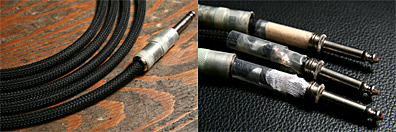
Three types of cables
HondaMany cables kill the picking attack, so I created cables that reduce noise, increase sound speed, and boost volume. I sell the best three out of 200 types. The insulation is patented. For a sound with acoustic harmonics, there's "paper"; for British mids that reach the ear quickly, there's "rubber"; and for high frequencies that reach the ear quickly, there's a "gauze-like material used for the spines of paperback books." These are the three types.
MochizukiThese are amazing too. But it's truly a shame that Honda Sound Works is closing.