
July 28, 2015
Yasuhiro Mihara | Japanese Craftsmanship Vol. 7: Hosoo's Nishijin-ori x TUMI (Part 1)
MIHARAYASUHIRO
Advance Orders Now Open on the "rumors" Web Store!
Part 7: MIHARAYASUHIRO × HOSOO × TUMI (Part 1)
This is the groundbreaking series "MEANING MADE IN JAPAN MIHARAYASUHIRO (MMM)" where fashion designer Yasuhiro Mihara visits Japan's proud factories and artisans to create new products unique to Japan. This installment features a collaboration bag with "TUMI," which debuted in the 2014 Spring/Summer collection. It's a collection of bags using original fabric developed with "HOSOO Co., Ltd.," a company that innovates while preserving the tradition of Kyoto's Nishijin weaving. Here is a conversation between Masataka Hosoo, the 12th generation head of HOSOO Co., Ltd., which has continued since 1688, and Mr. Mihara.
Photographs by Makoto MIKAMIText by Morito IWANAGA (OPENERS)

Luxurious TUMI with Nishijin Weaving
MiharaI've personally been a fan of TUMI bags, so I approached them with the desire to feature them in a Mihara Yasuhiro collection. We decided to use Nishijin weaving from Hosoo as the textile for this collaboration, and present what we consider a luxurious TUMI.
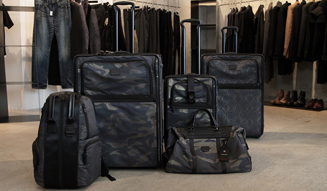
This trolley is a classic TUMI model. The Boston bag is a new release. I understand that in addition to TUMI's signature simple design and usability, the pursuit of luxury involved refining the shape and finish of the handles, and the overall balance.
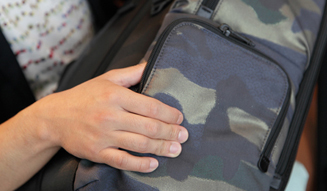
The backpack has a unique design with a handle on the front. The interior features dividers, making it easy to store laptops and other devices, and is highly functional. For this collection, we've adopted the camouflage and snake patterns created with Hosoo as signature fabrics.
HosooNishijin weaving was originally used for obi sashes, so it has high durability. Research suggests it's the strongest fiber among natural materials, comparable to silk or spider silk. The fabric for this collection is intended for use in bags, so it's woven with considerable density, making it one of our strongest fabrics.
1200 Years of Japanese Tailoring
MiharaAbout two years ago, around this time of year, I had the opportunity to visit a Nishijin weaving studio in Kyoto through an acquaintance. That's how I met Hosoo.
HosooOur first collaboration was for your 2012-13 Autumn/Winter collection presented in Paris in January. You used our Nishijin weaving with a camouflage pattern, and since then, we've been regularly supporting your Autumn/Winter collections.
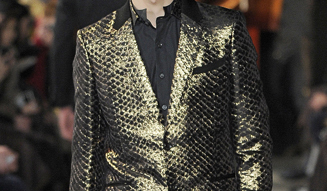
From the 2013-14 Autumn/Winter Men's Collection
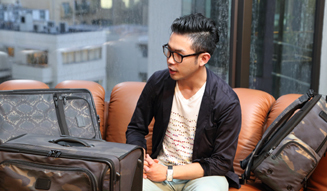
We had previously worked in the interior design field internationally, but had no experience in fashion. I invited Mr. Mihara to see our studio, hoping we could create something meaningful together. That was the beginning.
Hosoo was founded in 1688, but Nishijin weaving itself has existed for 1200 years. While the common image of Nishijin weaving today might be mass-produced obi sashes, that has only been the case for the last 100 years, particularly after the war. Before that, for 1000 years, during the era when Kyoto was the capital, it served high-end domestic clients.—Specifically, the Emperor, nobility, and during the Edo period, the Shogun and feudal lords, as well as temples and shrines.—The history of Nishijin is one of continuously weaving custom-made textiles for such individuals. In Kyoto, this is referred to as "O-atsurae" (bespoke tailoring).
Currently, the fabric we are developing with Mihara Yasuhiro uses this "haku" (foil). It involves applying real gold leaf onto Japanese paper, then finely cutting it and weaving it in.
In fact, this material itself was developed over 300 years ago. Conversely, Nishijin weaving holds many materials that have never been seen before, born from over 1000 years of history. We leverage these to continue developing innovative fabrics.
MiharaWhen I visited Hosoo's studio, I encountered a world that transcended the traditional image of Nishijin weaving. Nishijin fabric is narrow, only about 30 centimeters wide. This width is suitable for obi sashes and the like, but before meeting Hosoo, I could only imagine the stereotypical Nishijin weaving taught in schools.
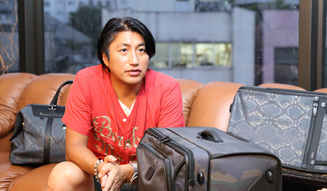
However, I was astonished to see a 150-centimeter-wide loom operating in Hosoo's studio. And the fabric woven from it far surpassed my previous image of Nishijin weaving. The designs were varied, not just traditional Japanese patterns, but also abstract representations of nature. Having produced fabrics for interiors, such as wallpaper and upholstery, they also possess strength, and the fact that they were "designed" was impressive.
I struggled with how to use Hosoo's Nishijin weaving. For example, with fabrics like denim, trench coats, or even military cloth, you can easily imagine clothing from the fabric itself. So, how could I express these jewel-like fabrics from Hosoo, which I had never seen before? It really made me think.
HosooFor us too, Mr. Mihara's request came from a completely different angle than our usual interior work. Initially, there were some hesitations, and I wondered if it was truly possible. But at the same time, I felt a sense of our dormant capabilities being stimulated and activated. Working with Mr. Mihara, I feel that we are also growing.
MIHARAYASUHIRO TOKYO
Tel. 03-5778-0675
http://www.miharayasuhiro.jp/
