February 25, 2015
kolor | An Interview with Designer Junichi Abe
kolor
Designer Junichi Abe Interview (1)
After the Paris Runway Show
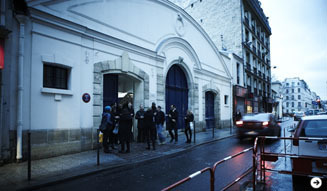
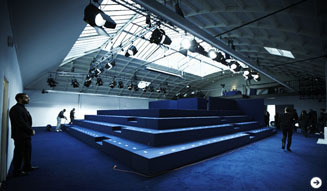
During the Paris Men's Fashion Week Autumn/Winter 2012-13, which began on January 18th this year, kolor, in its eighth year since its establishment, presented its first-ever runway show. The venue, ESPACE COMMINES in Paris, was carpeted in blue, evoking the image of the kolor Aoyama store, and guests watched with keen interest from the pyramid-shaped seating. This is Mr. Abe'sinterviewsince the Spring/Summer 2009 season.
Text by KAJII Makoto (OPENERS)Interview Photographs by SUZUKI KentaCollection Photographs by TAKAGI Masaya
A Show to Communicate kolor More Clearly
—First, we'd like to hear about your impressions of the runway show.
Honestly, I don't know the true evaluation yet. Of course, there are points for improvement, but I feel we did what we needed to do as our work.
—What prompted you to hold a show?
We didn't have any particular dissatisfaction with not holding runway shows. I liked the gallery where we exhibit in Paris every season, and I felt that the space, along with the presentation, conveyed the image of kolor.
For the past two seasons, we've been asking our international press to work with our PR office in Paris, and they said, 'Aren't you doing a runway show? I think what you and kolor want to convey could reach a wider audience.' That's what made me reconsider my own approach.
—It's not that you dislike the show format...
Of course, clothes are better understood in terms of fabric softness and balance when worn and walked in, and it's a better way to present products than hanging them on a hanger. However, it's also true that I felt a sense of discomfort with runway shows.
—What was that discomfort?
I felt that shows were about entering a system, being put into a framework.
—Has it always been like that?
Yes, but if I let go of that way of thinking, a show is a very straightforward way of expression, simple and easy to understand.
—Indeed, the media, and even consumers, unconsciously draw a line between brands that do shows and those that don't.
I've always been thinking about where that unconscious line comes from. I felt that people who like kolor appreciate things that are 'out of fashion,' and I wondered if they might find it nonsensical to become 'fashionable' by doing runway shows. That was a concern I had.
—Given that feeling, you made quite a decision this time.
Of course, holding a show doesn't change how we make clothes, our stance remains the same. With the same tension and attitude, I wanted people to see what kolor is trying to do. I thought of the show as a way to communicate what kolor has been all along, more clearly.
—But once you do it, people will expect it again.
I won't know anything from doing it just once, and I don't know if this is the best approach. I plan to continue with this methodology for a while, but as we evolve, I might feel that a different method is better. It's not yet time to have a definitive answer about shows.
kolor 2012-13AW Men's Collectionhere
kolor
Designer Junichi Abe Interview (2)
A New Sense for Men's Clothing
How to Make Classic Items Look Modern
—By the way, were you watching the NHK morning drama 'Carnation'?
No, I wasn't. (Explains the drama's content). My mother apparently attended fashion school with Junko Koshino. Back then, fashion school was largely seen as preparation for marriage, but I heard Ms. Koshino was exceptional. After graduating, my mother married my father, who owned a kimono shop, and helped with the family business.
—Were you born into a kimono business family?
Yes. Although it was a kimono business, my mother loved Western clothing and wore Chanel two-tone shoes while working. She bought me VAN jacket and mohair turtlenecks, which made me stand out a bit in elementary school (laughs). Then, when I was in middle school, she bought me a Gucci belt. The one with the 'G' buckle (laughs). I remember thinking, 'What is this?' When I was in high school and the DC boom happened, I became interested in fashion, and perhaps my mother's influence was why I was a bit more interested in fashion than others.
—The Spring/Summer collection is now in stores. Could you explain it?
As with every collection at kolor, it's about how to make items with a classic mood look modern. For example, for the windowpane fabric, we used 100% Tencel to create a drape that differs from the wool you're familiar with. This changes how it moves when worn and how it feels to the touch. That's how we introduce newness. We also mix sporty touches into British-style checks, or add a handcrafted feel by leaving the denim piping raw. We aim to convey new nuances through these elements.
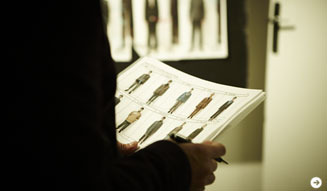
—Men's fashion trends change slowly, and it must be difficult to create something new.
For example, with traditional items like double-breasted jackets, trench coats, and button-down shirts, there's a strong, established idea of 'how it should be' in people's minds. It's easier to convey a new sensibility by skillfully utilizing those established notions. It's about conveying a new atmosphere while leveraging what's already in people's consciousness.
—I see, that's where you create attention. How was the reception in Japan for the 2012-13 Autumn/Winter collection presented in Paris?
It seems they liked it. We received comments like, 'So this is what Mr. Abe considers elegant,' 'You did the show just as you always do with kolor,' and 'It's pure kolor.'
kolor 2012-13AW Men's Collectionhere
kolor
Designer Junichi Abe Interview (3)
The Mystery of Clothing
Vague Images Emerging in Everyone's Minds
—Could you tell us about the start of kolor's creative process?
When I start creating a collection, I always begin by asking myself, 'Why did I start this job?' Then I start thinking about what kind of image I should create, but I don't set a specific theme.
—Where do you find specific inspiration?
People often ask me, 'What inspires you?' Of course, I engage with films, music, and books, but my emotions, that 'kind of feeling,' are built from small accumulations in my everyday life.
—How do you translate that into clothing?
It's not about a specific theme, but about nuance. A heavy, dark feeling, or a light, chemical feeling. For example, if we have the word 'proper,' does it mean things are tidy and organized? Or does it imply a nuance of being honest and not deceitful? I sort through these kinds of questions. Things I don't want to do. By discussing these various small fragments with my staff, even without a clear connection, a vague image begins to form through our conversations.
—Do you ever have differences in thinking with your staff?
Since we work together every day, we adjust as we go. We don't have a fixed ruler, so we develop it together, saying, 'It feels like this, right?'
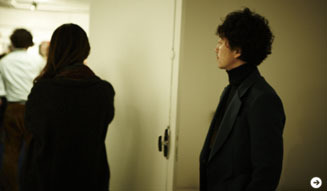
—Are you aiming for a perfect 100% in the final product?
Yes. Although I don't know what constitutes 100%. The satisfaction in creation comes when what I envision matches the reality and it turns out well. When the material, shape, sewing specifications, and details come together nicely as I imagined.
When creating part 2 or part 3 of that, I explore if there are other methods to express the same nuance. Whether it's through shape, detail, or texture... I search for ways to express the same nuance.
—Do you have any particular favorites?
Yes, I do. But clothing is a strange thing. Even though I wear the clothes I make, there are some I stop wearing, some I stop wearing but can't discard, and some I wear frequently, but when compared to others, I realize these are actually more important. I wonder if the value of an item isn't solely determined by how often it's worn. It's not about having memories associated with it; sometimes, you just like its existence and can't let it go.
—My closet is full of such clothes (laughs).
A woman once said something interesting: 'Clothes last a long time, but wouldn't it be nice if they melted away like ice cream after a year?' That way, she said, there's no guilt when buying something new (laughs). For us too, even if we own a pair of Alden chukka boots, we might want another pair in a different style. If it were just a tool, one would suffice, but we're drawn to them because they have appeal beyond mere function. We don't buy them solely for functionality and durability, I think. There needs to be something that moves our emotions.
kolor 2012-13AW Men's Collectionhere
kolor
Designer Junichi Abe Interview (4)
Our Attitude and Stance
Feelings and Nuances That Cannot Be Articulated
—You held a runway show in Paris this time; do you consider sales?
Of course, I do. It's an important form of evaluation.
—One of the fresh aspects of kolor's presentation is the lookbook. The styling is easy to understand, and the message comes across directly.
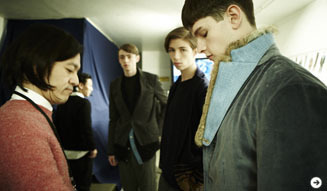
I'm glad to hear you say that. I believe the primary role of a lookbook is to explain the product, but since we weren't doing a show, I tried to convey even vague things like 'mood' within the lookbook.
—Vague things?
Clothing is made up of many accumulated elements. Materials, patterns, sewing specifications, buttons, interlinings, finishes – all are created through a series of concrete decisions. But what are we trying to express with them? It's vague things like feelings and nuances that cannot be articulated.
—I see. Is this the same for womenswear?
It's the same.
kolor 2012-13AW Men's Collectionhere
kolor
Designer Junichi Abe Interview (5)
My Method of Sorting 'In' and 'Out'
'I'm in this kind of mood right now.'
—In men's fashion, there are universal trends like military and workwear; do you consider those?
Yes. Those are essential elements in a man's wardrobe, but depending on the season, I might exclude them entirely or make them imperceptible. I find it too simplistic to assume that simply incorporating military or workwear elements will satisfy what men want.
—I see, are they forbidden techniques?
Not exactly, but if it doesn't align with what I want to convey that season, even if it might be good for sales, I choose not to use it.
—What kind of clothes do you want to create from now on?
Clothes that embody the mood and nuances needed for the times.
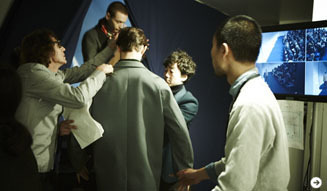
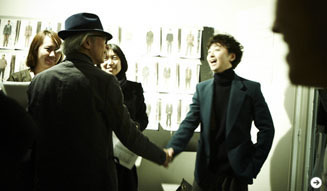
—You are currently planning next season's Spring/Summer collection. Do you have a direction in mind?
I'm still in the process of solidifying the image and discussing materials. When I find a direction, I divide things into 'in' and 'out.'
—'In' and 'out'?
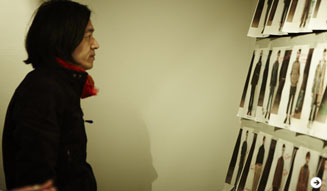
I have a stock of fabric swatches. Every season, when planning begins, I review them all. While looking at these swatches, I sort them into 'in' for this year or 'out.' This way, fabrics that were nominated each season but ultimately not used, or fabrics that suddenly get included, emerge.
—That's interesting.
I do the same with photos I've clipped that I like, sorting them into 'in' and 'out.' This helps me objectively grasp, 'I'm in this kind of mood right now.' I excavate and discover what I'm thinking through the materials and photos.
—We look forward to the Autumn/Winter season. Thank you.
kolor 2012-13AW Men's Collectionhere
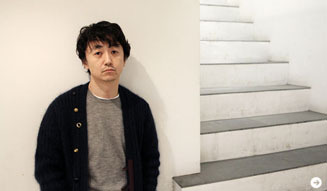
kolor Aoyama
5-6-10 Minami-Aoyama, Minato-ku, Tokyo B1F
Tel. 03-5464-5471
kolor
Tel. 03-5464-5484
http://www.kolor.jp/