A knit from the iconic rock band FRICTION, interviewed by RECK, is here | MEDICOM TOY
MEDICOM TOY
KNIT GANG COUNCIL “FRICTION” “CREW NECK SWEATER” “CREW NECK SWEATER”
FRICTION, the iconic rock band that emerged as a symbol of the "Tokyo Rockers" movement in the late 1970s and continues to shine brightly in the Japanese music scene. Knitwear featuring the graphics from their striking debut single and album is now available.
Text by SHINNO Kunihiko|Edit by TOMIYAMA Eizaburo
KNIT GANG COUNCIL × FRICTION: Crafting "Noir (Black)"
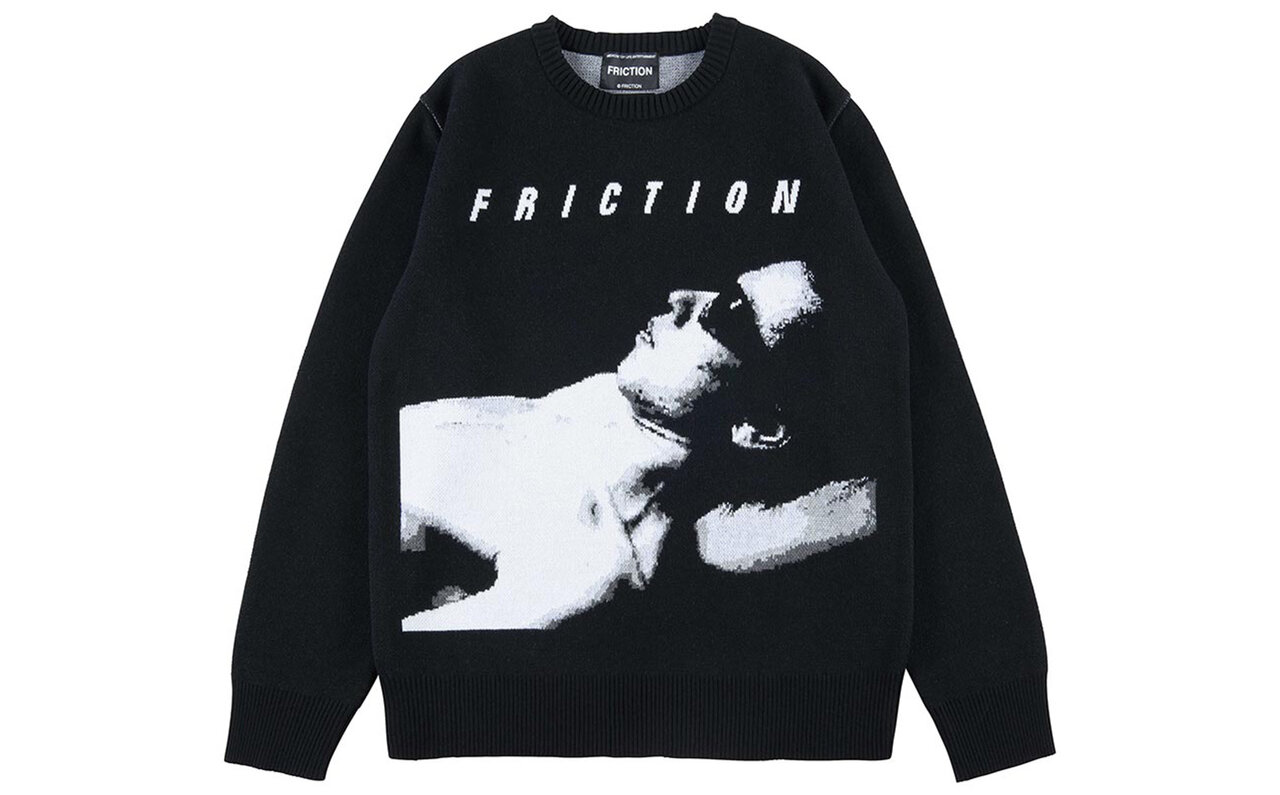
FRICTION's 1980 debut album, "Atsureki," is an essential masterpiece in the history of Japanese rock. The jacket of the simultaneously released single "I CAN TELL / PISTOL" features the "pistol" that band leader RECK cherishes.
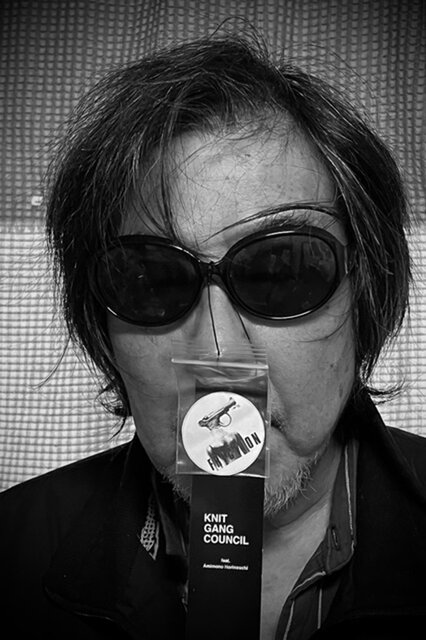
These iconic album designs are brought to life through a powerful collaboration between KNIT GANG COUNCIL, helmed by knit designer Ami-mono Horiuchi, and FRICTION. To commemorate the release, MEDICOM TOY conducted an in-depth interview with RECK. He discusses the artwork of "Atsureki" and "I CAN TELL / PISTOL," as well as his childhood and the band he formed in the 70s.
FRICTION
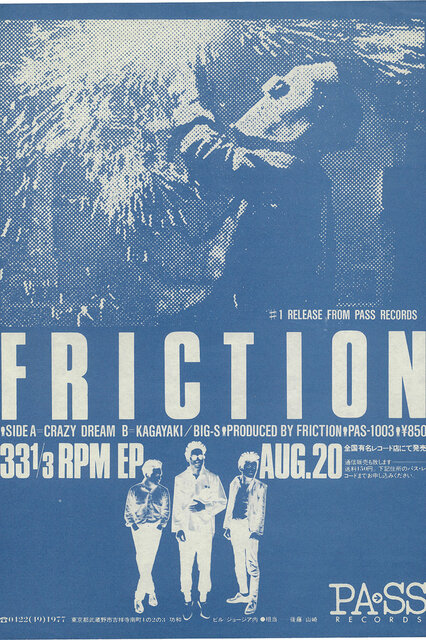
Formed in 1978 around RECK (bass/vocals) upon his return from New York. In 1979, participated in the omnibus album "Tokyo Rockers" with two songs and released an EP from PASS RECORDS. In 1980, released their first album "Atsureki," the only studio work from the trio of RECK, CHICO-HI-GE (drums), and TSUNEMATSU MASATOSHI (guitar). After subsequent member changes, the band went on hiatus after a live performance in November 1996. In April 2006, activity resumed with a duo of RECK and TATSUYA NAKAMURA (drums). This winter, "Atsureki," "Live in Rome," "79 Live," and "Live PASS TOUR '80" are scheduled for reissue on vinyl from P-VINE.
Nobody Could Read "Atsureki"
—Let's start by talking about the album "Atsureki," which is the motif for the sweaters being released.
RECK The album jacket was Haruna-kun's (Scher-Z Haruna) idea. He graduated from art school and was working in design when we met. He also came to FRICTION's shows. When we discussed the jacket for "Atsureki," he suggested we use a friend's photo studio, where they could take professional photos.
His idea was to capture the muscles that appear when you strain your neck. He said that a straight pose wouldn't convey strain, but lying on your back and slightly lifting yourself would. So, the three of us took off our clothes and posed. In the end, it was me. The photos of Hi-GE and Macchan (TSUNEMATSU MASATOSHI) remain unreleased.
However, holding that pose is tiring, right? So, someone actually supported us lightly with their hands, and it was later erased in black. That's a little anecdote. We put the title "FRICTION" on it. But since there was nothing else written, the record company wanted to add an obi strip. I wanted the jacket released without one, though. I never liked the obi strips on Japanese releases.
—It says "Atsureki" (軋轢).
RECKIf they were going to add an obi, they had to write something. So, I looked up FRICTION in the dictionary and found "friction" and "atsureki." I thought two kanji characters looked cool. I had just returned from New York and was rediscovering Japan (laughs). Since nobody could read "Atsureki," I thought it was interesting. The official title was "FRICTION," but because "Atsureki" was written so largely, people started calling it that.
—How did Ryuichi Sakamoto, who co-produced it, get involved?
RECKI knew of him because he was already with YMO when I met him, but we weren't acquainted. Goto-kun from PASS RECORDS (a music label founded in 1979 by Yoshitaka Goto and Kumi Yamazaki, releasing artists like FRICTION, Phew, and Totsuzen Danball) was a friend, and when it came to choosing an engineer, he recommended Sakamoto, saying he'd know about it. I was 30 then, and he was 28, but he looked older than me when we met at the studio.
—Is the photo on the back cover from the recording studio?
RECKHirose-kun (Tadashi Hirose), known as Jefferson, took that photo at the studio. The cables looked like living creatures, which was interesting. He was an acquaintance and had even filmed FRICTION's live shows, wanting to capture their performances. He apparently turned that into a film that was screened abroad. Jefferson's films are characterized by repeating the same scenes and movements, and I'm doing the same repetitive movements.
—What about the single "I CAN TELL / PISTOL," released at the same time?
RECKWe decided to release a single as well as the album, and picked "I CAN TELL" and "PISTOL." "PISTOL" isn't on the album, so it's only available on this single. It was like the old days, inspired by how many great songs were on the B-sides of Beatles singles.
"PISTOL" was a song I'd been doing with 3/3 before going to New York. We recorded it in one take on cassette right after playing it together in the studio, so the sound is incredible (laughs).
—The jacket for that single is also impactful.
RECKIt's a doll's head with a pistol stuck in it. I found a small photo in a newspaper called "The Village Voice" during my first trip to New York in 1977. Since I went to art school, I have a habit of cutting out and saving interesting photos. I pulled this one out and used it. I also collect interesting phrases. When I write songs, I pick words from those collections to create lyrics. To put it poetically, it's like cut-up (a technique invented by American novelist William S. Burroughs, involving randomly cutting and rearranging text).
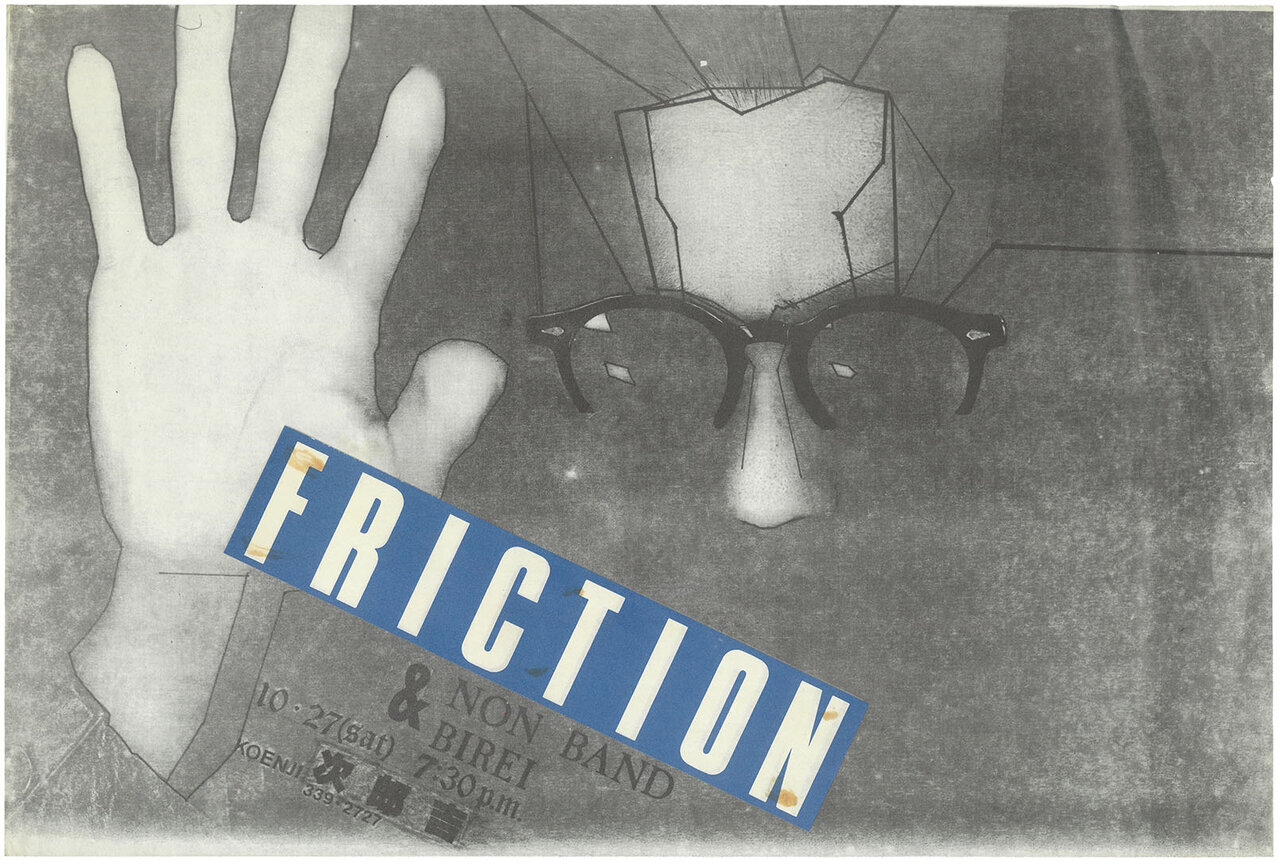
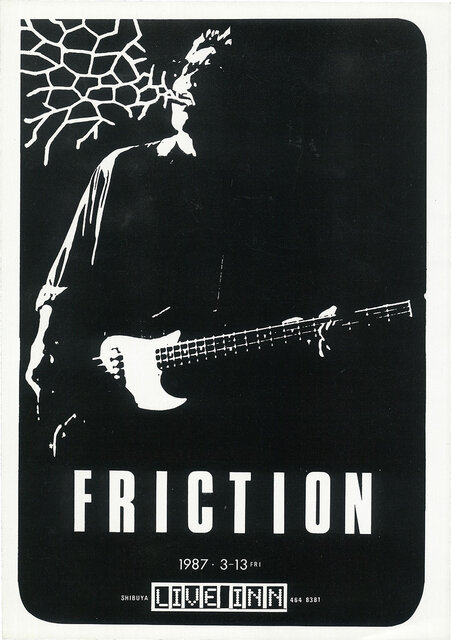
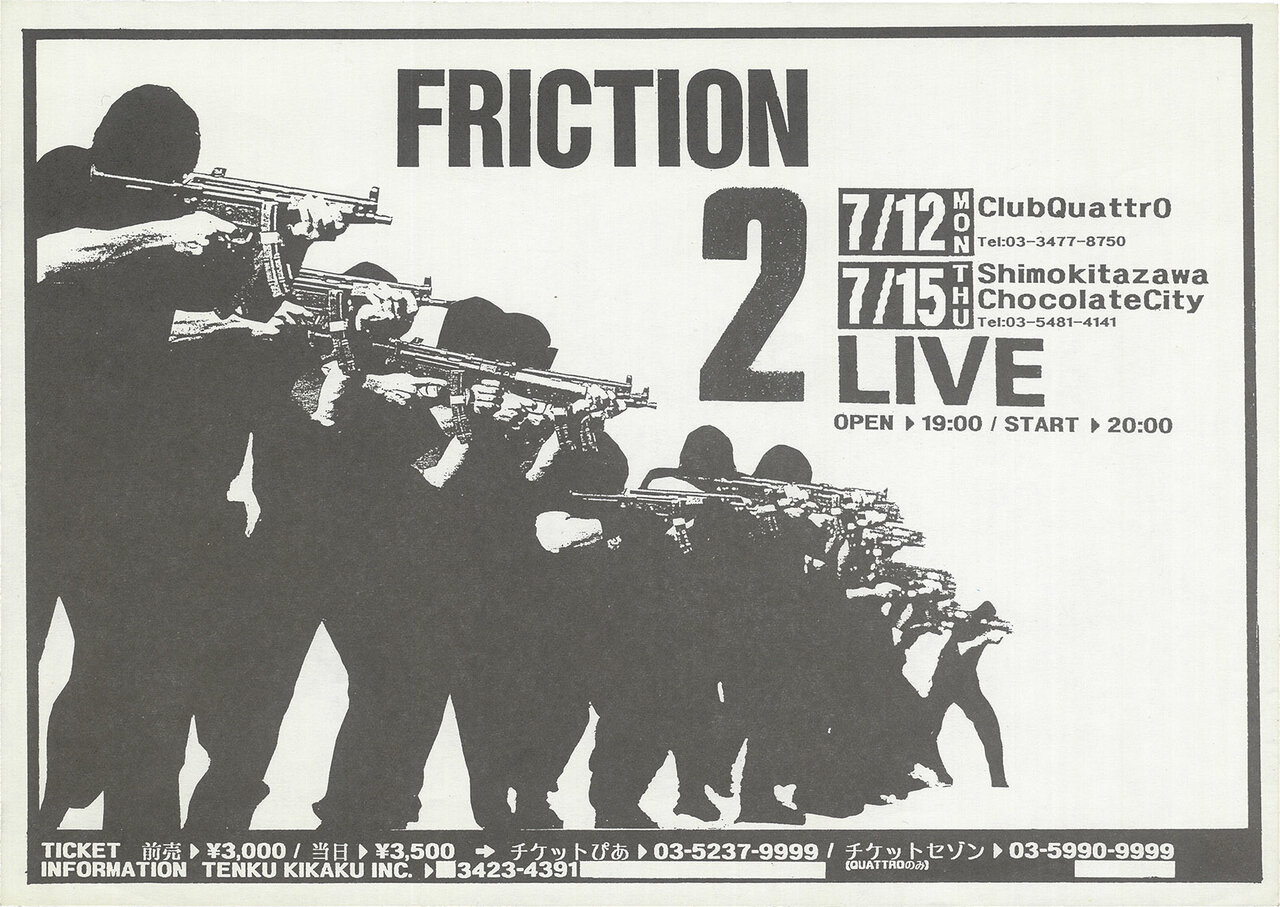
—Around this time, you were also creating FRICTION's live flyers and the mini-zine "WATCH OUT." Were you interested in graphic design from the start?
RECKI've loved drawing since I was a child, and I even considered becoming a manga artist. I was born five years after the war, so Tokyo was still being rebuilt. I was born in Ochanomizu, but where I grew up in Jujo, there were almost no buildings around, and the roads weren't paved. My childhood was like that of the boy in the movie "ALWAYS: Sunset on Third Street" (set in Tokyo in 1958) (laughs).
—What was your childhood like?
RECKWe didn't get a TV until I was in elementary school (TV broadcasting began in Japan in 1953). Before that, there was a public TV set placed high up in front of the station. They only showed news, baseball, or professional wrestling. Since broadcasting was new, there wasn't much content. I remember a photo taken from the TV's perspective, showing salarymen returning from work watching it, with many men looking up with happy faces. They must have felt the future, like things were going to get better and better. They had that kind of expression.
Once we got a TV at home, I was completely captivated by America. As an elementary school student, I watched American dramas every day. Many of them featured protagonists around my age, like "Lassie" (broadcast in Japan from November 1957 to March 1964). I was also hooked on war dramas like "Combat!" (broadcast in Japan from November 1962 to September 1967). Eventually, Japan started producing its own TV shows, but since there was no video recording yet, dramas were broadcast live. There were many broadcast accidents. I remember after "The Three Samurai" (1963-1969) ended, they accidentally showed someone who had just been killed getting up (laughs). The era I grew up in was full of such gaps and flaws, not just on TV, but in the whole city. Until the 70s. Now it's too suffocating, I can barely breathe.
Not Manga, But Gekiga
—Did you read a lot of manga too?
RECKI read them every day. The first I liked was a detective manga called "Billy Pack" (by Mitsuhiro Kawashima, serialized from October 1954 to July 1962 in "Shonen Gahō"). Then, I started going to rental libraries where you could borrow manga for 10 yen a day, and that's how I discovered Takao Saito. I especially loved his work "Taifū Gorō." Around that time, a private detective drama called "Hima-shi Tobidasu" (1955-1962) was popular on TV. I borrowed "Taifū Gorō" every time a new volume came out, and I also bought them when the rental shop sold them cheaper after some time.
—It's surprising that you were a fan of Takao Saito.
RECKTakao Saito declared that he wasn't drawing manga, but gekiga, and he created a club called "Gekiga Group Junior" for boys who loved drawing. If you sent a stamp, you'd receive a newsletter with instructions on how to draw gekiga using ink and G-pens, and if your work won, you could receive original artwork from Saito Takao. I drew a short story about gangsters.
I tried to give it a mature-sounding title like "The Glorious Murder" or something, and it won an honorable mention. I still have the original artwork I received. Much later, I realized that Takao Saito must have been heavily influenced by hardboiled and noir. There's a sunny side and a dark side to the world, and I was drawn to the dark side.
—When did you first encounter rock and roll?
RECKIt was in junior high school when I heard The Beatles' "Twist and Shout" on the radio. It was such a shock that I still remember it. Before that, a lot of American pop music had come to Japan, and I listened to songs like Neil Sedaka's "One-Way Ticket to Love" and "Calendar Girl" sung in his sweet voice. Then suddenly, there was that ♪Shake it up, baby now. Compared to the songs of that era, it was incredibly loud. So, I was surprised. That's how I learned about The Beatles, a British band. They had a song called "Rock and Roll Music," originally by Chuck Berry, and I realized, 'This is rock and roll.' From then on, I bought and listened to every album they released, and eventually, I wanted to play it myself.
At that time, out of 50 students in a class, maybe only one or two liked The Beatles. Most people probably didn't know them. There was one other person in my class who liked them, so we often stayed after school and sang along while looking at the lyrics on the single records. Singing songs like "She Loves You" felt great. After a while, we thought it would be better to have instruments, so I modified a classical guitar my relative gave me so I could wear it like an electric guitar. I couldn't play it then, though. It's like a child becoming Superman with a furoshiki as a cape (laughs). But I truly understood what rock and roll was when I saw Lou Reed perform at Nakano Sunplaza (1975). It was through his rhythm and movements—especially his lower body movements—that I understood rock and roll (laughs).
—When did you buy your first electric guitar?
RECKAfter I entered high school. In high school, there was a group of Beatles fans, and we always practiced in the sports equipment storage room. First, I bought a Teisco, which was affordable. Then, I got a model from Honey that looked just like George Harrison's Gretsch. My next guitar, a Greco Les Paul, I used for quite a long time.
—You mentioned during our sweater discussion that you saw The Beatles' concert in Budokan (five performances from June 29 to July 2, 1966, at Nippon Budokan, Tokyo). Is that correct?
RECKAn acquaintance offered me a ticket, saying they had two and would give me one. But I wasn't particularly blown away, thinking, 'Wow, amazing.' I loved The Beatles, but I wasn't desperate to see them. That's a bit strange. Maybe it's because I had already started playing music myself. Also, George Harrison used a Gretsch (Gretsch 6122 Country Gentleman) and John Lennon used a Rickenbacker (Rickenbacker 325), but around that time, George and John were using Epiphone semi-hollow body guitars (Epiphone CASINO), which looked different, right? (laughs) So, it felt like, 'The people on stage aren't The Beatles!'
—So, it was different from what you had imagined.
RECKIt was the same when Jimmy Page started using a Les Paul. When Led Zeppelin debuted, Jimmy Page was associated with a Telecaster. During their first visit to Japan (1971), he wore a vest, had a beard, and played a Les Paul, so it wasn't 'my' Zeppelin. I understand how FRICTION fans feel. Someone said, 'I won't watch FRICTION without Tsunematsu,' and I don't deny that. I still think their first album (1969's "Led Zeppelin I") is the best, and I'm a fan of anything, so I get interested and dive into it. But maybe that's what was good.
My Name, "RECK," Comes from Lautrec
—How did you meet CHICO-HI-GE?
RECKAfter graduating from design school, I was wondering what to do next when I saw an ad looking for a guitarist in "Music Life" or something similar. According to Hi-GE, I wrote "Want to play guitar" in large letters on rough paper. He probably thought a normal letter wouldn't be interesting. So, he must have thought, 'Who is this guy?' We met at a coffee shop in Shinjuku, and I apparently told him right after sitting down, 'I can't play guitar solos.' Which was true. When he asked what I could play, I said, 'Rhythm guitar' (laughs). That's what he liked.
Hi-GE's family was in Hokkaido, and he said, 'If you come here, you can live with us, eat with us, and practice every day.' So, I thought, 'Great!' and went to Hokkaido. At that time, Hi-GE was trying to form something like a Beatles cover band. He had two friends in Hokkaido, and they planned to form a band and debut in Tokyo, but we split into two groups—me and Hi-GE, and the other two—and eventually returned to Tokyo.
—Could you tell us about "Movin'," a rock coffee shop in Koenji where you were a regular?
RECKIt was run by Wada-kun (Hiromi Wada). He worked at the jazz coffee shop "DIG" in Shinjuku before opening "Movin'" in Koenji in 1969. In 1972, he joined the rock band "Hachimitsu Pie" as a bassist. I went there almost every day. It was a small shop. The first time, Kant, whom I met at design school, took me there. Kant later became the drummer for Murahachibu. The customers at Movin' were mostly long-haired people whose occupations were unclear. They called each other names like "Jan" or "Napo," not their real names.
He said "Napo" came from the American TV drama "The Man from U.N.C.L.E." (broadcast in Japan from 1965 to 1970). Eventually, I felt I needed a nickname too, so I gave myself the name "RECK."
—Does the name come from "REC" for recording?
RECKI liked Lautrec (1864-1901). He's a French painter considered the father of posters. I took the name from him, "RECK." Lautrec also has pharmaceutical connections (laughs).
The regulars at Movin' were a bit older than me, so they taught me a lot. Around that time, Shuji Terayama's Tenjō Sajiki theater troupe was popular in Japan, and his book "Throw Away Your Books, Go Out into the Streets" encouraged young people to run away from home. I didn't like Tenjō Sajiki because it felt too Japanese. I was more influenced by America. So, I argued with my father, left home with nothing, and ended up at Kant's place in Koenji.
Kant said, 'Well done.' It was a charming era. I also did a lot of hitchhiking. First, I tried it in Hokkaido, thumbing a ride from Asahikawa to Kushiro. If you didn't do that, people around you wouldn't consider you grown-up. Many people hitchhiked from Koenji to Kyoto. Rock was thriving there with bands like Murahachibu and the Seibu Kodo venue.
—It really conveys the atmosphere of the early 70s.
RECK Woodstock in 1969 (August 15-17, 1969, Bethel, New York State, USA, featuring over 30 acts including rock groups and folk singers, attended by approximately 400,000 people) was a major event.
I was shocked when I saw the movie. The sheer number of people gathered, people bathing naked... I had never seen anything like it. Richie Havens singing "Freedom" with just a guitar was incredibly impactful. Jimi Hendrix was on the last day, the third day, and the audience area was littered with trash. The Who were also powerful. Watching "Summertime Blues" made me think, 'What is this!' I liked The Who's live album "Live at Leeds." Richie's live albums, like Johnny Winter's and MC5's, were far better than their studio versions. Having that input made me want to create my own live albums.
—Do you have any particularly memorable live performance anecdotes from that time?
RECKWhen Hi-GE and I returned to Tokyo from Hokkaido and were looking for someone who could play bass, the Folk Jamboree (the 3rd All Japan Folk Jamboree, held August 7-9, 1971, with an audience of about 20,000) was scheduled to take place in Nakatsugawa.
I disliked folk music and wasn't interested, but a regular at Movin' suggested, 'We can get in for free if we ride in the back of a truck, why don't we all go?' Apparently, someone from the "Black Tent" theater group (along with Karato Juro's "Jōkyō Gekijō" and Shuji Terayama's "Tenjō Sajiki," it was a representative theater group of the underground theater boom) was setting up a tent at the venue and said we could do whatever we liked inside. Some of the Movin' regulars could play bass, so we all piled into the back of a truck and went to Nakatsugawa. It took hours.
Being young, we found things like that fun. However, the bassist didn't seem to get along with us and left midway. So, I asked an acquaintance to play the bass part, borrowing someone's guitar that was lying around. We played a song that could go on with just one chord, something like Jimi Hendrix.
—It's surprising that you performed at the Nakatsugawa Folk Jamboree.
RECKWell, I say I performed, but it wasn't on the main stage. It was just on a small stage, off to the side. By the way, we also played on a different stage from the tent, and there was a Twin Reverb (Fender Twin Reverb, an all-tube guitar amplifier made by Fender)! That was my first encounter with a Twin Reverb. I was like, 'In a place like this!' I wasn't using effects pedals back then, so I plugged straight in and was amazed by how good it sounded. 'This guitar can make this sound!'
After that, the truck we came in was going to "Nemunoki" (a resort in the Shima Peninsula, Mie Prefecture, which hosted the Yamaha Popular Song Contest from 1969 to 1973), which was managed by Yamaha at the time, so Hi-GE and I rode along. There was an outdoor stage, so we played there as a duo. Folk music was dominant then, so most people around us were playing folk, but after we finished, someone said, 'You guys are good.' I was happy because no one had ever said that to me before. Later, I realized it was Hiroshi Mikami. We bumped into each other on the Chuo Line later and said, 'Hey! It's you from back then!'
If It Doesn't Swing, It's Meaningless
—And then you formed the new band "BLOW UP" with CHICO-HI-GE, right?
RECKThe first time I encountered what I would call hard rock was The Beatles' "Revolution," but the next was The Yardbirds. Around that time, the movie "Blow-Up" (1966) was released, and I went to see it because the poster was cool. I admired the photographer protagonist's outfit: a dark green velvet jacket over a blue shirt, white pants. I found similar clothes and would dress up like that for my photography class at design school. I had many such trips (laughs).
There was a performance scene by The Yardbirds in that movie, and I became a fan instantly. There was a guy breaking guitars (Jeff Beck), and Jimmy Page was just playing his guitar with a smirk the whole time; they were just so cool. That's why I decided to name the band "BLOW UP," the original title of the movie.
—After BLOW UP disbanded, you formed "3/3" with CHICO-HI-GE (drums) and HIGASHI HIROSHI (bass). Your self-produced album "3/3," released in 1975, was reportedly pressed in only 10 copies.
RECKThe jackets were all handmade. I sprayed them myself and pasted on pictures of astronauts. It was possible because we didn't press many copies. The records were acetate, heavier and more fragile than vinyl. I was surprised to hear that one of those copies sold for 1.2 million yen at auction a few years ago.
—Nowadays, the music of "3/3" is available on subscription services, but it strongly reflects the influence of Jimi Hendrix.
RECKIn the late 60s, when I was playing in a Beatles cover band, we entered a band contest sponsored by a record store. While I was singing "Baby It's You," another trio was playing Jimi Hendrix's "Purple Haze." I didn't understand it at all back then, but I knew they were doing something much more innovative (laughs).
The first Stratocaster I bought was because I saw a picture of the Stratocaster Jimi Hendrix played at the Monterey Pop Festival (1967) and thought it looked cool. It had a tremolo arm and looked interesting, so I looked for one. I found one in Ochanomizu. It was a candy apple red Stratocaster with a few scratches. It was a model from the large headstock era. I bought it on an installment plan, paying monthly for a year. To make the payments, I did part-time jobs like capping shampoo bottles. I also did door-to-door sales for gas leak detectors. I quit those quickly, thinking I couldn't do them.
—Today, you've shared valuable stories about your childhood and the beginnings that led to FRICTION. What are your thoughts on the current music scene?
A grave problem is that most Japanese bands don't have the backbeat down. Because the second and fourth beats aren't solid, the sound becomes light and fast. If they could achieve that, they could create a much more satisfying feel.It's not about the backbeat itself, but last year I saw two bands that I found interesting. One was a trio formed by a friend's son, all in their early twenties... maybe. The drummer is a girl (H.A.M.). The other is also a trio, CHO CO PA CO CHO CO QUIN QUIN. What is this? I've never heard anything like it. Even their long instrumental tracks, about 10 minutes long, were psychedelic and kept me engaged until the end. I thought they should tour together. It's none of my business, but perhaps (laughs).
—You seem to keep a close eye on contemporary bands.
Not closely, but I'm curious about what young people are doing. Among American bands, there's Die Spitz. They're a four-girl group, energetic, and play really solid rock. The guitarist and drummer sometimes switch roles, and the drummer girl is incredibly good. I'd love to bring them to Japan (laughs). The duo NOVA TWINS is also great. The bassist is super cool.—Finally, following the reissue of four albums, including "Atsureki" and live albums, on vinyl starting this December, and rumors of a new film about "Tokyo Rockers" directed by Tomorowo Taguchi and written by Kankuro Kudo, could you tell us about FRICTION's future plans?
I want to play live. If I can create a rhythm that feels good to me. This is my theory: musicians who perform live without feeling pleasure will damage their bodies. It should start from there, but the problem begins when it becomes a job. I just want to feel good. I just want to create "good feelings." That's all. Receiving "good feelings" and creating "good feelings." If I can't do that, there's no point in performing live. It's like Duke Ellington said, 'If it ain't got that swing, it don't mean a thing.'a
KNIT GANG COUNCIL “FRICTION”
CREW NECK SWEATER “Atsureki”
Knit Design by Ami-mono☆Horiuchi
Sizes: M, L (Includes a can badge)
Release Date: Scheduled for release and shipping in December 2024 at MEDICOM TOY's directly managed stores, online store, and select retailers.
Price: ¥30,800 (tax included)
©️ FRICTION
CREW NECK SWEATER “PISTOL”
Knit Design by Ami-mono☆Horiuchi
Sizes: M, L (Includes a can badge)
Release Date: Scheduled for release and shipping in December 2024 at MEDICOM TOY's directly managed stores, online store, and select retailers.
Price: ¥30,800 (tax included)
©️ FRICTION
Note: Orders may close without prior notice if a certain number of orders is reached, even within the order period. Thank you for your understanding.
Note: The product shown is a sample under supervision. It may differ slightly from the actual product.
Note: This is a limited quantity item. Please forgive us if it sells out.
Inquiries
MEDICOM TOY User Support
Tel. 03-3460-7555
![[RECK Interview] Knitwear from the Solitary Rock Band FRICTION Appears | MEDICOM TOY](https://nrzrbfnxu4s7ucc9gsgt7ehg.global.ssl.fastly.net/item_images/images/000/174/675/large/0f095531-cbbd-484e-8ac2-cad996816bf8.jpg)