DANESE | The Essence of Danese. (2)
DANESE
The Essence of DANESE. (2)
This is the second installment of our feature exploring the allure of DANESE, Italy's quintessential design brand.
Continuing from our previous discussion, we invited Motohiro Kuwano, representative of Kuwano Trading, the general agent for DANESE, to share his thoughts on the brand's product design in more detail.
The Essence of DANESE. (1)
Text by Masato KawaiPhotos by Yoshio Kato
Overwhelming sculptural power. That's all there is to it.
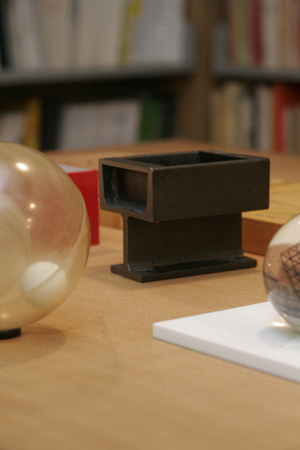
One piece from the "PUTRELLA" series, created using iron between 1958 and 1959. Designed by Enzo Mari.
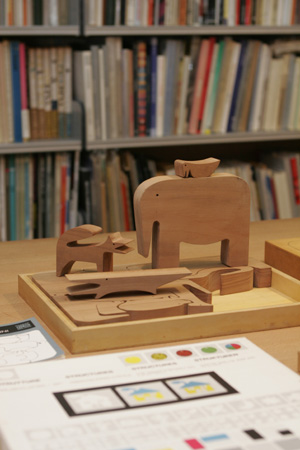
An early model of the wooden animal puzzle "16ANIMALI," originally designed for the department store La Rinascente and released by DANESE in 1959. Designed by Enzo Mari.
—Could you tell us about the appeal of early DANESE?
DANESE was born in 1957 in Milan, a city buzzing with economic prosperity in the 1950s.
The core of product design was led by Bruno Danese and Jacqueline Vodoz, the founders, along with Bruno Munari and Enzo Mari. Personally, my impression of DANESE is that about 70% of it is shaped by Mari's work. If I were to describe his design characteristics and their brilliance, it would be his overwhelming sculptural power. That's all there is to it.
Masculine, virile, cool, perhaps.
This is evident even in the earliest works, the iron series created by welding steel. And then, the "16 ANIMALI" is indispensable.
It's now spoken of as an icon of Italian design, isn't it?
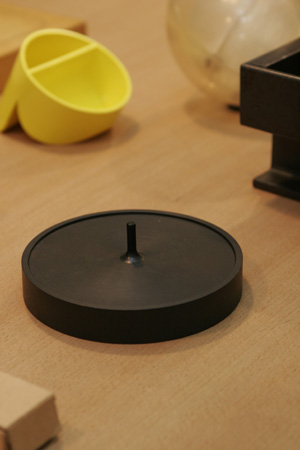
The ink pad "HAINAN," designed in 1961/65, features exquisite precision in its form, designed to prevent ink evaporation. Designed by Bruno Munari.
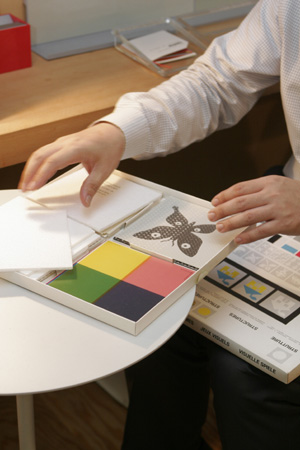
"STRUTTURE," released in 1972, allows children to create houses by layering transparent sheets in various colors and designs. Designed by Bruno Munari.
Munari wasn't primarily designing the main product items.
He was also significantly involved in determining the brand's direction, proposing three product lines that characterize DANESE: "PRODUZIONE" for regular mass-produced industrial goods, "EDIZIONE D'ARTE" for limited production items leaning towards artistic expression, and "EDIZIONE PER I BAMBINI" for children's objects.
Regarding the products he handled, even with the ashtray "cubo," it's a minimalist form that distills the essential function into a cube. The designs often give an impression of being unapproachable or stark, with the "Falkland" lighting being an exception.
Among Munari's works, the ones I'd like to have are from the "EDIZIONE PER I BAMBINI" series. I'm also searching for the "OraX" clock, which has no hands. As a collector, this is actually what I want the most right now!
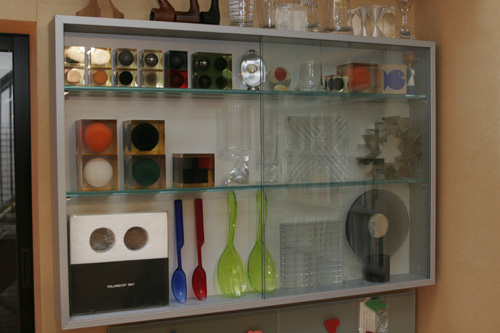
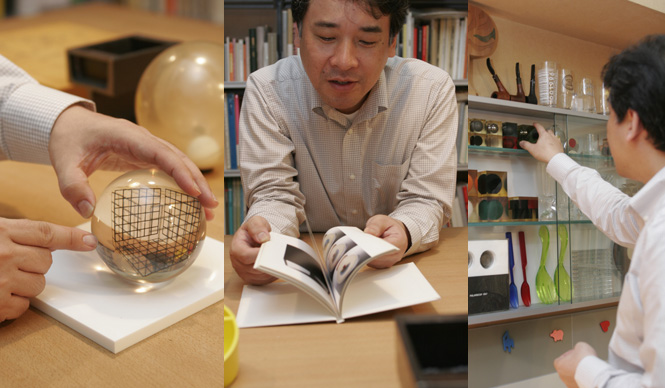
A display of Kuwano's collection on an office shelf. It's rare to see such a comprehensive collection of Enzo Mari's acrylic cube objects.
Still, even with these small desk accessories, I marvel at how such passion could be poured into such tiny items.
None of these were likely profitable ventures for the designers either. Truly, the achievements of Bruno Danese and Jacqueline Vodoz are immense.
To have allowed Munari and Mari to go this far is remarkable.
This kind of collaboration between a company and designers, I doubt we'll see anything like it again.
The New DANESE Evolves Through Collaborations with Emerging Talent
—Could you tell us about the current DANESE and its future plans?
DANESE ceased operations in 1991 and relaunched in 2000. Currently, it features Naoto Fukasawa, Paolo Rizzatto, and James Irvine as main designers, while also engaging talented young designers like Yves Béhar.
The selection of designers is decided by the current owner, Carlotta de Bevilacqua, who is also an active designer.
In terms of product composition, in addition to the traditional lineup and reissued items, various products are designed to suit contemporary diverse lifestyles and office environments.
Fukasawa has a very close relationship with DANESE, having directed the DANESE exhibition at Matsuya Ginza and curated the DANESE display at Designers' Block in 2004 (the entrance featured Munari's "cubo" ashtray!).
I hear that products like "Bincan System" are selling very well overseas, and I believe DANESE has no intention of parting with Fukasawa.
Currently, a large-scale DANESE exhibition, directed by Fukasawa, is being held at Musashino Art University. It offers a comprehensive overview of their activities to date and a chance to see many valuable works, so I highly recommend visiting.
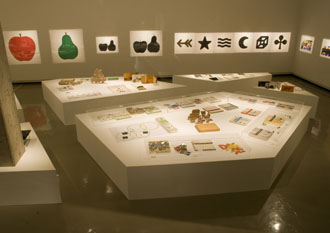
DANESE: Editor of Products
-Daily Goods, Art Editions, Educational Toys-
Dates | November 12, 2007 [Mon] - December 15, 2007 [Sat]
Hours | 10:00 - 18:00 [Open until 17:00 on Saturdays and Sundays]
Closed | Sundays, National Holidays [Open Sundays on November 18 and December 9]
Venue | Exhibition Room 1F, Musashino Art University Museum & Library
Admission | Free