Japanese Designers: A Series Interview (1) S&O DESIGN's Hisakazu Shimizu & Eizo Okada
A Series of Interviews with Japanese Designers (1)
S&O DESIGN: Hisakazu Shimizu & Eizo Okada
The Current State of "Industrial Design"
Hisakazu Shimizu, who was with Canon until this year and handled the design of digital cameras and other products, and Eizo Okada, who presides over the website dezain.net, a source of the latest information on architecture, design, and art, and directs various projects. The two, who hold distinct roles as product designer and design director, launched their design company "S&O DESIGN" in July 2012. Their stated goal is, quite simply, "industrial design." We spoke with them about their work, which encompasses not only the design of individual objects but also the broader role of design in society.
Text & Photographs (portrait) by Takashi Kato
New Endeavors Through "Design x Direction"
──Could you tell us about your respective roles at S&O DESIGN, as a designer and a design director, which are similar yet distinct?
Eizo Okada (hereinafter, Okada)I handle the direction, and Shimizu is originally a product designer. Our initial idea was that by working together, we could expand the possibilities of what we could achieve compared to a single designer working on a product alone. In a company focused on industrial design, we can consider a broader scope beyond just product design, including the framework of design, public relations, and distribution. Industrial design also involves concept creation, where I can leverage my directorial experience. We believed that by establishing a design company together, a designer and a director could create synergistic, excellent designs.
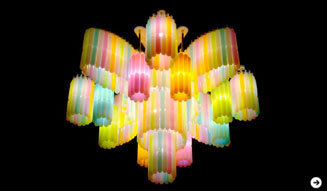
"Chuchu Chandelier" 1994 A chandelier made from over 300 actual "Chu-pet" ice pops.
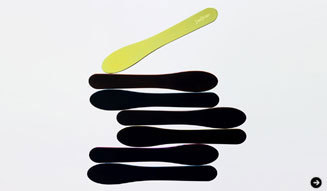
"ICE CREAM SPOON" 1998 A wooden ice cream spoon, typically disposable, crafted from stainless steel.
Hisakazu Shimizu (hereinafter, Shimizu)While there have been designers who also handled their own direction, at S&O DESIGN, we aim for "design multiplied by direction," not just "design plus direction." The combination of a designer and a director is something we haven't seen before, so we believe we can do interesting things.
OkadaFurthermore, at S&O DESIGN, we are focused on industrial design. We want to apply the expertise we've cultivated together over the years to the future of industrial design in Japan.
──Could you tell us about your respective views on industrial design?
ShimizuWhile I am fundamentally an industrial designer, designers employed by companies often don't have their names publicly recognized. Also, through activities with SABO STUDIO (a design studio founded by Shimizu), where I design under my own name, I felt that my identity as industrial designer Hisakazu Shimizu was becoming less prominent to the general public.
OkadaIn reality, industrial design demands a high level of technical skill and experience, and only a limited number of designers possess these capabilities. In that sense, we wanted to leverage Shimizu's achievements at Canon and contribute to industrial design in a broader sense going forward.
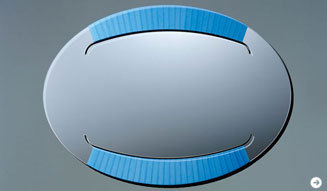
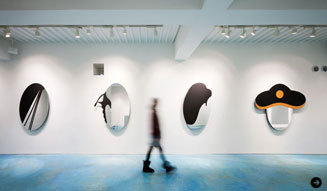
"HAIRSTYLE MIRROR" Inoue Ribbon Industry Co., Ltd. 2004 Ribbon is directly woven into the mirror.
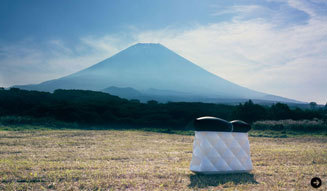
"Topknot Piggy Bank" 2008 Planned by Okada, realized as a work by Shimizu.
──Does this perspective stem from your thoughts or concerns about the current state of industrial design in an era where products are not selling well?
ShimizuThat concern is always present. We face numerous issues, such as products not selling, or low prices being the sole competitive advantage in the market, leading to low profits for companies even if sales are achieved through price wars. Recently, industrial products have become homogenized in terms of price and quality, and I believe Japanese industrial products are losing their competitive edge in the market from a design perspective. I'm curious to see what happens in the current market when we create something with good design that possesses competitive strength.
OkadaWhile it's true that good design doesn't always guarantee sales, excellent design is a fundamental prerequisite. Beyond that, we need to create products that sell.
If creating products with good design that are widely accepted doesn't become the premise of manufacturing, I believe the role of designers in society will become increasingly questioned. Those involved in design, including the shaping aspect, need to clarify this point once again.
A Series of Interviews with Japanese Designers (1)
S&O DESIGN: Hisakazu Shimizu & Eizo Okada
The Current State of "Industrial Design"
On S&O DESIGN's Design Methodology
──Shimizu, you've been involved in numerous projects. What do you consider most important in your design process?
ShimizuTypically, the production of industrial products involves many specialized engineers and goes through various processes. As is the fate of mass-produced items, the initial, vibrant ideas tend to degrade during the product development process. My design philosophy is that nothing surpasses the initial sketch; the less work involved in transforming that initial idea into a product, the better. However, industrial products also have the inherent challenge of requiring extensive work beyond just product design and concept creation before they can be realized. To simplify this flow, I call it "Continuous Design," and I've developed a unique way of using 3D design software.
In our Continuous Design approach, we don't even create initial rough sketches. We begin by modeling directly in 3D, and once the form is decided with minimal necessary adjustments, we can proceed to the final finishing without the translation work of creating drawings or models. This eliminates the need to provide instructions to engineers via drawings, allowing the initial idea to be directly reflected in the molds. As a result, the design undergoes almost no degradation from the initial concept to the final product. Canon's "IXY DIGITAL" series was designed precisely through this process.
CANON IXY DIGITAL
One of Shimizu's signature works, Canon's compact digital camera series, IXY.
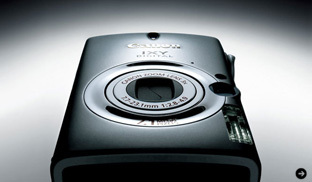
"CANON IXY DIGITAL 920IS" Canon 2008
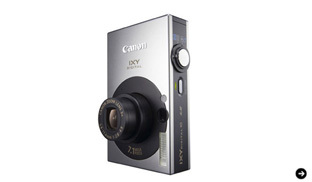
"CANON IXY DIGITAL 10" Canon 2007
OkadaWhile everyone uses existing technology for design, surprisingly few have attempted to change the modeling process with the latest technology.
ShimizuThe industrial design process is difficult to alter, not only due to design issues but also interpersonal dynamics. Established systems are inherently resistant to change.
OkadaEach stage involves its own specialists, and changing them requires considerable will and execution. Shimizu is a rare individual who has achieved this within a company.
Think of a ceramic artist who doesn't knead clay excessively on the potter's wheel. You can consider this the digital equivalent.
──Will this capability become a strength of future industrial design?
OkadaYes. Our company's greatest strength lies in our modeling capabilities. Modeling skills are not easily acquired, which makes them valuable and a powerful asset.
There's a trend where the role of designers seems to be shifting towards concept development and framework creation, and discussing form is considered old-fashioned. However, this hasn't necessarily led to better design or environments. The ability to give form to concepts is still essential, and we must focus on this aspect. I believe it's important to be consciously aware of the value of form, which is difficult to systematize.
Fruit Series
Created with Okada in 2011, this series of works is themed around "fruit." It was exhibited at VIVID, a contemporary design gallery in Rotterdam, Netherlands.
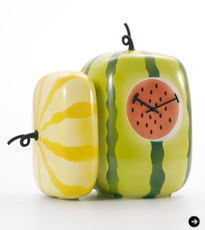
"Watermelon Clock" Galerie Vivid, 2011
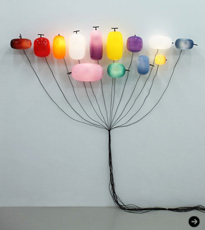
"Fruit Wall Lamp" Galerie Vivid, 2011
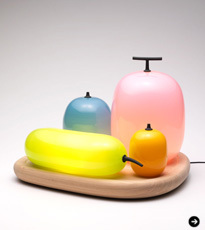
"Fruit Table Lamp" Galerie Vivid, 2011
──Do you prioritize new technologies or traditional techniques, such as those used in your "Fruit" series (a collection of works inspired by fruit, including clocks and lamps)?
ShimizuI always want to prioritize new technologies. Regarding materials, for example, if we focus on the inherent beauty of glass when creating a product, the emphasis on its properties can hinder new design challenges. I don't want to be constrained by materials or techniques; I always want to prioritize design. In fact, I believe form itself can be considered a new technology.
OkadaWhile handmade crafts are undoubtedly appealing, their charm often stems from the underlying techniques, effort, material value, and history. Designers shouldn't rely solely on such "narratives." We should strive for designs that are compelling in themselves, even if their background is not apparent.
What is Needed for Future Industrial Design
──Design, in its essence, should not be limited to design enthusiasts or interior aficionados. Yet, in Japan, design often seems to be perceived as something uncommon by the general public.
OkadaIf design appears to be something specialized, it might indicate that there is still not enough of it. Perhaps design is not yet sufficiently integrated.
We sometimes hear criticism that certain products are "over-designed." However, this is likely because the creator's self-consciousness is evident, meaning the design is incomplete. If designed thoroughly, it should transcend the level implied by the criticism of being "over-designed."
Anyone familiar with industrial product design knows that, for example, Apple's products are designed to an extreme degree. Yet, no one says they are "over-designed."
──What are your thoughts on the timescale of products? Against the backdrop of environmental issues and a shrinking society, industrial products often claim "long life," yet their consumption speed is accelerating in reality.
ShimizuI'm somewhat skeptical about that. While I desire designs that endure, I also have a preference for using new industrial products. People buy new products for the excitement they bring, so design must constantly evolve with the times to provide that sense of exhilaration.
OkadaI believe we also need to consider what is practical. As design evolves with technology, material handling methods will change, potentially leading to new ecological products for a new era. The aluminum used in compact cameras, for instance, may not have a long product lifecycle, but it is recycled, contributing to a circular economy. Just as the concept of "long life" changes with the times, so too might our understanding of it.
──What do you believe modern industrial design should be?
OkadaThe term "industrial design" was an older term that gradually fell out of use, replaced by "product design." The individuals who pioneered industrial design likely felt a mission to create new manufacturing industries, not just design objects. Subsequently, the functions of industrial design became specialized, and the designer's role was scaled down to "product design."
The reason we want to use the term "industrial design" now is a declaration of our intent to actively contribute to the industry at a time when its very structure is undergoing significant change.
Furthermore, in today's world, it's becoming commonplace for designers to be involved broadly, from creating business frameworks to distribution. We intend to use the term "industrial design" to encompass this expanded role. To that end, we also want to form teams with experts from various fields to create new things.
ShimizuIn terms of spirit, it's like the image of Space Battleship Yamato emerging from underground (laughs).
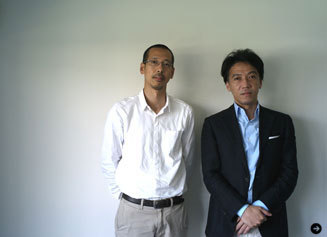
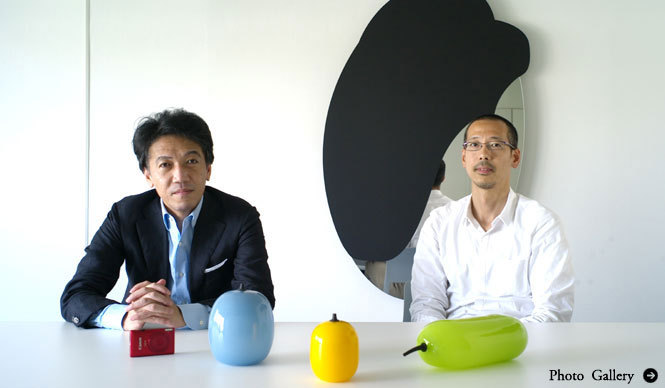
Eizo Okada (left) and Hisakazu Shimizu
Hisakazu Shimizu
Born in Nagasaki in 1964. Graduated from Kuwasawa Design School, Industrial Design Department, in 1984. Joined Canon Inc. in 1989, where he was involved in the design of digital camera series such as IXY. Established SABO STUDIO in 1998. Began activities as S&O DESIGN in 2012.
Part-time lecturer at Kuwasawa Design School.
Eizo Okada
Born in Fukuoka in 1970. Completed doctoral program at Chiba University Graduate School (Ph.D. in Arts). Director of the "Ribbon Project," exploring the potential of ribbon as a material, and director of "DEROLL Commissions." Presides over dezain.net, a daily design news website. Began activities as S&O DESIGN in 2012.