
Choemon Kamiide Kiln x Maruwakaya Dialogue
Choemon Kamide Kiln x Maruwakaya Dialogue
The Sensibility of Today's Heirs in Carrying on Traditional Crafts
Keigo Kamide is the fifth-generation heir to a Kutani ware kiln that has been in business for 130 years. Hirotoshi Maruwaka produces content about the present and future of Japanese craftsmanship, including traditional crafts. Though they grew up in vastly different environments, they resonate as creators in their 30s involved in Japanese traditional crafts. They are the duo who brought to life the collaboration with Jaime Hayon, a highlight of last year's Design Week, and who are breathing new life into Japan's traditional crafts.
Text by Yuka KobayashiPhotos by JAMANDFIX
Keigo Kamide, the fifth-generation heir of "Choemon Kamide Kiln," one of the representative traditional craft producers of Kutani ware in Ishikawa Prefecture, has earned high acclaim for his diverse activities that sublimate the Kutani ware he inherited into ever-changing forms. Hirotoshi Maruwaka, of "Maruwakaya," a craft stylist who connects traditional industry producers and users, has produced many of his projects. Traditional Japanese crafts are built upon the exquisite techniques and aesthetic sensibilities cultivated over long histories. The two believe that to pass these on to the future, it is essential to "always be at the forefront of the times."
KamidePerhaps it's because Ishikawa Prefecture experiences harsh winters, but the preparations for spring are truly vibrant. Kutani ware, in particular, often features designs that express the anticipation of the longed-for spring through vivid colors and patterns. There's a word, "Sakigake" (harbinger), often depicted on red-enameled vessels, and I believe "Sakigake" represents a uniquely Japanese sensibility of trying to capture the essence of the season just before others do, much like these spring preparations. I think Japanese crafts, while preserving tradition, have always held a spirit of creating something new and unprecedented, a "Sakigake," in every era.
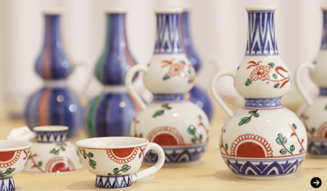
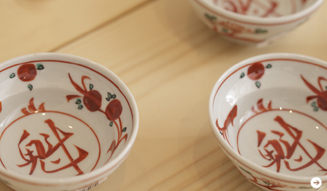
Left: Sake flask with handle, red enamel, ¥5,775 / Sake cup with handle, red enamel, ¥3,475. Right: Small dish, red enamel, "Sakigake" pattern, ¥5,250. Purchase from: http://www.choemon.com
MaruwakaCertainly, traditional crafts with centuries of inherited techniques are captivating in themselves. However, I feel the way traditional crafts are treated today differs from the past. In the past, during their vibrant periods, weren't artisans more aggressive about what they created? I want to experience that atmosphere from when things were more dynamic. It feels like maintaining tradition is prioritized now. Because tradition is so revered, many craft items tend to be viewed as mere hobbies, yet they originally began as everyday objects, so they should be incorporated more naturally. I sense that same approach in your work, Kamide-san.
Keigo Kamide | KAMIDE Keigo
Born in 1981. Fifth-generation heir to "Choemon Kamide Kiln," a Kutani ware kiln founded in 1879. While studying at Tokyo University of the Arts, his Kutani ware pieces received high praise from the contemporary art world. Since then, as director of the Kamide Kiln, he has garnered attention for presenting various projects and works.
Choemon Kamide Kiln
http://www.choemon.com/
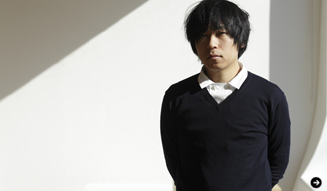
KamideThat's right. Traditional crafts, which were once daily necessities, are now seen as hobbies, and in today's era where the items themselves are not selling well, it's a harsh reality for artisans. I feel a strong sense of crisis. In that sense, I believe it's necessary to organize what has been historically accumulated and start anew. For the past three years, I've been continuing activities as a new venture of the kiln, focusing on applying tradition to the present. The opportunity to collaborate with a world-renowned designer on Kutani ware was extremely meaningful for me. It truly felt like encountering the word "Sakigake."

Hirotoshi Maruwaka | MARUWAKA Hirotoshi
Born in 1979. Serves as the proprietor of "Yorozuya Group," which engages in contemporary manufacturing in collaboration with artisans and companies across Japan. He proposes answers to questions such as "Where is Japanese manufacturing heading?" and "What do people desire?" through the act of creation.
Maruwakaya
http://maru-waka.com/
MaruwakaWhen the collaboration between Kamide-san and Jaime Hayon began, given that it was for the historic Choemon Kamide Kiln, some people around me repeatedly suggested that we should strongly promote the collaboration between Japan's excellent traditional crafts and a famous designer. However, what made me happy was that Choemon Kamide Kiln and Hayon respected each other's sensibilities and techniques, resulting in something 120% from their wonderful harmony. The high evaluation was a result; we weren't aiming to attract attention with an "unconventional collaboration." I enjoyed playing the role of an "air conditioner," preserving the initial inspiration of both parties (laughs).
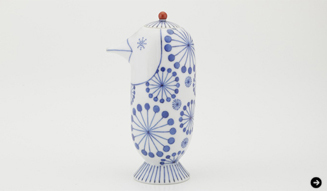
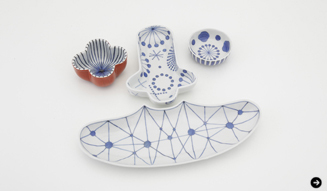
The collaborative works between Jaime Hayon and Choemon Kamide Kiln, which garnered attention at Design Week 2010. Produced by Maruwakaya. Left: Product name: Bird-shaped "Fireworks" soy sauce dispenser, ¥18,900. Right: Top left: Small bowl, eye-shaped, linear pattern, red glaze, ¥10,500; Top center: Small plate, nose-shaped, "Fireworks," ¥13,650; Top right: Small bowl, eye-shaped, "Fireworks," ¥9,450; Bottom: Long plate, mouth-shaped, linear pattern, connected, ¥12,450. http://maru-waka.com Photo by Koichiro Kutsuna
KamideIt's not that the number of years in business gives me confidence, nor am I necessarily looking to collaborate with famous designers in the future. It was simply a fortunate encounter with Hayon, and I simply want to cherish that. More importantly, to continue to be appreciated by people, it's crucial to create things properly by hand and to keep doing so. That's what's truly important.
Revisiting the Concept of "Tradition" to Avoid Being Stuck in the Past
MaruwakaI agree. When it comes to ceramics, there are many people in China and Korea creating excellent pieces, so clinging to the idea that "Japanese traditional crafts are amazing" is misguided. However, I believe the underlying software of Japanese traditional crafts is unique. The spirituality and way of thinking align with the principles of nature. And the humor that arises from earnestness. It's not about trying to be funny, but rather, it's interesting precisely because it's done with sincerity... That's what I feel is the unique Japanese software.
KamideWhen I see people overseas making ceramics and taking actions similar to ours, I'm impressed by their skillful presentation, and at the same time, I wonder why Japanese people can't present things that way. One reason, I suspect, is an obsession with stubbornly preserving tradition. Therefore, I realize we need to be more flexible. Japanese people are inherently playful and possess a sense of anticipating and enjoying the future, like "Sakigake." However, in recent years, by fixating on preserving tradition and making the same things, we've lost that sense of newness. In that sense, I want to reintroduce the feeling of "Sakigake" to traditional crafts. I want to experience that myself again.
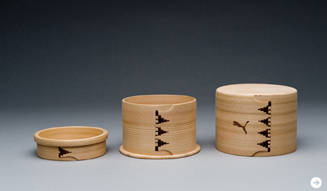
PUMA Custom-made Bento Box, Magewappa. Released as part of the "Monozukuri Project" launched by Puma Japan in 2009, the "Bento-Box" series included this magewappa made from natural Akita cedar, produced by Maruwakaya. Photo by HONMA Hiroshi
MaruwakaDesign arises from customs, so if we don't clearly identify what we want to do, what we put out will simply be consumed by the passage of time. Therefore, tradition needs something intuitive, like your approach, Kamide-san, and it must constantly be at the forefront of the times. Because if you're second or third, you won't last, will you? I don't view "tradition" as "history to be preserved." When buying traditional crafts like Kutani ware, I believe individuals should choose based on their immediate intuition. It's fine if the 130-year history comes as a bonus gift afterward. People don't know the history before buying clothes, do they? (laughs) If asked why I like something, it's simply because I like it; explaining too much would spoil the magic.