
Takashi Homma x Ricoh GXR: 'Transit'
Takashi Homma × Ricoh GXR+A12 50mm
Transit
Takashi Homma, a world-renowned photographer, consistently releases innovative works using film cameras. With Ricoh's digital camera, the GXR, he captured the inexpressible feeling, like a sudden air pocket, that arises during airport transit. The photographer's sensibility resonates with the latest digital camera.
Photos by Takashi HommaText by Wakako Miyake
I'd want to use this every day
“This camera is really good. I really like it.”
said Takashi Homma, holding the Ricoh GXR.
“First, it starts up quickly, and the buttons for frequently used functions are easy to understand. For example, exposure compensation can be done intuitively with a single press.”
He seemed impressed by its excellent operability.
This time, he photographed scenes of airport transit with the GXR.
“When you're transferring, you always feel a bit sluggish, right? Then, the sunset suddenly streams in, and you get this feeling of not knowing where you are. I captured that kind of feeling (laughs).”
Therefore, he deliberately did not limit the locations. Places that are not the destination, during moments of unexpected free time. A feeling of drifting, with ambiguous time and space. The GXR seemed to respond effortlessly to capturing such ineffable atmospheres.
“For now, digital cameras are still secondary for me, but this one made me think I might want to use it regularly. I actually own a GR, but I don't like wide-angle lenses, so the GXR suits me better than the GR with its wide-angle prime lens.”
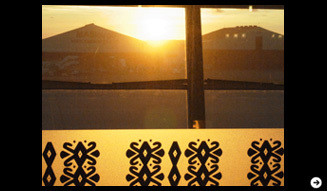
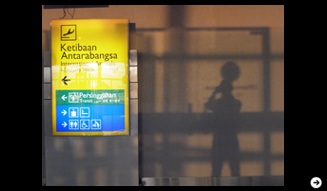
He also mentioned that the fact that it consists of a body and a camera unit, allowing for lens changes, was a significant plus.
“We are particularly accustomed to changing lenses. A friend happened to have the same camera, and when we were together, I mentioned I needed more zoom, so he lent me a slightly longer lens. It just slid in with a click. I thought it was cool, like Mazinger Z.”
He also finds the ability to photograph close-up subjects, not just distant ones, appealing. The 50mm prime lens allows for macro photography from approximately 7cm.
“Attaching this 50mm lens, and then buying another body and attaching the S10 24-72mm zoom would be perfect. Also, that friend had an automatic lens cap, which looked very convenient. I definitely want that too.”
Furthermore, Homma is paying attention to the video mode.
“I can still shoot stills on film. However, for video, digital is overwhelmingly superior. I believe the unique advantage of digital lies in video.”
He seems to believe that there is more potential in the video mode of cameras that can shoot short clips.
Although Homma seems quite pleased with the GXR, he mentioned, “I wish I had a longer lens too.” Currently, there are four types of GXR camera units. We recommend the unit with the longest 28-300mm lens!

Takashi Homma | HOMMA Takashi
Born in Tokyo in 1962. Photographer. In 1999, he received the 24th Kimura Ihei Photography Award for his photobook "Tokyo Suburbia" (Kolinsha Publishing). In 2008, he published the photobook "Tokyo" from Aperture in New York. It contains works shot with Tokyo as the theme between 1993 and 2007, representing a culmination of his work up to that point. In 2009, he published the book "Fun Photography: A Photography Class for Good Children" (Heibonsha). Since 2010, he has been a visiting professor at Tokyo Zokei University Graduate School.
http://betweenthebooks.com
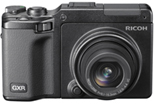
Ricoh GXR | RICOH GXR
A digital camera with interchangeable units. Each unit is equipped with a lens of a different focal length, an image sensor optimized for it, and an image engine. By changing these units, it can handle a wider variety of scenes than simply changing lenses. It includes the GR LENS A12 50mm, a 50mm prime lens with a field of view close to human vision, as well as the camera units RICOH LENS S10 24-72mm, RICOH LENS P10 28-300mm, and GR LENS A12 28mm. Open price.
Customer Service Center0120-000-475