The World's Smallest Animation, Drawn with Atoms | IBM
IBM Research
An Animation Too Small to See
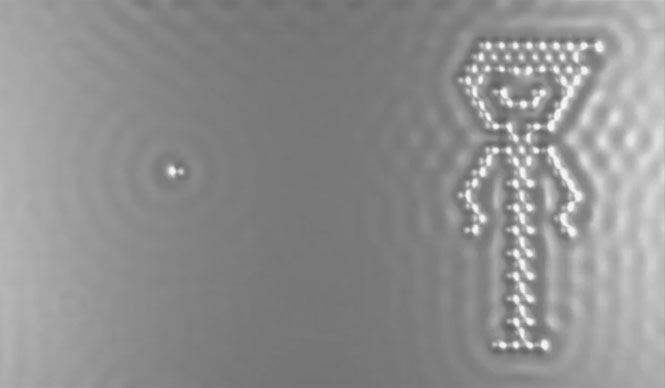
IBM's research division in the United States has created and released "A Boy and his Atom," the "world's smallest animation" made with atoms.
Text by HORIGUCHI Yoshihiro (OPENERS)
A Story from a World Invisible to the Eye
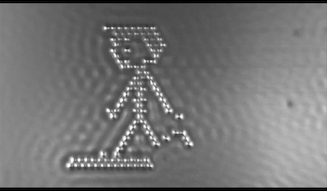
The animation released this time is a simple, monochrome piece depicting a boy named "ATOM" kicking and bouncing a dot. However, each of these dots is made of atoms, the smallest of particles. This is the world's smallest animation, created in a world so small it is invisible to the naked eye.
The creation utilized a scanning tunneling microscope developed by IBM. This microscope, weighing two tons, boasts the capability of 100 million times magnification at a temperature of minus 268 degrees Celsius, just 5 degrees above absolute zero. Only a few facilities worldwide can precisely manipulate atoms in this manner, and IBM Research is one of them.
Using this microscope, a sharp needle was brought within one nanometer (one-millionth of a millimeter) of the surface of a copper plate, separating molecules and atoms, and precisely arranging the atoms. The scientists then captured 242 frames to complete the animation.
Overwhelmingly High-Density Data Storage
This announcement holds more significance for IBM than mere entertainment. It is part of ongoing research to further miniaturize digital recording devices such as HDDs and memory, which are used in various applications like computers and mobile phones.
Computer circuits, as is often said, grow according to "Moore's Law," where performance doubles (or size halves) every 18 months. Consequently, the miniaturization of circuit design faces a limit in the near future. Therefore, IBM is researching new manufacturing technologies distinct from current methods. This video serves as a demonstration of their technology for freely manipulating atoms.
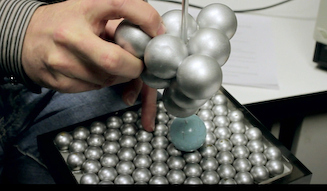
Furthermore, research is actively being conducted on actual storage media. One of the members of the animation's production team is experimenting to determine the minimum number of atoms required to reliably store one bit of data magnetically.
While current state-of-the-art recording devices use approximately one million atoms, this experiment revealed that it is possible with just twelve.
A single bit of data, as mentioned, constitutes one half-width alphanumeric character in 8 bits, or 16 bits for a full-width character in Japanese. Thus, a rough calculation suggests that one kanji character could be stored using just 192 atoms. If this memory technology were to become practical, it would be possible to store all the movies ever produced within an area the size of a fingernail.