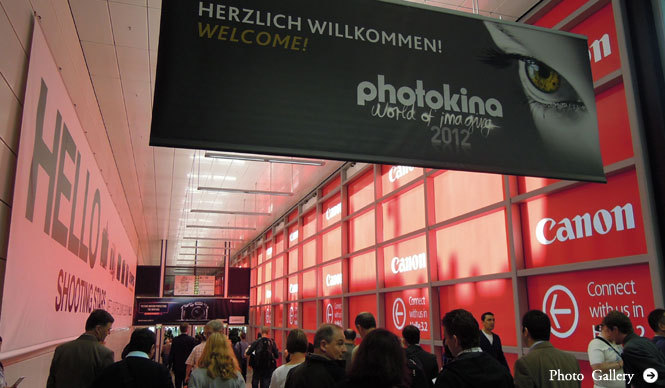
Photokina 2012 | The biggest topic: affordable "full-frame sensors"
Photokina 2012
The Biggest Topic: Full-Frame Sensors Within Reach
Held every two years in Cologne, Germany, the world's largest photo and imaging trade fair, "Photokina 2012" (officially Photokina World of Imaging), took place from September 18th to 23rd.
Japanese camera manufacturers, including local German prestige brand Leica, Nikon, Canon, Sony, Panasonic, Fujifilm, Ricoh (& Pentax), Casio, and Epson, all participated and announced/exhibited new products. What was the biggest topic this year?
It was "accessible models equipped with full-frame sensors."
Text & Photographs by SHIBUYA Yasuhito
Interchangeable-Lens SLRs for Advanced Amateurs Enter the Full-Frame Sensor Era
For camera enthusiasts, there's likely no need for a refresher, but a full-frame sensor is an image sensor (solid-state imaging device) approximately the size of a 35mm film frame (also known as Leica format), about 36mm wide by 24mm high (sizes may vary slightly by manufacturer).

Photo exhibitions and other events were also held in the spaces connecting the booths.
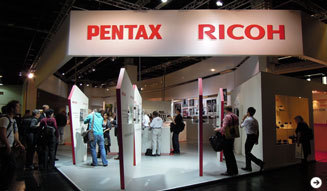
Ricoh and Pentax exhibited together as a single company for the first time this year.
With effective pixel counts ranging from 36 million to 24 million, the sensor size is the same as 35mm film. This makes it significantly larger than the APS-C size commonly found in digital SLRs (excluding professional models), which is typically around 23.4 x 16.7mm for APS camera systems. Consequently, the amount of information per image increases. Furthermore, the absolute size of each pixel on the sensor is larger, leading to improved sensitivity. (For comparison, the total sensor area for APS-C is only about 40% of that of a full-frame sensor.) Additionally, with APS-C size, the field of view is effectively cropped, making lenses designed for 35mm film cameras behave as if they have a focal length about 1.5 to 1.6 times longer. This means wide-angle capabilities are lost.
Full-frame sensors eliminate these issues.
However, until now, full-frame sensors were primarily found in professional or high-end amateur interchangeable-lens SLRs, with a few exceptions from Canon and Nikon. This was due to the significantly higher cost of the sensors, the need for expensive and high-performance image processing engines (circuits), and the fact that lens performance is directly reflected. Even non-professional full-frame cameras were priced around 300,000 yen for the body alone, limiting their market.
This year's Photokina saw the unveiling of new interchangeable-lens, full-frame sensor SLRs from Canon, Nikon, and Sony, designed to be smaller, lighter, and more affordable for amateur users, challenging the conventional wisdom surrounding full-frame sensors. The areas buzzing with visitors at the venue were the exhibition corners for these "new era full-frame sensor interchangeable-lens SLRs."
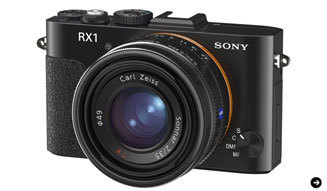
Sony's "Cyber-shot DSC-RX1," a compact digital camera with a full-frame sensor, generated considerable buzz.
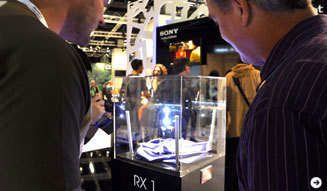
The RX1 was a major attraction at Photokina, drawing crowds eager for a first look.
Sony announced its top-of-the-line interchangeable-lens SLR, theα99, the compact digital camera "Cyber-shot DSC-RX1," and the interchangeable-lens HD video camera recorder "Handycam NEX-VG900" on September 12th, just before Photokina, to highlight the dawn of the "full-frame sensor era."
Nikon, also on September 13th, just before Photokina, announced and released theNikon D600, which is significantly smaller, lighter, and more affordably priced than previous full-frame sensor models.
Canon, a leader in the interchangeable-lens full-frame SLR market for advanced amateurs since 2005 with its "EOS 5D" series, unveiled the new series' first model, the world's lightest, on September 17th, the press day of Photokina: theEOS 6D.
The booths for the EOS 6D and Nikon D600, which have made the world of full-frame sensor digital SLRs much more accessible, were constantly crowded.
While there are differences in specifications such as pixel count, the body-only prices on their direct sales sites are 198,000 yen for the EOS 6D (scheduled for early December release) and 218,000 yen for the Nikon D600 (currently available). These prices are more affordable, and the cameras are smaller and lighter than previous full-frame sensor models.
The era of "amateur SLRs also featuring full-frame sensors" has begun.
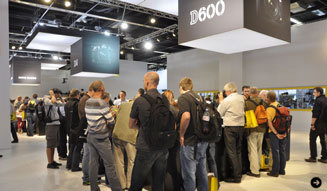
Nikon's "D600" corner was filled with people intently examining the camera.

Canon's booth featured a wide range of products, including video cameras.
A Quiet "Mirrorless" Boom in Europe Too
Another significant topic at Photokina 2012 was the evolution and advancement of mirrorless interchangeable-lens cameras.
The event showcased a wealth of new products, far exceeding the number of full-frame sensor SLRs. Leading the pack was Fujifilm's world premiere of the premium mirrorless interchangeable-lens camera "X-E1." Also featured were Canon's first mirrorless camera, the "EOS M"; Panasonic's "LUMIX DMC-GH3"; Nikon's "Nikon 1 J2"; Olympus's "OLYMPUS PEN Lite E-PL5" and "OLYMPUS mini E-PM2"; and Pentax's ultra-compact mirrorless camera "PENTAX Q10," marking the first exhibition under the Pentax Ricoh double brand name. Additionally, the Hasselblad "Luna," a mirrorless camera utilizing the Sony E-mount and announced through a technical partnership with Sony, was also unveiled.
Visitor response to these mirrorless models also appeared to be very positive.
The corner for Canon's "EOS M" was particularly popular, and at the Pentax Ricoh booth, the Q10 attracted women who stopped to examine it closely.
Although mirrorless cameras have been said to "not be particularly popular in European and American markets," their popularity is steadily growing.
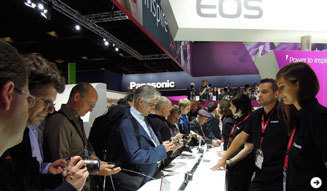
Canon is finally releasing its mirrorless camera this month.
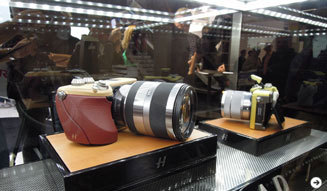
Hasselblad's prototype "Luner," which adopts the Sony E-mount, was a popular exhibit.
Following Photokina 2012, "CP+ 2013" will be held at Pacifico Yokohama in Japan from the end of January 2013. It will be exciting to see what further advancements and developments in interchangeable-lens SLRs and mirrorless cameras will be showcased in Yokohama.