BOSE, Cars, and China | BOSE
BOSE
BOSE, Cars, and China
BOSE, which is exhibiting at the Beijing Motor Show and expanding its domestic sales network in China. BOSE is already a strong impression as a representative global brand, not only in home audio but also in car audio. How does BOSE evaluate China? And how does China evaluate BOSE? Tatsuya Otani reports from both car audio and home audio perspectives. Discussing the Beijing Motor Show,Part 1following the first installment, this second part introduces the current state of BOSE's expansion in China, focusing on the "BOSE Store" in Beijing.
Text by OTANI Tatsuya
Photographs by OGAWA Yoshifumi
The "BOSE Store" Unchanged in Beijing
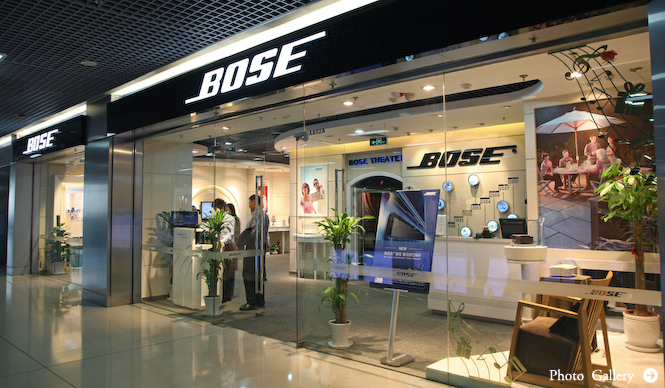
The shop we were looking for was in a corner of a commercial building. Next to it was McDonald's, and across the way was Nike. It was a typical scene found in shopping malls, familiar not only in America but also in Europe and Japan. However, this was not London, nor Tokyo, nor even New York. It was Beijing, the capital of China, a country experiencing remarkable economic development as both a huge market and a huge production base. We visited the "BOSE Store" located in the heart of Beijing.
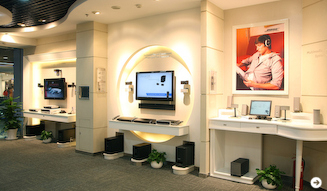
However, the interior, based on white, and the store's atmosphere with its spacious product layout were common to the BOSE directly managed stores we often see in Japan. The home theater, personal audio, and headphone products displayed there were also exactly the same, including model numbers, as those sold in Japan. Upon closer inspection, while there were slight differences due to exchange rates, the prices were almost the same as in Japan.
We learned that the primary demographic of Chinese customers frequenting BOSE stores has an annual income of around 35,000 US dollars (approximately 2.7 million yen). While this figure itself is not particularly high compared to the average in America or Japan, it places them in a considerably affluent category within China. Apparently, the number of such individuals is no longer small, as BOSE stores have grown to 90 locations across China, with 13 stores in Beijing alone. In the short time I visited this particular store, a man in his 20s purchased a "Computer Music Monitor" (around 40,000 yen in Japan), and a woman in her 40s connected her iPhone to the "SoundDock 10" in the store to check its sound quality. These scenes suggested that BOSE, as an audio manufacturer, has firmly taken root in China.
Home Audio and Car Audio
John F. Ma, General Manager of BOSE Automotive China, states, "Chinese customers are becoming more sophisticated by the day. Products of low quality can no longer survive in the Chinese market." Ma himself is in a position to handle automotive-related products within BOSE, but he emphasizes that it is impossible to improve BOSE's position in the Chinese market by considering home audio and car audio separately.
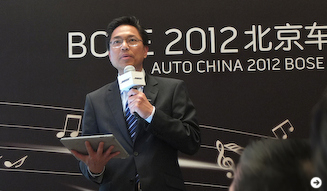
John F. Ma, General Manager of BOSE Automotive China
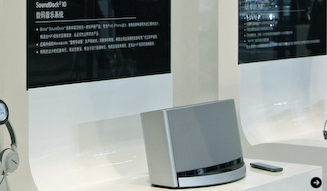
BOSE SoundDock 10
"In China, sales of BOSE's home entertainment-related products are growing at an incredible pace. This indicates that Chinese people's discerning tastes and demands for sound are increasing. And we are seeing more cases where people who have experienced BOSE in home audio choose BOSE car audio. In fact, conversely, we are also seeing an increase in customers who learn about BOSE through car audio and then purchase home audio products. In other words, for BOSE, home audio and car audio are like the two wheels of a car, mutually supporting each other to drive sales."
However, Chinese people's love for music is not a recent phenomenon; it has a long history, says Ma. "Chinese people traditionally have a deep love for music, and this country has a very rich musical history. Against this cultural backdrop, the demand for premium audio like BOSE is likely increasing." BOSE entered China in 2002. Its China headquarters are in Shanghai, with 600 employees, and as mentioned, there are 90 stores across the country.
BOSE
BOSE, Cars, and China (2)
Trends in Home Audio
"The gender ratio of our customers is 60 percent male and 40 percent female. Most of them own cars and live in detached houses. We believe these factors contribute to the high demand for home audio. Also, young couples in their 30s often purchase a home theater system when they buy a new house."
This explanation comes from Joel Tasso, the General Manager of the local subsidiary handling home audio at BOSE. "The most popular item is the 5.1 channel home theater system. Second is personal audio devices like theWave Musicsystem. Third are SoundDocks that connect to iPhones and iPods."
"In 'Tier 1' major cities like Shanghai and Beijing, in addition to home theater systems, there is strong interest in a wide range of products such as the wireless mobile speaker 'SoundLink',SoundLink' and the noise-canceling headphones 'QuietComfort',QuietComfort'. In contrast, in Tier 2 and Tier 3 cities, which are smaller in scale, home theater systems are particularly popular." Is the growing interest in personal audio in major cities due to changing lifestyles, especially among younger people? Meanwhile, the concentration of popularity for home theater products in other regional cities seems related to the favorable living environments there.
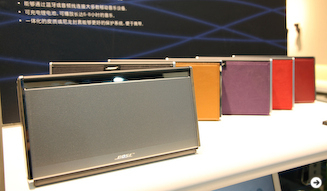
BOSE SoundLink Wireless Mobile speaker
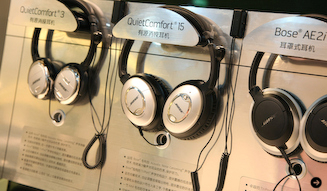
BOSE QuietComfort 3, QuietComfort 15, Bose AE2i
BOSE Gradually Increasing Its Recognition
However, it seems that not everything went smoothly from the beginning of BOSE's entry into China. Ten years ago, BOSE's name recognition was not particularly high, but by expanding stores and running advertisements, its name gradually spread. Among these efforts, the promotional activities they call "roadshows" are unique. This involves setting up temporary booths in the courtyards of shopping malls to display BOSE products. Separately, there is also an increasing pattern of affluent customers traveling abroad to America or Europe, discovering BOSE there, and then purchasing products after returning to China. Furthermore, sales have grown rapidly since the opening of the first directly managed store in China in 2007, and the company is now recording an annual growth rate of over 20 percent.
BOSE, a premium audio brand that continues to create unique, technology-driven products, appears to be steadily gaining recognition in China.