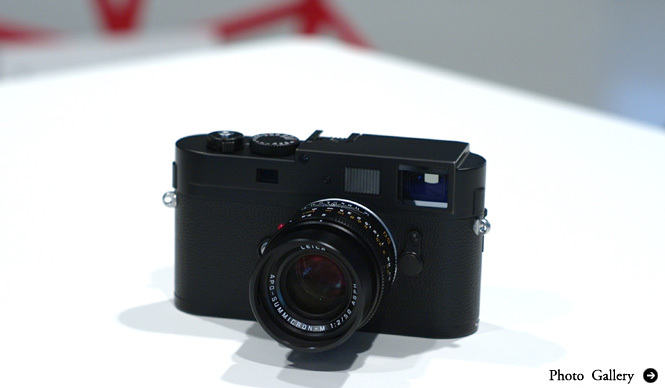
Leica | Developer Interview & Hands-on Photography
Leica
Continuous Report: Leica M Monochrom
Interview with Developer Stefan Daniel & On-Location Shoot
Leica Camera AG has announced the "Leica M Monochrom," the world's first digital rangefinder camera exclusively for monochrome photography, equipped with a 35mm full-frame sensor. A new product announcement was held in Germany, Leica's home country, on May 10th. The following week, Stefan Daniel, Director of Product Management at Leica Camera AG, visited Japan to present new products, including the "Leica M Monochrom." This article features an interview with Mr. Daniel, accompanied by portraits of him shot by the author, a digital M user, using the new "Leica APO-Summicron-M f/2.0 50mm ASPH." lens, which was announced concurrently.
Text & Photographs by KATO Takashi
An Idea Born from Technical Aspects: Dedicated Monochrome
—The "Leica M Monochrom" is a unique and exciting camera, unlike any other, as it's dedicated to monochrome digital photography. When did the concept for a monochrome digital M camera first emerge?
The idea for a monochrome digital M camera existed from the time we announced the digital M, the "Leica M8," in 2008. However, at that time, the priority was on developing color and full-frame digital Ms, so the monochrome concept was put aside.
Now that the M digital is full-frame and the digital camera market has matured, user interest in monochrome photography has grown, and monochrome photography is also a trend. We determined that now is the best time.

Stefan Daniel, Director of Product Management

Sample images by Magnum Photos ©Jacob Aue Sobol/Magnum Photos
—Nevertheless, a monochrome-only digital camera seems like a marketing challenge. Is this also a challenge to the current digital camera market?
Actually, the background to the creation of the monochrome M digital was more about technology than marketing. Leica's engineers knew that a digital camera without a color filter, unlike a color digital camera that uses one, could theoretically achieve higher resolution. However, as you mentioned, at the time, it was judged to carry too high a marketing risk, and it wasn't immediately commercialized.
—By removing the color filter, do you think photographers who use this camera will see the world of photography more directly, without the "colored glasses" of color?
Yes. Conventional digital cameras apply digital processing through a color filter. A monochrome camera without this filter allows for a more direct view of the world.
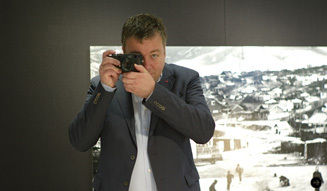
Mr. Daniel oversees not only the M series but also compact cameras and other divisions.
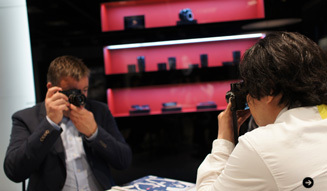
The author also photographed Mr. Daniel with his beloved Leica M8.
—Please tell us about the benefits of a monochrome digital M.
There are three benefits. The first is the increase in resolution by removing the color filter, as I mentioned earlier. Specifically, it's calculated that the resolution is about twice that of a color digital camera with the same pixel count. The second benefit is that a color filter acts like tinted sunglasses, slightly degrading the light passing through. By removing it, we can increase the camera's sensitivity by about 1.5 to 2 stops. The third benefit is that, as a monochrome-only camera, photographers can concentrate on shooting without considering elements like color. For those accustomed to color photography, I believe it offers a completely new way of approaching their craft.
—By becoming monochrome-only, I believe photographers can now focus on artistic image creation and communication with their subjects, much like when using monochrome film in a digital camera.
Yes. Our goal wasn't just to increase resolution by removing the color filter; we also want photographers to capture better monochrome images.
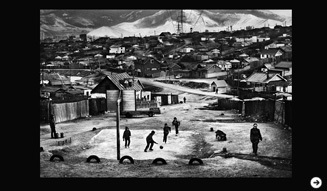
©Jacob Aue Sobol/Magnum Photos
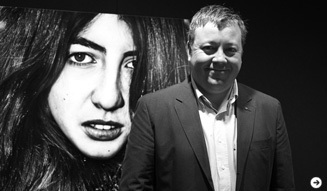
I had the opportunity to shoot early with the Leica M Monochrom.
—One of the camera's concepts is "to record light faithfully, without seeing color." In the sense that "photograph" means "light drawing," isn't this a return to the origins of photography?
I believe that's exactly right. We see it as a rediscovery of the original principles, both for Leica cameras and for the photography Leica Camera has pursued.
Tradition and the Next Generation of Leica M Cameras
—Since the "Leica M3" was announced in 1954, the form of the Leica M camera has remained largely unchanged, appearing as beautiful as a completed work of art. Will this form continue to be inherited?
While the shape of the Leica M is traditional, we are not inheriting it simply because it's traditional. It's because there are practical advantages, such as how it fits comfortably in the hand, its size, and its ease of handling. Therefore, we believe the M camera's form is already complete and doesn't require significant changes.
—Announcements of new Leica cameras always generate global buzz. Just as the "Leica M9" digital was announced on the auspicious date of September 9, 2009, the announcement that Leica Camera would reveal new products on May 10th (May10) created significant excitement.
The numbers themselves don't hold any special meaning. The press conference was held on May 10th simply because the venue was available that day (laughs).
—I see (laughs). Many Leica fans were likely anticipating the announcement of the "Leica M10."
Of course, something like that will happen eventually, but I can't say anything more right now (laughs).
—I understand (laughs). Finally, could you please share a message for your fans in Japan?
In Japan, Leica cameras have long been highly regarded, perhaps even more so than in Germany, and we are always deeply grateful for that. We hope that everyone will use Leica cameras to beautifully record many wonderful moments and enjoy their lives.
Leica Camera Japan
Tel. 03-5221-9501
http://www.leica-camera.co.jp