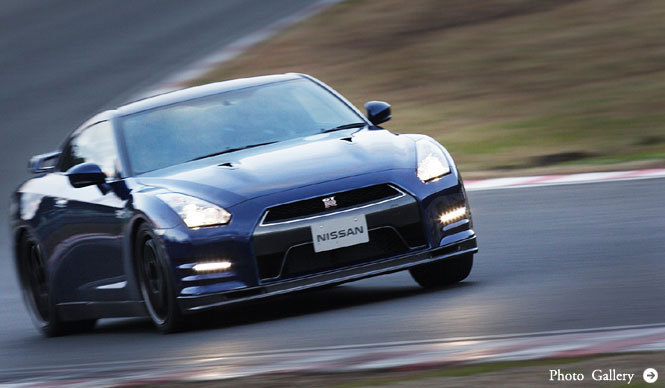
Nissan GT-R 2012 Model: A Test Drive Review | NISSAN
NISSAN GT-R
2012 Model Test Drive: Further Refinements
The 2012 Nissan GT-R boasts significant advancements beyond a typical model year update, including a 20ps increase in maximum output and the adoption of asymmetrical suspension. We present a test drive impression from automotive journalist Toshiyuki Watanabe.
Text by Toshiyuki WatanabePhotos by Masayuki Arakawa
Absolute Precision, Thoroughly Polished
"You know how car manufacturers often claim to adopt world-first new technologies? I dislike that," he began. "It's not something that needs to be explicitly stated, and it's irrelevant to the customer. What truly matters is sincerely and fully responding to what is demanded..."
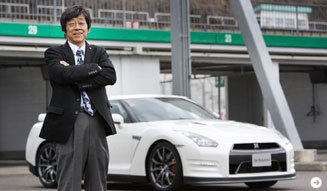
At the technical briefing for the 2012 GT-R, Chief Vehicle Engineer Kazutoshi Mizuno addressed us media members with these words.
He passionately articulated his vision, varying his tone, then humbly apologized for his boldness. The meticulously prepared PowerPoint slides were largely ignored. Instead, he stood before a whiteboard, fluidly explaining the development philosophy while sketching diagrams with a marker. His presentation, rich with nuance and inflection, unusual for an automotive engineer, now inspires a certain anticipation in listeners as a form of stylistic beauty.
I ventured to ask: In other words, is the GT-R a car built on conventional engineering?
"Naturally. Very conventional. We haven't used any unknown technologies; the GT-R's speed range cannot be entrusted to such things. Mr. Watanabe, for the past four years since this car was completed, all I have done is meticulously refine the precision of its development and production. That is all."
Absolute precision over new technology. The diligent refinement towards this goal guides a mass-produced car towards the realm of mastery. Is this his unyielding philosophy of craftsmanship?
Five years since its debut. Among its new rivals, some incorporate technologies not available at the time of the GT-R's development, yet the GT-R makes no attempt to adopt them. My initial impression upon experiencing a prototype in Germany just before its launch and glimpsing the development site – that this was an incredible digital monster – is beginning to shift slightly. This is despite the development process remaining entirely unchanged.
NISSAN GT-R
2012 Model Test Drive: Further Refinements (2)
Acceleration Approaching the Bugatti Veyron
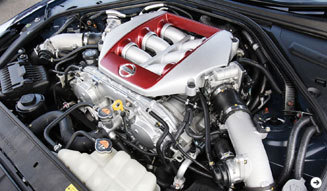
The 2012 GT-R achieves an output of 550ps, a 20ps increase over the previous model. The modifications involved, in broad terms, were improved intake and exhaust efficiency, enhanced cooling, and optimized management. Although the engine internals were touched for the first time, this is a conventional refinement in the automotive world. In reality, for an ordinary driver like myself, it would be difficult to perceive this difference in power. Generally, anything over 500ps operates in such a realm, and besides, the GT-R's speed is not solely dependent on horsepower.
Indeed, the source of the GT-R's astonishing speed lies in its traction performance – how efficiently it transfers its power to the road. The 0-100 km/h acceleration, a testament to this, recorded 2.84 seconds for the 2012 model. This is an extraordinary figure, surpassed only by the Bugatti Veyron among production cars.
Watching it accelerate without violent tire squeals or smoke, completely defying its 1,730kg mass, gives the illusion of being in a distorted space-time continuum. The quality of the GT-R's movement has reached an unprecedented level.
Asymmetrical Suspension Settings for All Four Wheels
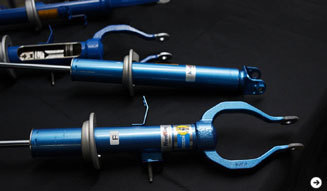
Speaking of unprecedented, the biggest highlight of the 2012 model is arguably its asymmetrical suspension setup. This is applied exclusively to the right-hand drive specification, with the primary goal of minimizing the difference in drivability caused by the weight imbalance between the left and right sides of the car when the driver is seated. Due to the transmission's placement at the rear axle and the routing of the differential and propeller shaft to the front wheels, the static weight distribution is approximately 50kg heavier on the right side.
While this imbalance can be offset in left-hand drive models by the driver's weight, in right-hand drive versions, it can subtly contribute to understeer.
Specifically, the spring rate for the front-left wheel is set slightly higher, and the alignment of the rear-left wheel is adjusted to a near-preload state, thereby correcting the left-right balance from a static condition. In other words, the right-hand drive 2012 GT-R features asymmetrical suspension settings for all four wheels, another unusual situation for a production car.
The 'for Track Pack' Set Option, Replacing the Spec V
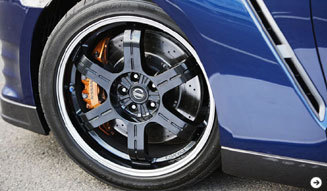
Other changes include minor modifications to the transmission components, a change in the specified differential oil, enhanced precision in full-body vibration measurement, reinforcement of the front dashboard area, and alterations to the BOSE sound system's woofer structure and meter illumination. The meticulousness of these updates over the past year is, as always, impressive. Furthermore, the 2012 GT-R is available with a set option called 'for Track Pack' for ¥1,470,000. Aimed at owners who actively enjoy circuit driving, it enhances driving quality while minimizing compromises to daily usability. It shares components with the former Spec V, such as the 2-seater configuration, front spoiler with brake cooling ducts, and lightweight forged wheels, while adding specially designed suspension with variable control and seats upholstered in high-grip fabric to prevent body slippage.
NISSAN GT-R
2012 Model Test Drive: Further Refinements (3)
Enhanced Immediacy of Connection
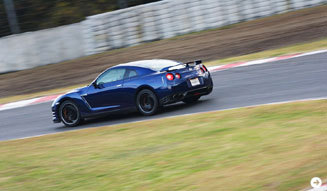
The test drive, held at Sports Land SUGO, was designed to clearly convey the 2012 model's evolution through comparisons with the 2011 model on the track and on public roads. Driving at a moderate pace, utilizing low to mid-range speeds on public roads, the most noticeable changes compared to the previous model were the improved suppleness of the suspension, which absorbed inputs more gently, and a slight reduction in intrusive noise.
However, the most significant change I perceived was a newfound 'dampness' or 'rawness' in the steering feel. Previously, this sensation was only attainable at extremely high speeds; at lower speeds, the steering felt cold, as if merely inputting commands. But with the 2012 model, even when cornering normally, changes in camber and the twisting of the tires are transmitted along with the road conditions. In reality, the ultra-rigid run-flat tires on the GT-R cannot twist at such speeds. Yet, the sense of immediacy, as if riding on ordinary radial tires, is added, resulting in a more fulfilling sense of control.
A Deeper Dialogue with the Car
To think that this digital monster would gain emotional depth. This impression remained unchanged even on the track. The aforementioned asymmetrical suspension settings demonstrably reduced understeer compared to the 2011 model, effectively bridging the gap in feel between left and right corners during comparative testing. However, what surprised me even more was that an average driver like myself could now perceive nuance in the feedback from the car. The way the body settles under braking, the tire contact during cornering, the car's trajectory as it's propelled forward with a twist upon acceleration – even at speeds that, while exhilarating for me, are far from those of a racing driver, the car precisely synchronizes with my intended line. This is undeniably proof that the car's dynamic range has expanded not only upwards but also downwards, resulting in a deeper dialogue. It's akin to an audio system that produces excellent sound even at lower volumes. In any case, the feeling of being merely a passenger in the car has significantly diminished. It's as if we are witnessing the convergence point where the debate between analog and digital dissolves, much like with audio equipment.
Predicted Nürburgring Lap Time: Sub-7:10?
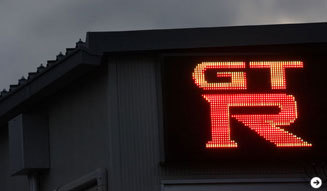
In any case, the GT-R's absolute performance continues to evolve year by year. The Nürburgring lap time, measured as a clear indicator for users, is expected to break the 7:10 barrier. This figure itself holds no practical meaning for us.
Extracting this performance to its absolute limit is the work of highly skilled professionals. Even knowing this intellectually, one can't help but feel a thrill at the presented numbers, perhaps due to the expectation that this car embodies Japan's ultimate automotive achievement.
The GT-R continues to be updated through the relentless pursuit of mastery by those involved. Incidentally, at the Tochigi plant's mixed-model production line, most of the personnel assigned at the start of production continue to silently build the GT-R without change.
NISSAN GT-R Pure edition
Body Dimensions: Length 4,670 x Width 1,895 x Height 1,370mm
Wheelbase: 2,780mm
Vehicle Weight: 1,730kg
Engine: 3.8-liter V6
Transmission: 6-speed dual-clutch transmission
Maximum Output: 404kW (550ps) / 5,400rpm
Maximum Torque: 632Nm (64.5kgm) / 3,200-5,800rpm
Fuel Economy (JC08 mode): 8.7km/ℓ
CO2 Emissions: 267g/km
Price: ¥8,694,000