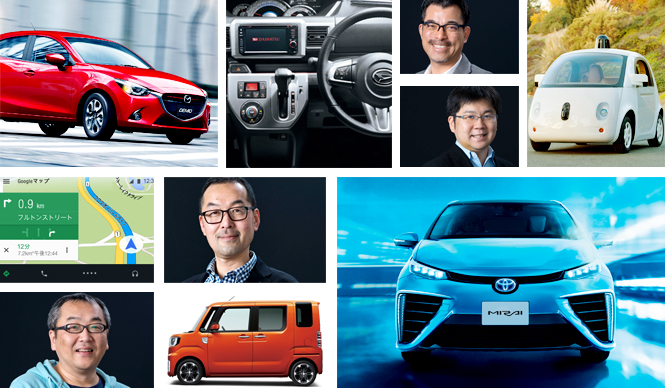
Talk Session | The Near Future of Cars: A Roundtable Discussion, Part 1
Talk Session: A Roundtable Discussion with Four Journalists, Part 1
Discussing the Uncertain Near Future of Cars in 201X
Following the 1997 debut of the hybrid car "Prius," Toyota last year launched the mass-produced FCV (fuel cell vehicle) "Mirai," another world-first. The automotive industry is now seeing models previously confined to research, such as FCVs, PHVs (plug-in hybrids), and EVs (electric vehicles), rapidly entering the general market. If hardware development is a race, then the current software competition is in ICT, leveraging information and communication. Naturally, it's not just car manufacturers eyeing this market; Silicon Valley giants like Google and Apple are also keenly observing. We convened a roundtable discussion with four journalists to discuss the future image of cars. Here is the first part.
Photographs by ABE MasayaText by SHIOMI Satoshi
Talk Session: A Roundtable Discussion on the Near Future of Cars, Part 2 →
Will Cars Become Smartphones?
SHIOMI Satoshi (hereafter Shiomi)2013 was a year when cars sold particularly well in Japan after a long time. Although it was predicted that 2014, last year, would see a backlash, the reality was that sales remained almost unchanged from 2013 (3,290,008 registered vehicles, 2,272,790 mini vehicles). While sales declined after April due to the consumption tax increase from 5% to 8%, the surge in demand before March helped maintain sales at a stable level for the full year. So, what kind of year was 2014, and what cars garnered attention? First, please share your impressions.
Watanabe Toshifumi (hereafter Watanabe)Cars that were expected to sell, the classic or conservative choices, sold well.Mercedes-Benz C-ClassJust like the Mercedes-Benz C-Class, and the Mazda Demio.
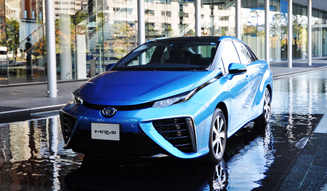
Launched in December last year, the Toyota "Mirai." Despite its high price of 7,236,000 yen, it received 1,500 orders in its first month, significantly exceeding its annual sales target of 700 units.
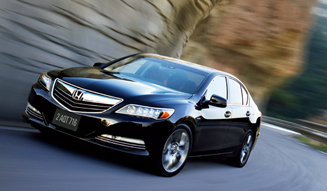
Honda's flagship sedan, the "Legend," which made a comeback after approximately two and a half years since its production ended in June 2012.
OGAWA Fumio (hereafter Ogawa)There were several major trends. First, mini vehicles sold very well. I'm impressed by how they manage to differentiate and market so many models within the constraints of size and engine displacement. Some cars were also interesting in terms of design. Another trend was the increase in next-generation vehicles. Toyota started mass production of the fuel cell vehicle "Mirai," Honda's hybrid system in the "Legend" is new, and hybrid and plug-in hybrid vehicles from import brands are no longer uncommon.MiraiMirai," a fuel cell vehicle, and Honda's "LegendLegend" has a new hybrid system, and hybrid and plug-in hybrid vehicles from import brands are no longer uncommon.
ShiomiMr. Ishikawa, an IT journalist and our guest today, may not have many opportunities to test drive new cars, but from the perspective of an IT expert, what are your impressions of the recent automotive industry?
ISHIKAWA Tsutsumu (hereafter Ishikawa)Cars are mature products compared to IT products, but I feel it's still an exciting industry with technological innovation. Not only hybrids and electric vehicles, but the designs are also interesting. The phrase "cars are becoming like smartphones" is often heard recently, and indeed, there are aspects of that. For example, with the Tesla "Model S," it's quite smartphone-like that software updates are delivered via a 3G connection after purchase.Tesla Model SModel S, it's quite smartphone-like that software updates are delivered via a 3G connection after purchase.
ShiomiIn the past, it was called "white goods-ification of cars," but now it's "smartphone-ification of cars" (laughs). The smartphone-like aspect is also appearing in how we acquire cars. While cars don't have "two-year contracts" like phones, options beyond outright purchase, such as leasing, residual value financing, or car sharing, have increased.
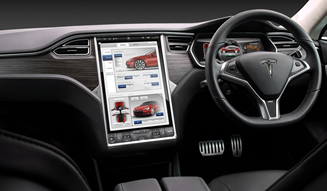
The Tesla "Model S" is equipped with a large touchscreen panel that is almost indistinguishable from a tablet. It has a unique style that continues to evolve through wireless software updates, much like a smartphone.
TALK SESSION: A Roundtable Discussion on the Near Future of Cars, Part 1
Discussing the Uncertain Near Future of Cars in 201X (2)
Avant-garde, Challenging, and Innovative: That's the Kei Car of Today
ShiomiCould you tell us about specific cars that left an impression? To start, I was impressed by the handling of the Suzuki "Alto," which I test-drove recently, thanks to its curb weight of just over 600 kg. Nowadays, even light mini vehicles with their abundant safety and comfort features often weigh in the 700s or 800s, and some even exceed 900 kg. In that context, I think it deserves praise just for coming in at around 600 kg, the average weight of a mini vehicle in the 1980s. It actually drives very well; being this light makes you wonder if a turbo is even necessary.
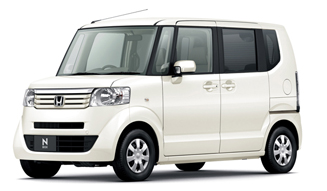
The "N-BOX," which has become the face of Honda's tall wagon-style mini vehicles since its debut in June 2011.
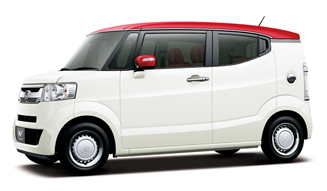
The "N-BOX SLASH," a low-roof model launched in December 2014, seemingly going against the original N-BOX's high-roof design.
WatanabeIn improving a car's performance, weight reduction is the only thing that offers gains without any drawbacks. That's why it's so difficult and costly. But what's interesting is that Suzuki probably wasn't thinking much about contributing to environmental protection by reducing weight and improving fuel efficiency. I suspect the Alto was created under the directive: 'Reduce weight at all costs because it makes the car cheaper!' (laughs).
ShiomiIt's mentioned in Chairman Osamu Suzuki's book, isn't it? Ultimately, the price of a car is determined by the amount of steel used, a "dollars per gram" commodity, so reducing weight allows it to be sold cheaper. Well, weight reduction is an unavoidable path for cars going forward, so I think the Alto is commendable regardless of its initial motivation (laughs). On the other hand, Honda's "N Series," which are built more robustly than their size suggests for mini vehicles, are also selling very well, offering an interesting contrast to the Alto. Then there's the "N-BOX SLASH," which is like a back-and-forth effort, almost a playful dare, by taking the already tall N-BOX and cutting down its roof.

Mr. OGAWA Fumio (right) states, "In rural areas where gas stations are becoming scarcer, fuel-efficient mini vehicles will become even more indispensable."
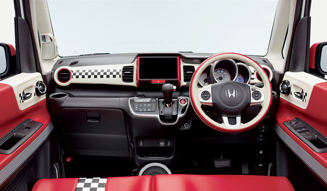
The interior of the "N-BOX SLASH" features an optional "Diner Style" package, evoking 1960s diner restaurants.
WatanabeIndeed, mini vehicles these days are more avant-garde, challenging, and innovative.
ShiomiYes. Having constraints on size and displacement seems to foster various innovations, which is very Japanese, and perhaps somewhat like feature phones. Although, they aren't strictly size-restricted.
OgawaTo be nitpicky, I wish they would do something about the design of the side mirrors on mini vehicles. Not just mini vehicles, but I think the design of mirrors on Japanese cars is terrible and a missed opportunity. It's particularly noticeable on mini vehicles because they are small. But overall, I find recent mini vehicles quite appealing. Some models achieve over 30 km/L, rivaling next-generation vehicles, and in rural areas where gas stations are disappearing, mini vehicles will become even more indispensable.
TALK SESSION: A Roundtable Discussion on the Near Future of Cars, Part 1
Discussing the Uncertain Near Future of Cars in 201X (3)
A Future Where 50% of Current Occupations Disappear
WatanabeIf gas stations continue to decrease, electric vehicles might become more practical even in rural areas. However, the rivals for EVs at that time might not be hybrids or fuel cell vehicles, but mini vehicles.
ShiomiCurrently, mini vehicles account for 40% of new car sales...
WatanabeI predict it will reach 50% before long.
ShiomiIn the past, mini vehicles were basic cars, but as the mini vehicle market has grown, we've seen genre divisions within them, like luxury mini vehicles and basic ones.
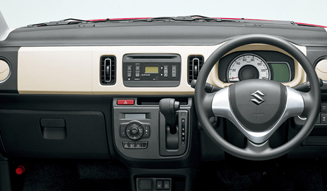
The interior of Suzuki's new "Alto." Many owners now use smartphone map apps for navigation, and recently, even if mini vehicles have monitor screens, they often don't come with built-in navigation software.

Mr. Watanabe suggests, "The rivals for electric vehicles might not be hybrids or fuel cell vehicles, but mini vehicles."
OgawaDoes this expansion of the mini vehicle market have any impact on the IT industry?
IshikawaHmm, I wonder. Regarding the impact of IT on mini vehicles, smartphone map apps have become very sophisticated recently and function perfectly as car navigation systems. This means there's no longer a need to install expensive navigation systems in affordable mini vehicles.
WatanabeIndeed. Recently, many mini vehicles come with monitor screens but without navigation software, and a considerable number of models allow users to connect their smartphones and display the smartphone's navigation function on the monitor. Originally, car navigation systems were profitable options that dealerships wanted customers to install, so they probably aren't happy that smartphones can substitute for them, but mini vehicles were quick to adopt this.
IshikawaNowadays, cars only need to have a monitor and speakers; that's sufficient.
ShiomiWhen car navigation systems first became popular, I never imagined that phones would eventually replace them. It's difficult to predict the future.
OgawaIt is difficult. After all, there are predictions that 50% of current occupations will disappear in 20 years, aren't there?
TALK SESSION: A Roundtable Discussion on the Near Future of Cars, Part 1
Discussing the Uncertain Near Future of Cars in 201X (4)
Sony Transitions from Manufacturer to Supplier
ShiomiMr. Ishikawa, I'd like to ask you: while cars are increasingly incorporating IT and evolving, do you feel a similar approach from the IT industry towards cars? There have been reports about Google and Apple developing cars, for instance. Is there any truth to that?
IshikawaYes, there is. Google is trying to take over the car navigation segment, and Apple is fully intending to handle all infotainment systems with "CarPlayCarPlay." And car manufacturers are actively collaborating with these moves, rather than resisting them. Are they being absorbed, or are they absorbing? Nowadays, most cars can connect with iPhones or Androids. To put it extremely, perhaps smartphone companies view cars as just another output terminal.
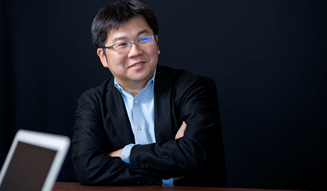
IT journalist Mr. Ishikawa says, "While car manufacturers may use Google's or Apple's OS, they might differentiate themselves with their own user interfaces," commenting on the current situation.
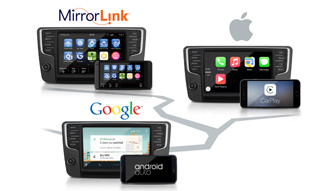
At CES in January this year, Volkswagen announced the "Connected Golf," which can connect with "Android Auto" (Google) and "CarPlay" (Apple). It is scheduled to be introduced in North America and Europe within the year.
ShiomiI see. Will car manufacturers eventually be controlled by IT companies?
IshikawaIn some aspects, and to some extent, perhaps. The growth of smartphones themselves is slowing down, so they are seeking new avenues in cars. At this year's CES, I believe it was VW, where they introduced a system where occupants' actions inside the car are detected by cameras or sensors, initiating actions like playing music. Car manufacturers might use Google's or Apple's OS, but differentiate themselves with their own user interfaces.
ShiomiSo, those who possess the platform or OS are indeed strong.
IshikawaCars are important customers for IT suppliers as well. Sony is currently focusing on camera modules, which are used in various IT products. About 40% of smartphones use Sony's camera modules, but with the smartphone market reaching its limits, they will likely focus on cameras installed inside and outside vehicles in the future.
ShiomiThis means Japanese companies are finding new opportunities by transitioning from manufacturers to suppliers, even more so than in the automotive industry itself.
IshikawaYes. Sharp is developing flexible liquid crystal displays, which could also be utilized in various parts of a car.
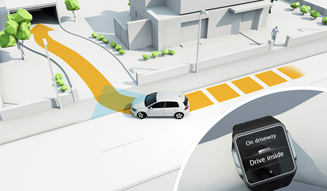
VW aims to establish technology that allows the car to remember a series of parking maneuvers, enabling the driver to leave the vehicle and control its entry and exit using a remote control device or smartphone.
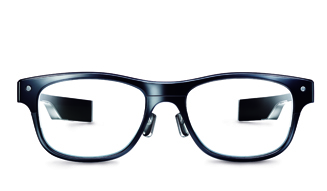
Eyewear maker "JINS" is collaborating with Denso to research driving support technology using "JINS MEME," next-generation glasses equipped with a 3-point electrooculography sensor.
ShiomiYou mentioned earlier that car monitors would remain for output purposes, but perhaps the era of projecting all information onto the windshield is not far off.
OgawaThe eyewear company "JINS" is considering embedding computers into glasses to project information onto the lenses. It seems they are also thinking about preventing drowsy driving by reading eye movements. It might be similar to Google Glass. If they position it with the objective of preventing drowsy driving, it might be easier to get approval for commercialization, so perhaps that's their initial aim.
IshikawaIf you wear it, it can detect not only eye movements but also head movements, allowing it to detect if the driver is dozing off.
ShiomiSo, ultimately, are we heading towards an era of embedding computers within our bodies?
IshikawaComputers that can be attached and used are certainly conceivable. However, Google Glass is currently being considered a failure. The presence of a camera raises privacy concerns, which may be hindering its widespread adoption.
TALK SESSION: A Roundtable Discussion on the Near Future of Cars, Part 1
Discussing the Uncertain Near Future of Cars in 201X (5)
Nitori, Inaba Warehouse, or Wake?
OgawaReturning to mini vehicles, it really makes you wonder how far they've come.
ShiomiDoesn't the 40% market share indicate that people who buy a mini vehicle don't go back to a regular car? They think, 'This is good enough.'
WatanabeMy prediction of 50% is based on population decline and an aging society. Elderly people don't need to carry many passengers or drive fast, so many find mini vehicles sufficient.
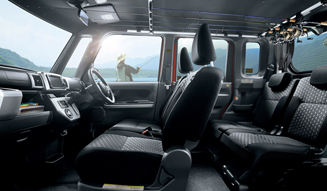
The Daihatsu "Wake" allows for the storage of fishing rods on its interior ceiling. The current mini vehicle market is vibrant with unique car developments that don't fit existing categories.

The storage space in the "Wake" can accommodate two road bikes without folding them.
ShiomiIn the 1990s, several sports mini vehicles were released: the Honda "Beat," Suzuki "Cappuccino," Mazda "AZ-1," and others. Looking back, they feel like a product of the bubble era's exuberance. However, the second-generation Daihatsu "Copen" and the upcoming Honda "S660S660" might not just be fads, but could establish themselves as a genre within the now-enormous mini vehicle market.
OgawaWhat are the best-selling models?
WatanabeWhile tall wagons like the Suzuki "Wagon R" and Daihatsu "Move" have long been dominant, the trend is shifting towards super tall wagons like the Daihatsu "Tanto" and Honda "N-BOX," which are even taller.
OgawaSo, in Japan, even mini vehicles are becoming like minivans.
WatanabeThat's right.
ShiomiAt the end of 2014, Daihatsu released the "Wake," which is even taller than the Tanto and N-BOX.
WatanabeThat one is intense. It barely stays upright (laughs). Or rather, to prevent it from tipping over, the suspension is extremely stiff, so the ride comfort isn't great. But the fact that they can push through such a wild concept and sell it shows the current momentum of mini vehicles.
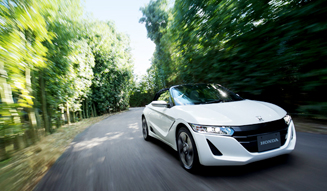
The "S660," the modern successor to the Honda "Beat," has finally been released. The mini vehicle lineup has entered an era of unprecedented variety, from minivans to full-fledged sports models.
ShiomiDaihatsu and Suzuki have been in fierce sales competition for decades. Whenever one develops a new genre, the other follows suit. So, by summer, they might release a model a few millimeters taller than the Wake.
OgawaPerhaps they'll even release models where you drive while standing.
WatanabeIt's getting close to that. When you look inside, it feels like you're in a Nitori or an Inaba warehouse.
ShiomiIt would be problematic if the OPENERS article focused solely on mini vehicles, so I'd like us to also discuss cars with white license plates.

OGAWA Fumio
Worked for approximately 20 years at the editorial department of "NAVI," a magazine that fuses cars and culture, where he served as editor-in-chief. He has also been editor-in-chief of "Motor Magazine" and the gourmet journalism publication "Arigatto." Currently, he is a freelance journalist covering lifestyle topics. He contributes to numerous magazines and websites, including "GQ" (Condé Nast Japan), "UOMO" (Shueisha), "LEON" (Shufu-to-Seikatsu-sha), and "ENGINE" (Shincho-sha).

WATANABE Toshifumi
Born in Fukuoka Prefecture. After working in the editorial departments of motorcycle and car magazines at Kikaku Shitsu Neko (now Neko Publishing), he became a freelancer. His serialized feature "Car Nabe" in "Shukan Bunshun" gained popularity as a witty commentary on society and life through the lens of automobiles, and was later published in two volumes by CG BOOK. He also writes for many general magazines such as "MEN'S EX" and "UOMO."

ISHIKAWA Tsutsumu
Born in Tokyo. Worked as an editorial reporter at "Nikkei Trendy." He specialized in mobile phones, which were rapidly gaining popularity at the time, and later became a freelance mobile journalist. He also appeared on TV Tokyo's "TV Champion" mobile phone expert competition, where he placed second. Currently, he is active in a wide range of media, from television programs to magazines.

SHIOMI Satoshi
Born in Okayama City, Okayama Prefecture. After graduating from Kwansei Gakuin University, he joined Sanyo Shimbun. Although he became a local newspaper reporter, he couldn't give up his dream of becoming an automotive magazine editor and moved to Tokyo. After working at the editorial departments of "Best Car" and "NAVI," he became a freelance editor/writer in 2010.
Talk Session: A Roundtable Discussion on the Near Future of Cars, Part 2 →