
Test Drive the McLaren MP4-12C | McLaren
McLaren MP4-12C | McLaren MP4-12C
A Supercar Like No Other, Now Yours!
Test Drive: McLaren MP4-12C
McLaren's first entry into the mass-produced sports car market, theMP4-12Cis finally here for a test drive. Yasuhisa Shimashita shares his impressions from the test track at Dunsfold Aerodrome in Surrey, England.
Text by SHIMASHITA Yasuhisa
Taking on Ferrari: The Driver's Seat
When one thinks of McLaren, the legendary Formula 1 constructor, their road car legacy brings to mind the iconic McLaren F1, unveiled in 1991. Also fresh in memory is theSLR McLaren, developed and produced in collaboration with Mercedes-Benz.
Now, McLaren has reorganized its road car development and manufacturing division, McLaren Automotive, and is entering the mass-produced sports car market. The first model in this new era is the MP4-12C. While "mass-produced sports car" encompasses various segments, the MP4-12C squarely targets the Ferrari458 Italiaas its primary rival. In Japan, its price is set at 27.9 million yen, compared to the 458 Italia's 28.3 million yen.
We had the opportunity to thoroughly test the MP4-12C on both the test track at Dunsfold Aerodrome in Surrey, England, and on public roads. Incidentally, this test track is the same one used by the renowned British automotive show, "Top Gear."
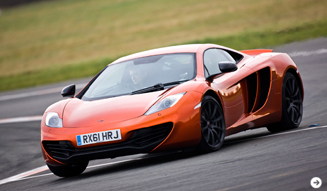
Seen up close, the MP4-12C appears more compact than expected. While its 4,507mm length and 1,909mm width are indeed slightly smaller than the 458 Italia's, this is by no means a negative. Its lean, sculpted form ignites a desire for driving.
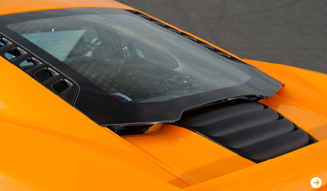
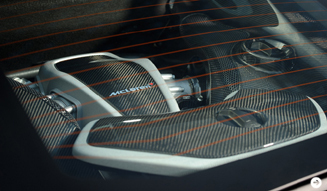
Touching the sensor opens the dihedral doors, and stepping over the substantial sill reveals the interior. The cockpit is indeed snug. The narrow space between driver and passenger seats is a result of pushing the seats as close as possible to maximize performance. The absence of a shift lever on the floor and the vertical orientation of the navigation screen are for the same reason. However, the low scuttle and expansive windows create an illusion of spaciousness, and unlike many cars in this class, rearward visibility is surprisingly good.
The engine, mounted behind the cabin, is a McLaren Automotive-manufactured 3.8-liter twin-turbo V8, producing a maximum output of 600 ps and 600 Nm of torque. The choice of a twin-turbo setup contributes to a smaller, lighter package and improved fuel efficiency. The gearbox is a 7-speed dual-clutch unit, known as 'SSG'.
McLaren MP4-12C | McLaren MP4-12C
A Supercar Like No Other, Now Yours!
Test Drive: McLaren MP4-12C (Part 2)
Engaging the Gears to Explore Its Potential
We set off immediately. Pulling the right side of the seesaw-style shift paddle to engage first gear and pressing the accelerator, we were met with an immediate, superb response, even from this high-output turbocharged engine. The torque, which responds faithfully to throttle inputs, makes it incredibly easy to drive even at everyday speeds.
Yet, pressing the accelerator further unleashes a surge of power that builds relentlessly, propelling the car to its high 8,500 rpm redline with astonishing speed. The sound is not a high-pitched scream, but a deep, resonant growl throughout. While this might be a matter of personal preference, the engine's characteristics are undeniably flawless for a sports car heart.
The directness of the gear changes is also captivating. The SSG features a 'pre-cog' function; by lightly pulling the paddle just before an intended downshift, the gearbox prepares for the change, allowing for an instantaneous shift when the paddle is fully engaged. This is an utterly exhilarating experience.
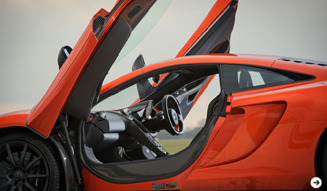
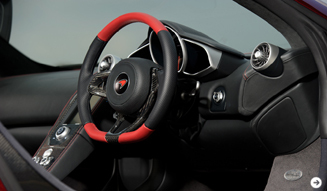
Honestly, I had reservations about the feel of a turbocharged engine. But this has exceeded all expectations. I can confidently say that it not only delivers on raw power but also on sharpness, fully satisfying the demands of a sports car heart.
However, what truly surprised me, even more than the powertrain, was the astonishingly high level of chassis refinement. The ride comfort, alongside the handling, was initially breathtaking.
The Dunsfold track surface is quite rough. Yet, the body remains incredibly rigid, allowing the suspension to stroke smoothly and absorb road imperfections. This ensures a serene cabin experience, regardless of speed. The impression remains the same on the surrounding public roads; even when traversing road joints, the impact is completely isolated.
McLaren MP4-12C | McLaren MP4-12C
A Supercar Like No Other, Now Yours!
Test Drive: McLaren MP4-12C (Part 3)
The Exceptional Chassis: What It Delivers
The MP4-12C's most defining feature is its carbon monocoque, a CFRP (carbon-fiber reinforced plastic) shell forming the basic structure of the body. While carbon-bodied supercars, including the SLR McLaren, are not new, they have always been high-priced, limited-production models. This is the first time such a construction has been employed for a mass-produced sports car, with a planned annual production of 2,000 units.
The advantages are its light weight and high rigidity. Combined with a design that meticulously pursues efficiency, including dimensions slightly smaller than the 458 Italia in all aspects and optimized component placement, the MP4-12C's curb weight remains under 1,400kg (DIN).
Yet, the sense of rigidity is overwhelming. Coupled with the rigid connection of the aluminum subframes supporting the suspension and engine, it offers a level of solidity previously unexperienced in a production car.
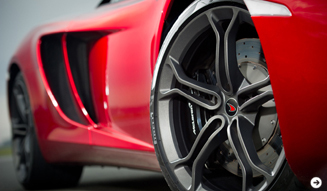
The suspension also holds a secret. The MP4-12C's four-wheel double-wishbone suspension is, in fact, not equipped with anti-roll bars. Instead, it features a proactive chassis control system that links the four dampers to manage the vehicle's attitude. This system gently absorbs road inputs while effectively suppressing body roll and pitch.
The result is truly impressive handling. As you cycle through the Normal, Sport, and Track modes, body control becomes progressively tighter. Combined with the lightweight, high-rigidity body and the precisely functioning suspension, cornering behavior is exactly as intended. The stability during cornering is exceptional, thanks to the mid-engine's excellent front-rear balance and the proactive chassis control system, which relentlessly presses all four wheels into the tarmac. Even when aggressively mounting a curb with the inner wheel, the opposite tire is unaffected, minimizing any disruption to the car's composure.
Thanks to the chassis's unparalleled road feel and elimination of vague movements, the controllability is superb. It's astonishingly easy to hit the desired line, and you can confidently manage any situation, even if the car begins to slide.
In fact, even in Track mode with limited ESC intervention, when accelerating hard, the car will enter an oversteer state. However, you can naturally apply the necessary counter-steer to keep the car moving forward. It feels nothing like the intimidatingly precise machine one might imagine from a 600 ps mid-engine car.
The high traction that keeps the car moving forward in any situation is also greatly aided by brake steer. The MP4-12C does not have a mechanical LSD; instead, it uses brake control on the inner wheel during cornering to achieve a similar effect. While similar systems are now seen in other manufacturers' cars, this technology originated from McLaren's F1 efforts in 1998-1999.
McLaren MP4-12C | McLaren MP4-12C
A Supercar Like No Other, Now Yours!
Test Drive: McLaren MP4-12C (Part 4)
McLaren's Passion
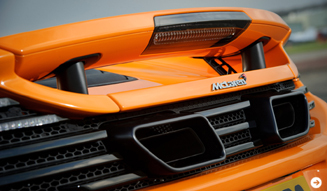
Reminiscent of F1, the rear spoiler deploys during hard braking to increase downforce, stabilizing the rear tires' grip. This acts as an air brake, but its characteristic feature is enhancing braking force by maximizing tire grip, rather than solely relying on air resistance.
Reflecting on the test drive, the chassis left a stronger impression than the engine. After all, McLaren is a chassis constructor, while Ferrari is an engine specialist. This familiar dynamic from F1 carries over to their road cars.
However, this does not imply a lack of passion. The PR staff described it this way:
"We have our own McLaren passion, different from Italian brands, driven by the pursuit of technology and meticulous attention to detail."
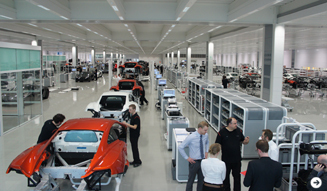
Indeed, this is evident not only in the car itself but also in the McLaren Production Centre (MPC), built to produce the MP4-12C and future models. Its immaculate state, unlike any typical automotive factory, reflects the perfectionism of CEO Ron Dennis, permeating every aspect. This could only be achieved through immense passion.
For those captivated by the exceptional quality and cutting-edge technology, and who are driven by the desire to master its formidable performance, the MP4-12C is the ultimate machine. It marks the welcome arrival of a completely new breed of supercar.

McLaren MP4-12C | McLaren MP4-12C
Body Dimensions | Length 4,509 x Width 1,908 x Height 1,199 mm
Curb Weight | 1,434 kg
Engine | 3.8-liter V8 Twin-Turbo
Max Output | 600 ps (441 kW) / 7,000 rpm
Max Torque | 600 Nm / 3,000-7,000 rpm
0-100 km/h Acceleration | 3.3 seconds
Transmission | 7-speed Dual-Clutch
Fuel Economy | 11.7 L/100 km
CO2 Emissions | 279 g/km
Price | 27.9 million yen