Was There a Future at the 2011 Tokyo Motor Show? (Part 2)
The 42nd TOKYO MOTOR SHOW 2011
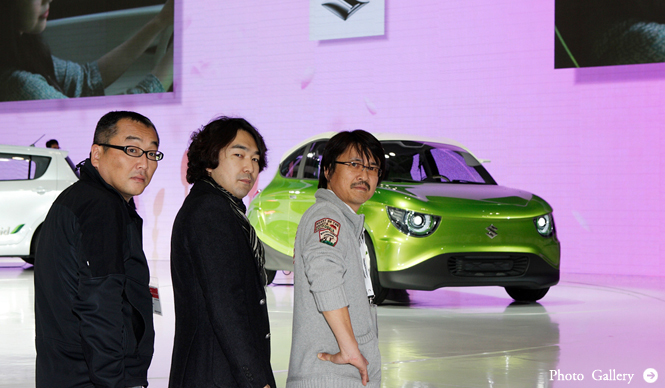
Yasuhisa Shimashita, Satoshi Watanabe, Soichi Shimizu Weigh In
Did the Tokyo Motor Show 2011 Hold a Glimpse of the Future? (Part 2) (1)
The Tokyo Motor Show, held at Tokyo Big Sight from November 30th to December 11th, finally opened its doors to the public.Toyota 86The popularity of the Toyota 86, among other factors, contributed to an attendance of 842,600 visitors, exceeding expectations. Although Italian and American manufacturers were absent, the return of many overseas makers likely had a significant impact on visitor numbers. The automotive landscape faces serious challenges: a growing detachment from cars among young people, traffic congestion in urban areas, fuel scarcity, and environmental concerns. In this context, did this year's Tokyo Motor Show offer a vision of a brighter future? We asked three experts for their insights.
Text by DAI MATSUOPhoto by MASAYUKI ARAKAWA
It Was All Just "Mom-and-Pop" Bikes
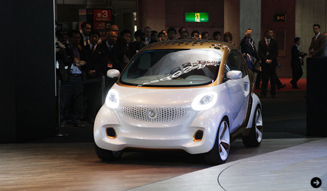
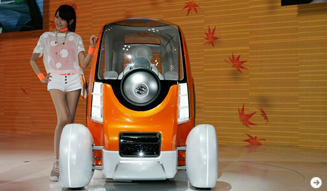
──I find the two-seater commuters proposed by Japanese manufacturers to be functional as means of transport, but I don't feel much appeal as cars. On the other hand, the smart forvision, for example, while sharing a similar concept, has an appeal that resonates with car enthusiasts. What are your thoughts on this?
WatanabeWhile the concepts and packaging are indeed similar, I believe the commuters from Japanese manufacturers and the smart are at opposite ends of the spectrum. In a sense, the former have been castrated.
──In other words, they are not cars that we desire, or that make us want to drive somewhere, becoming objects of desire?
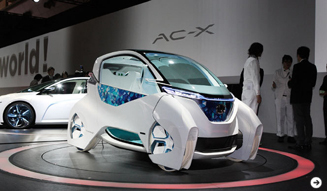
ShimizuThat's because they are born from the Japanese cultural context. They are, so to speak, like "Tsurezuregusa" or "Hojoki." The value of living in a confined space of about three meters square – a "hojo" – and finding it sufficient. The quiet movement, the sound of a nearby stream, can be enjoyable. The cars created by Japanese people and the cars created by Westerners, who are a hunting people, have fundamentally different backgrounds.
──For instance, we have bicycles as minimal transport devices. And among bicycles, some make you want to choose them with sparkling eyes, while others are merely tools for getting around.
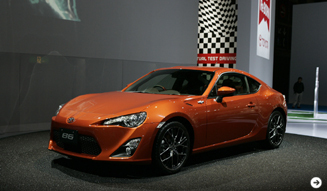
ShimashitaIn that sense, it's understandable that Japanese car manufacturers, who have been producing only "mom-and-pop" bikes for a while, might wonder, "Why aren't people attracted to them?" Finally realizing they only had "mom-and-pop" bikes, Toyota, for example, released cars like the FJ Cruiser and the 86. The EV commuters exhibited by each manufacturer this time are currently like "mom-and-pop" bikes, but perhaps we'll see different things in the future.
──Speaking of which, the Tokyo Motor Show this year also featured the theme of "smart mobility," proposing relationships between people's lives and mobility. It was also striking that housing manufacturers like Sekisui House participated.
WatanabeThis is a crucial time for both car manufacturers and housing manufacturers. The so-calledsmart gridand smart communities will be extremely difficult to popularize without breaking down the barriers between car and housing manufacturers.
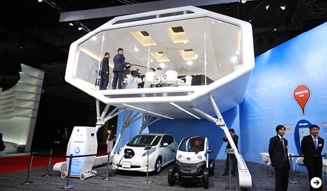
ShimizuInitially, orders for the Nissan Leaf poured in, but the tone softened due to the earthquake. Currently, sales are only about 70% of the planned target. However, if Nissan's proposed“LEAF to Home”system, which supplies electricity from the EV's battery to the home, becomes widespread, it could truly shine.
ShimashitaAccording to someone at a housing manufacturer, the number of people building homes who are installing charging facilities in their garages is increasing dramatically. Even if they don't own an EV now, they're thinking about their next car being an EV. What's remarkable about Japan's progress is that the only mass-produced EVs are the Leaf and the i-MiEV. In Europe, a German consortium is developing a standard other than CHAdeMO, but if you're going to install charging stations now, you have no choice but to go with CHAdeMO. There's an advantage to being early.
──Products must become the de facto standard.
ShimashitaThose who follow will find it more convenient to use CHAdeMO. It's that advanced, and everyone is installing home charging systems. People at Mitsubishi are also creating roadmaps for when things will happen. A V2H (Vehicle to Home) kit for the i-MiEV will also be released soon. It will become a powerful fait accompli.
ShimizuEveryone assumes it will eventually go that way. For now, there's also a wait-and-see approach due to short-term electricity shortages.
The 42nd TOKYO MOTOR SHOW 2011
Yasuhisa Shimashita, Satoshi Watanabe, Soichi Shimizu Weigh In
Did the Tokyo Motor Show 2011 Hold a Glimpse of the Future? (Part 2) (2)
Car of the Tokyo Motor Show?!
──The concept of smart grids, in the first place, was conceived in America, where power supply is unstable and blackouts are frequent. Although not originating in Japan, in recent times, Japanese manufacturers have been actively pursuing it, partly due to the earthquake. Nissan Motor CEO Carlos Ghosn also stated in a press conference that "the era when car manufacturers only made cars is over."
WatanabeTo generalize V2H, collaboration between car manufacturers and companies in other industries is crucial. Nissan recognized this early in the development of the Leaf, which allowed them to work with Sekisui House and Daikyo.
──Toyota and Nissan are listed alongside power companies, housing manufacturers, and home appliance makers in the demonstration project promoted by the Ministry of Economy, Trade and Industry.
ShimashitaEven if the Ministry of Economy, Trade and Industry formulates V2H standards, it cannot proceed without car manufacturers. Therefore, at Mitsubishi Motors, for example, the development team includes two chief engineers: one for hardware and one for external affairs. Currently, the external affairs chief is visiting countries worldwide that want the i-MiEV, working on infrastructure and legal frameworks. Nissan is moving in a similar direction. This will likely result in significant first-mover advantages.
ShimizuFrom a consumer's perspective, even without a networked system like smart grids, "LEAF to Home" alone is appealing.
ShimashitaEveryone hopes that if something happens, they'll at least have electricity.
WatanabeHowever, it requires a tremendous amount of investment, and there are many issues to resolve. The earthquake was a trigger.
ShimashitaIt pulled the trigger on the consumer side, preceding any political movements. No one wants to experience a repeat of the immediate aftermath of the earthquake, and people are thinking about how to survive on their own if something happens, so it's natural for public attention to turn towards securing lifelines. When everyone has a V2H system at home and starts buying EVs, it will become a movement, and society and politics will follow. I hope that the economy will drive this change, even without political intervention.
──Finally, based on this Tokyo Motor Show, could you offer some guidance on choosing a car in the current climate?
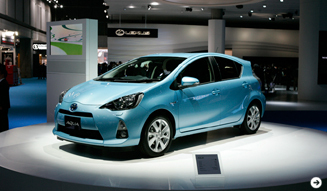
ShimizuI think it depends on the usage. If you drive 20,000 km a year, a clean diesel is suitable. If you only drive two or three times a month, rental cars or car sharing might be better. Japan offers a range of cars that generally suit people's lifestyles. By the way, I recently reserved aToyota Aquafor city driving. The Aqua weighs 1,080 kg. For city commuters, the smaller, the better. For long distances, the Citroën C5, and for a hobby, the Ferrari 512 TR. I say this myself, but it's the perfect car life.
WatanabeThe Toyota 86 is quite good.
ShimizuFor diversity, cars like that are necessary. It felt like seeing the resilience of the Japanese automotive industry.
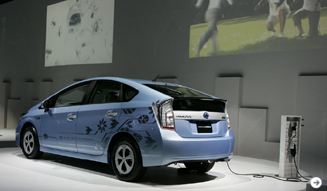
ShimashitaI'm actually drawn to thePrius PHV, even though I don't really need it for my lifestyle. It's because it offers a new kind of automotive fun. I think everyone should buy what they like, even if it's not strictly logical.
ShimizuIf you want it, buy it.
ShimashitaI think many consumers rely too much on information. Instead of thinking "it's probably like this" without even driving it, they should at least go to a dealer and test drive it. What was striking this time was that despite it being the Japan premiere of thenew 911, there weren't as many people at thePorsche boothas I expected. Rather than just reading articles or looking at photos, it's better to experience it yourself.
ShimizuAt the motor show venue, I thought theCitroën DS5was good. If I had to wish for something, it would be the option of a diesel engine with hydropneumatic suspension.
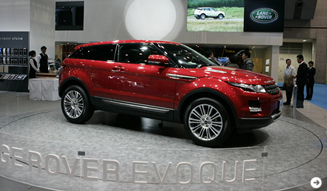
WatanabeI thought theRange Rover Evoquewas good. First of all, the price was lower than I expected. At 4.5 million yen, it seems inexpensive considering its rivals from other brands.
ShimashitaI thought I had gotten used to the Evoque, but seeing it in person, it's still stylish. It also drove well.
WatanabeConsidering its price point and competitors, it lines up against theVolkswagen Tiguan, theAudi Q3, and theBMW X1. It has entered a market crowded with strong contenders. Beyond that, the only other showstopper for me was theSuzuki Regina. I think this kind of package might be sufficient for future cars. I always wonder how mini-vehicles can become international products, but Suzuki's ability to create designs within the kei car regulations that rival European cars is impressive.
ShimizuIt might be very ordinary, but I'd say theAudi A1 Sportback. In the compact class, compared to, for example, theVolkswagen Polo, it's more stylish and seems more practical.
ShimashitaThe models we've just mentioned were all attractive in their own ways.