ALFA ROMEO MiTo | ALFA ROMEO MiTo Test Drive (Part 2)
ALFA ROMEO MiTo Test Drive (Part 2)
You Can Tell It Pursues Sportiness
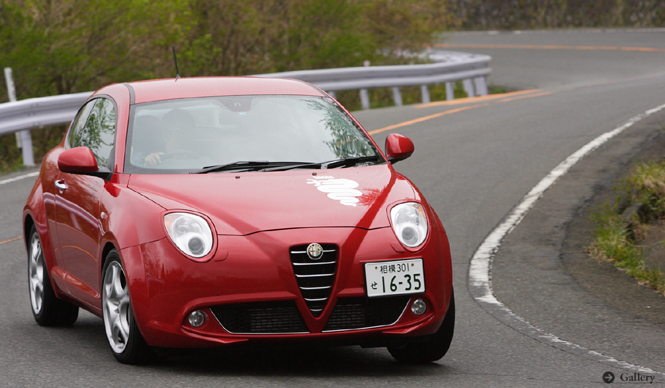
The "MiTo," Alfa Romeo's compact two-door hatchback, has garnered attention for its cute design reminiscent of a small animal. This second part focuses on the impressions of automotive journalist Fumio Ogawa.
Text by Fumio OgawaPhotos by Masayuki Arakawa
Acceleration Like a Fighter Jet
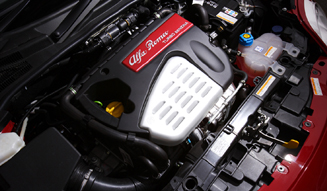
Driving the MiTo, you can indeed tell it pursues sportiness. First, I was impressed by the precise handling and the car's agile movements. As expected from a 1.4-liter engine, it doesn't have rocket-like power, but by selecting the D (Dynamic) mode of the "Alfa Romeo D.N.A. system," you can experience acceleration akin to a fighter jet, if not a rocket.
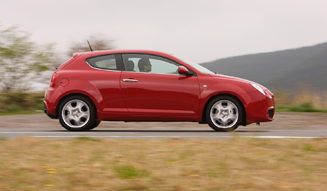
The MiTo is said to incorporate the image of the 8C Competizione, a racing car of the past. While its looks are rugged, there's something about it that stirs the hearts of car enthusiasts. The side window graphics also convey a sense of upward lightness, showing that Alfa Romeo understands market demands well.
The driver's seat is comfortable, with sports seats featuring large side bolsters to prevent body roll during spirited driving. Although the arrangement of instruments and switches is a bit cluttered, it might be considered part of the charm of a youthful, baby Alfa.
A Unique Ride
The ride quality is by no means bad, but it is unique. While it absorbs shocks from the road well, the suspension is firm. Alfa Romeo explains this is due to the use of dampers with built-in rebound springs in the front and rear suspension, achieving sporty cornering performance without sacrificing ride comfort.
The impression is of firm springs and supple dampers. It has a distinctive way of moving, with the outer front wheel momentarily dipping when the steering is turned. Getting accustomed to the car might also be a joy for Alfa Romeo owners, so let's accept it as it is.
The car is available in three colors: Alfa Red (pictured), Bianco Spino white, and Etna Black metallic. The seats are standard fabric in a black/red combination. Leather upholstery is available as an option. Colors include Natural, and Red is also offered for black bodies. Metallic colors are an additional 50,000 yen, and leather seats are an additional 200,000 yen.

ALFA ROMEO MiTo
Body | Length 4070 x Width 1720 x Height 1475mm
Engine | 1.4L Inline 4-cylinder DOHC 16-valve
Max Output | 114kW [155ps] / 5,500rpm
Max Torque | 201Nm [20.5kgm] / 5,000rpm (Normal) 230Nm [23.5kgm] / 3,000rpm (Dynamic)
Drivetrain | FF
Transmission | 6-speed manual transmission
Steering | Right
Price | 2.85 million yen
Alfa Contact
0120-779-159
BRAND HISTORY
From sedans to open-top sports cars, ALFA ROMEO boasts overwhelming popularity in Japan due to its stylish Italian design and sporty performance. The company was founded in 1910 when Italian entrepreneurs bought a car assembly plant from the French company Darracq in Milan, establishing A.L.F.A. The name A.L.F.A. is an acronym for "Anonima Lombarda Fabbrica Automobil," meaning "Lombard Automobile Manufacturing Company."
A.L.F.A. soon introduced its own model, the "24HP," and began to distinguish itself as a sports car manufacturer through racing participation. However, its financial situation was not favorable, leading to a significant change in management in 1915. It was at this time that businessman Nicola Romeo took the helm. In 1918, the company name was changed to Nicola Romeo & Co., and in 1920, after World War I, the first model bearing the Alfa Romeo emblem, the "Torpedo 20-30," was released.
In 1922, the company introduced the "RL," a full-fledged sports model. A 1-2 finish at the 1923 Targa Florio brought the Alfa Romeo name to prominence. In the same year, 1923, the racing car "P1" was developed, featuring a DOHC engine in its 1990cc 6-cylinder configuration, which would become a signature technology for Alfa Romeo. However, the P1 itself was a failure. Consequently, Alfa Romeo recruited the brilliant engineer Vittorio Jano from Fiat to develop the Grand Prix car "P2," which left a brilliant mark on racing history.
After World War II, the company transitioned to mass-producing cars, releasing iconic models such as the "Giulietta Sprint" in 1954 and the "Giulia" in 1962. After coming under the Fiat umbrella in 1986, models like the "Alfa 156," "Alfa 145," and "Alfa 147" became hits in Japan, further increasing Alfa Romeo's popularity.