March 4, 2015
ALFA ROMEO MiTo Test Drive (Part 1) | Compact and True to Alfa
ALFA ROMEO MiTo | First Drive (Part 1)
Compact and Distinctly Alfa
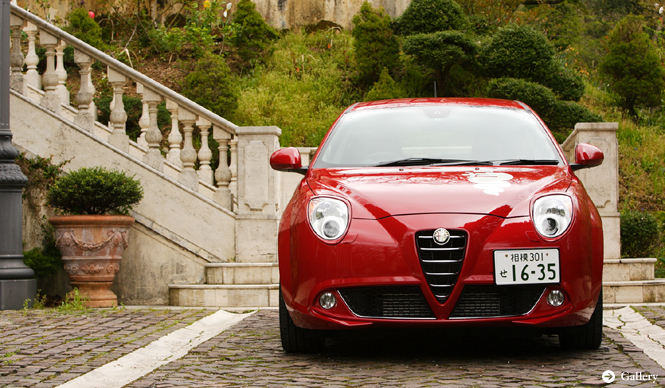
The Alfa Romeo MiTo, a compact two-door hatchback, has garnered attention for its cute design reminiscent of a small animal. Automotive journalist Fumio Ogawa takes the wheel of this model, now available in Japan.
By Fumio OgawaPhotos by Masayuki Arakawa
Milan + Turin = MiTo
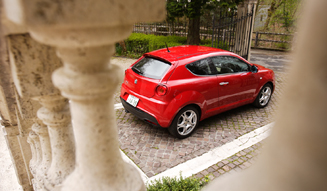
The new "MiTo," Alfa Romeo's most compact two-door hatchback, went on sale in Japan on April 2nd. It is powered by a 1.4-liter four-cylinder engine with an intercooled turbocharger and is exclusively available with a 6-speed manual transmission. The price is ¥2,850,000.
MiTo is a rather unique name, carrying a double meaning. Firstly, it means 'myth' in Italian. Secondly, it's an acronym for Mi (Milan) + To (Turin). The name was chosen because the car is designed at the Centro Stile (design center) in Arese, Milan, and produced at the main factory in Turin.
While boasting comprehensive safety features, including seven airbags and active headrests to prevent whiplash in collisions, it embodies Alfa Romeo's characteristic emphasis on driving pleasure. To address the power lag before the turbo kicks in, it employs a small turbine impeller with reduced inertia to ensure swift response to accelerator pedal input.
The Noteworthy New Technology: Alfa Romeo D.N.A. System
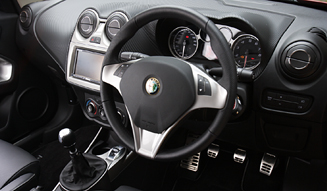
Another new technology worth noting is the "Alfa Romeo D.N.A. System." D stands for Dynamic, N for Normal, and A for All-weather. Selecting D via a switch on the center console, for example, activates the turbocharger's overboost function, increasing power. Specifically, torque increases from the normal 20.5 kgm/5000 rpm to 23.5 kgm/3000 rpm, while the power steering assist is reduced.
The MiTo is equipped with VDC (Vehicle Dynamic Control), which ensures cornering stability through control of the brakes and engine power. In D mode of the "Alfa Romeo D.N.A. System," the intervention timing of the VDC is slightly delayed, allowing for a more spirited driving experience.
With cooperation from Albergo Bamboo Tel. 0460-84-3311
BRAND HISTORY
From sedans to open-top sports cars, ALFA ROMEO boasts overwhelming popularity in Japan, thanks to its stylish Italian design and sporty performance. The company was founded in 1910 when Italian entrepreneurs purchased a car assembly plant from the French company Darracq in Milan and established A.L.F.A. The name A.L.F.A. is an acronym for "Anonima Lombarda Fabbrica Automobil," meaning "Lombard Automobile Manufacturing Company."
A.L.F.A. quickly introduced its own model, the "24HP," and began to distinguish itself as a sports car manufacturer through racing participation. However, its financial situation was not robust, leading to a significant change in management in 1915. At this time, businessman Nicola Romeo took the helm. In 1918, the company name was changed to Nicola Romeo & Co., and in 1920, after World War I, the first model bearing the Alfa Romeo emblem, the "Torpedo 20-30," was released.
In 1922, the company launched the "RL," a full-fledged sports model. A 1-2 finish at the 1923 Targa Florio brought fame to the Alfa Romeo name. In the same year, 1923, the racing car "P1" was developed, featuring a DOHC engine in its 1990cc 6-cylinder configuration, establishing DOHC as a signature technology for Alfa Romeo. Although the P1 itself was a failure, Alfa Romeo then recruited brilliant engineer Vittorio Jano from Fiat to develop the Grand Prix car "P2," leaving a brilliant mark on racing history.
After World War II, the company transitioned to mass-producing cars, releasing iconic models such as the "Giulietta Sprint" in 1954 and the "Giulia" in 1962. After being acquired by Fiat in 1986, models like the "Alfa 156," "Alfa 145," and "Alfa 147" became hits in Japan, further increasing Alfa Romeo's popularity.