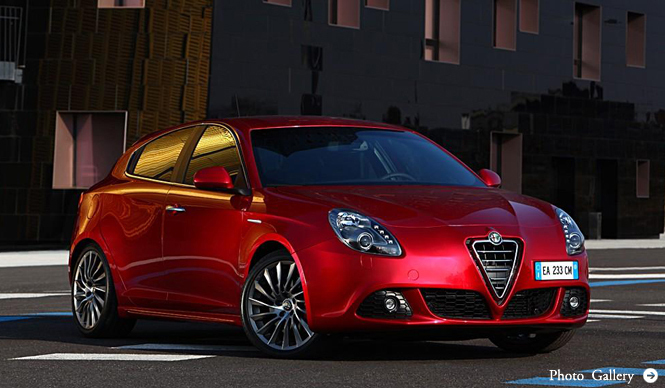
Alfa TCT equipped in the ALFA ROMEO Giulietta
ALFA ROMEO Giulietta
The New Giulietta with the More Direct "Alfa TCT" Transmission
Alfa Romeo has announced specifications for a new Giulietta model for the European market, featuring a dual-clutch transmission for its engine.
By Giraffe
Available on MultiAir and Diesel Turbo Models
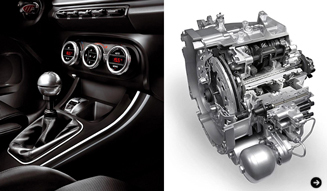
The "Alfa TCT" dual-clutch transmission enables swift shifts without any perceptible interruption in power delivery. This system, already featured in the MiTo, is capable of demonstrating its dynamic performance under various conditions.
The Giulietta will be offered with two engine options: a 170ps 2.0-liter inline-4 turbodiesel, and a 170ps direct-injection 1.4-liter inline-4 turbo MultiAir. Both will be equipped with the Alfa TCT.
The new Giulietta made its debut at the Paris Motor Show and is scheduled to arrive in Japan in 2011.
The introduction of this dual-clutch version is, of course, anticipated.
BRAND HISTORY
From sedans to open-top sports cars, ALFA ROMEO has earned immense popularity in Japan with its stylish Italian design and sporty driving dynamics. The company was founded in 1910 when Italian entrepreneurs purchased the Milan-based car assembly plant of the French company Darracq, establishing A.L.F.A. The name A.L.F.A. is an acronym for "Anonima Lombarda Fabbrica Automobil," meaning "Lombard Automobile Manufacturing Company."
A.L.F.A. soon introduced its own model, the "24HP," and began to distinguish itself as a sports car manufacturer through racing participation. However, its financial situation was precarious, leading to a significant change in management in 1915. At this juncture, businessman Nicola Romeo took the helm. In 1918, the company name was changed to Nicola Romeo & Co., and in 1920, after World War I, the first model bearing the Alfa Romeo emblem, the "Torpedo 20-30," was released.
In 1922, the company launched the "RL," a full-fledged sports model. A one-two finish at the 1923 Targa Florio brought widespread recognition to the Alfa Romeo name. Also in 1923, the racing car "P1" was developed, featuring a DOHC system in its 1990cc 6-cylinder engine, a technology that would come to define Alfa Romeo. Although the P1 itself was a failure, Alfa Romeo then recruited the brilliant engineer Vittorio Jano from Fiat to develop the Grand Prix car "P2," which would leave a brilliant mark on racing history.
After World War II, the company transitioned to mass production, releasing iconic Alfa Romeo models such as the "Giulietta Sprint" in 1954 and the "Giulia" in 1962. Following its acquisition by Fiat in 1986, models like the "Alfa 156," "Alfa 145," and "Alfa 147" became hits in Japan, further increasing Alfa Romeo's popularity.