January 23, 2015
Series | Michiko Fujiwara | Rediscover the Wonder of Japanese Tools with a Beautiful Broom!
A long-standing problem has finally been solved!
Rediscovering the Beauty of Japanese Tools with an Elegant Broom! (1)
Lately, I’ve come to love traditional Japanese brooms. The catalyst was moving house recently, for the first time in ten years. My new home has all hardwood floors.
Text and photos by Michiko Fujiwara
After more than a decade of contemplation, I've finally found a solution!
Well, that was the direct trigger, but I actually got a broom to solve a problem that had been bothering me for years. That problem concerns my dog. My current beloved dog is my second, but both of them bark incessantly when I vacuum and try to bite the hose. To avoid this, I have to go through the tedious process of isolating the dog in another room, vacuuming, then moving it to yet another room once I'm done. That’s how I’ve always vacuumed. I thought maybe I could do it in the morning while the dog is sleeping, but the vacuum cleaner’s noise would wake the dog up, and it would end up barking anyway.
“What should I do…?” I pondered for over a decade. Finally, I found a solution. One day, while preparing for this move, I saw a broom in a shop that sold Japanese tableware and baskets. The moment I saw it, I had an epiphany: “That’s it! My new place has hardwood floors, so maybe a broom would work!” This way, I could clean while the dog is sleeping without worrying about the noise, thus avoiding the barking and biting attacks.
I immediately researched and bought one. I think the last time I used a broom was back in elementary school. It felt so fresh. And the sensation of sweeping was so gentle! Because the broom is made from natural grass, it glides softly over the floor, and that gentleness transfers to my hands as well. It’s strangely enjoyable and refreshing to smoothly sweep dust and debris. And, perhaps obviously, I was impressed that it could easily sweep dust from the grooves of the baseboards. With a vacuum cleaner, I’d need to switch to a narrow hose attachment, but a broom requires no such hassle (!)
Furthermore, the swept-up dust is collected in a dustpan and discarded, so there’s no need for the somewhat tedious and unappealing process of emptying the vacuum cleaner’s filter (though I hear the latest models can empty with a simple push). Naturally, it doesn’t break down, and since it doesn’t use electricity, it’s eco-friendly.
Why, oh why, did I forget about such a wonderful tool? Vacuum cleaners are convenient, but brooms are just as convenient… Somehow, at some point, I had come to believe that cleaning must be done with a vacuum cleaner. That assumption probably prevented me from noticing these excellent tools.
An elegant and excellent broom is too good to pass up!
Rediscovering the Beauty of Japanese Tools with an Elegant Broom! (2)
Cleaning is manual work, so it’s important to find tools that feel right in your hands.
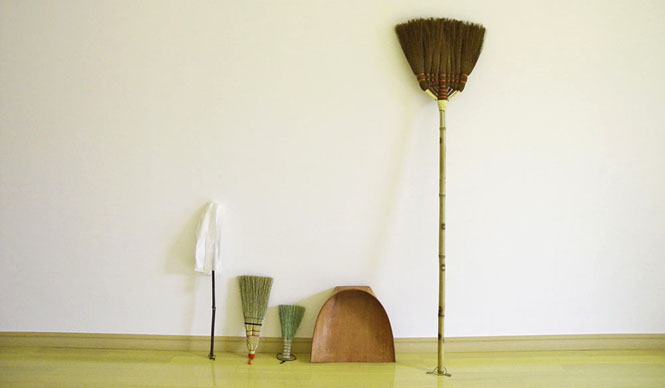
The broom I’m using is made from the fibers found on the trunk of a palm tree called shuro, purchased from the long-established Edo broom shop, Shirakoya Nakamura Denbei Shoten. Of course, the shop also had traditional brooms made from straw, but after trying several, I decided on this one. It was here that I first learned that even among brooms, some are suited for tatami mats, while others are better for hardwood floors or carpets. Indeed, just as makeup brushes differ for the eyes and cheeks, and are chosen to match techniques, it’s only natural that the right broom would vary depending on the purpose and conditions.
Still, how beautiful brooms are! They possess a refined, unadorned elegance, yet also convey the warmth and skill of the craftsperson. Fascinated by the wonderful craftsmanship, I found myself wanting them all, so I asked the shop owner for advice. She helped me select a few brooms suitable for hardwood floors and effective at sweeping up dog hair. I decided to choose from those. But when the owner said, “Ultimately, it’s best to choose one that feels right in your hands,” I couldn’t help but exclaim, “Exactly!” Cleaning is manual work, so it’s important to find tools that feel right in your hands. Beyond suitability for the purpose, choosing something that feels natural in your hands is just like selecting makeup brushes. Her words resonated deeply, and I chose a broom that was neither too light nor too heavy, neither too soft nor too stiff, and that fit comfortably in my hand. This is something you never consider when choosing a vacuum cleaner. The criterion is performance, and I’ve never thought about whether it feels right in my hands. Of course, if the performance is judged to be good, the choice might ultimately come down to a feeling of suitability.
My broom’s companion, the dustpan, was also a handmade piece crafted from Japanese paper coated with persimmon tannin, purchased from the same shop. Like the broom, it too is beautifully shaped. I was thrilled to be able to clean with such beautiful tools, and I’m now enjoying the benefits of doing so.
I also bought brushes for clothes and tables, as well as a duster, from this shop. The clothes brush gently removes dust, debris, and even dog hair without damaging the fabric. I used to waste rolls of tape, but now I don’t have to. The table brush sweeps quickly and satisfyingly. I can’t remember the last time I touched a duster, perhaps since childhood. But I realized it would make it easy to dust curtains and lampshades, so I bought one. The shop had many other appealing brushes, like “that one’s nice,” and “this would be useful,” but I restrained myself and chose these three beautiful items.
It makes me wonder if there aren’t many other traditional, eco-friendly tools besides brooms. Especially in times like these, perhaps it’s worth reconsidering them. And above all, they are excellent and beautiful – it would be a shame not to use them!