
Series: Rei Tanaka | Part Seven: "Tongue Memory"
As the new year dawns, the air and our spirits feel refreshed.
This time, I want to write about the foundation of my relationship with food, my roots.
Part 7: "Tongue Memories"
Text by Rei TanakaPhotos by Masahiko Nakagawa
The first thing I ever put in my mouth was likely my mother's milk. It's packed with essential nutrients for infants, and I craved it instinctively. Next came solid food. Neither of these early experiences remain in my memory.
As I trace the threads of memory, I recall that the first thing I consciously ate seems to have been small, individual grapes. Of course, I must have eaten other things before grapes, but in my memory, grapes are the first food. Perhaps I remember them because I liked them so much then? I would eat the tiny grape berries quickly, yet they never seemed to diminish. Hurriedly, but carefully, I'd fill my mouth with them.
In my early childhood, when my awareness was more developed, I was a typical child who preferred meat and sweets, and disliked vegetables. I particularly disliked them for their color, leading to many foods I wouldn't try out of prejudice. For instance, eggplant. Its intensely vibrant, glossy purple hue even instilled a slight sense of fear, making me unwilling to eat it.
After such days, it wasn't until my late teens that I finally came to appreciate the deliciousness of eggplant and various other vegetables. The catalyst was a farm near my home at the time. I bought freshly harvested vegetables there, and they were prepared for me in simmered dishes, which I ate often. These vegetables had such strong, rich flavors.
Influenced by my mother's cooking, who loved to cook, I also began to prepare dishes like simmered foods around that time. She would carefully prepare dashi broth, bring out the natural flavors of the ingredients, and simmer them slowly. Her simmered dishes were seasoned very lightly. My mother, who grew up in the Kanto region but favored Kansai tastes, always made food with gentle colors and flavors.
My mother, in particular, was meticulous about seasonings. For example, with soy sauce, she used dark, light, white, and sashimi varieties. For sugar, she'd choose high-purity types like rock sugar or granulated sugar, or darker sugars with more complex flavors, depending on the dish. She also kept several types of sesame oil, each with a different aroma and fragrance. What all these seasonings had in common was that they contained 'nothing superfluous.' They were simple, and their simplicity enhanced the natural taste of the ingredients, which in turn, I believe, contributes to health and beauty. While it's important to choose organic or pesticide-free vegetables, she taught me the value of being particular about fundamental seasonings as well. My own kitchen is stocked with the same seasonings as my mother's, and my Japanese cooking is almost identical. My palate remembers it well.
Yet, what remains unforgettable, etched in the memories of my eyes, tongue, and emotions, are the Christmas meals of my childhood. Every year, without fail, we had a whole roasted chicken stuffed with pilaf, pumpkin soup, and cake – all homemade. Alongside these, there were colorful dishes, and the air was filled with a happy aroma and joy. It remains a precious and special day to me even now.
Someday, I hope to create this radiance myself, to make it 'my own taste.' I still have much to learn. But it's alright. It's all carefully stored in the drawers of my tongue's memory.
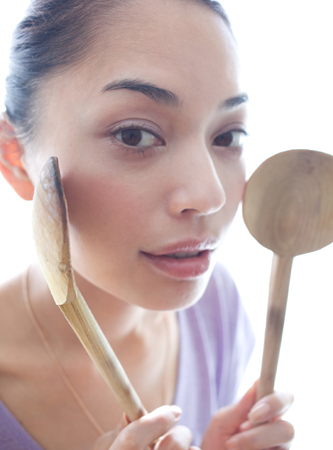
My most cherished cooking utensil is a wooden spatula, passed down from my mother. She bought it at a folk craft shop in Jindaiji, Chofu. As I've used it, it has become more and more flavorful.